





Oliver's insights
Three reasons why it pays to be an optimist as an investor
“I have observed that not the man who hopes when others despair, but the man who despairs when others hope, is admired by a large class of persons as a sage.” J.S. Mill
7 min read

Key points
The combination of the natural human tendency to focus on bad news, expectations rising beyond the ability of the economy to deliver, the increased availability of information & the rise of social media are likely magnifying perceptions around worries and making it easier to be gloomy.
However, to succeed as an investor it makes sense to err on the side of cautious optimism: otherwise, there is no point in investing; growth assets like shares have trended up over the long term; and trying to get the timing right of the 2 or 3 years out of 10 when they fall can be very hard.
“I have observed that not the man who hopes when others despair, but the man who despairs when others hope, is admired by a large class of persons as a sage.” J.S. Mill
Introduction
In a recent Econosights my colleague Diana Mousina pointed out that much of the gloom and doom around Australia is overdone. This is not to say we don’t have issues – including poor housing affordability - or that we can’t do a better. But pessimism can feed on itself and lead to political – and notably populist – outcomes based on simplistically attractive notions that make any perceived problems far worse, not better.
But there is also another angle to this in that history tells us that succumbing to pessimism as investors doesn’t pay. Of course, this is often easier said the done. The “news” has always had a negative bent, but one could be forgiven for thinking it’s become even more so with constant stories of disasters, conflict, wrongdoing, grievance and loss. And the worry list for investors seems more threatening – with trade wars, social polarisation, rising geopolitical tensions and wars, alarm about climate change, talk of job loss from AI, higher public debt and higher inflation.
Four reasons why worries might seem more worrying
There is no denying there are things to worry about and that these may result in more constrained investment returns at some point. But four things may be combining to add to a greater sense of pessimism.
First, our brains are wired in a way that makes us natural receptors of bad news. Humans tend to suffer from a behavioural trait known as "loss aversion" in that a loss in say financial wealth is felt much more negatively than the positive impact of the same sized gain. This likely reflects the evolution of the human brain in the Pleistocene age when the key was to avoid being eaten by a sabre-toothed tiger or squashed by a wholly mammoth. This left the human brain risk averse and on guard for threats. Which in turn makes us more predisposed to bad news stories. Hence the old saying “bad news” sells. This is particularly true as bad news shows up as more dramatic (e.g. “billions wiped off shares”), whereas good news tends to be incremental (e.g. “shares rose 0.3% today”). Reports of a plane (or a share market) crash will generate far more clicks than reports of less plane crashes (or a gradual rise in the share market) ever will. This bias towards bad news means prognosticators of gloom are more likely to be revered as deep thinkers than optimists as observed by the philosopher and economist John Stuart Mill in the quote above.
Secondly, we are now exposed to more information than ever. It’s easier to check facts, analyse things and sound informed. But it’s often just noise. As Frank Zappa noted “Information is not knowledge, knowledge is not wisdom.” If we don't have a process to filter this extra information, we can suffer from information overload. This can be bad for investors as when faced with more information we can freeze up & make wrong decisions with our investments. Our natural “loss aversion” can combine with what is called the “recency bias” – that sees people give more weight to recent events – to see investors project recent bad news into the future and so sell after a fall.
Thirdly, the explosion in social media is serving to amplify bad news. We are now bombarded with economic and financial news and opinions from apps, subscription services, finance updates, dedicated TV and online channels, chat rooms and social media. To get our attention news needs to be entertaining. And, following from our aversion to loss, in competing for our attention dramatic bad news trumps incremental good or balanced news in getting clicks. And the social media algorithms amplify extreme views. So naturally it seems the bad news is “badder” and the worries more worrying. Politics has added to this with politicians more polarised and more willing to scare voters. Just Google the words “the coming financial crisis” and you’ll find lots of references to a major disaster ahead. People have always been making gloomy predictions but prior to the information and social media explosion it was harder to be exposed to such stories.
Finally, expectations have likely risen above the ability of the economy to keep up. My mother’s generation born in the 1930s saw depression, a world war and the regular death of siblings. Their expectations were low and it didn’t take much to make them happy in the 1950s (for my Mum it was holidays spent in a tent at the beach around a surf club). For them getting a consumer good like a car, fridge or washing machine generated a huge pay off in happiness. Today it’s very different. Consumer goods are ubiquitous and while smart devices come with great things they also come with a lot of bad (doomscrolling, bullying, a sense of missing out, amplification of grievance, etc) which can lead to agitation and dissatisfaction. We have lots more and live longer, but our expectations have increased beyond that. This makes it harder for the economy to deliver even if economic growth is good. This is consistent with studies on happiness that show that from low levels of income, extra income and the more things that come with it, can provide a big lift in happiness, but at higher levels extra income has little impact. This is not to deny issues around the cost of living or that we can’t do better by boosting productivity – but it suggests that even if the economy were to perform more strongly, we may not be any happier. As the next chart shows while GDP per capita has trended up happiness has fallen.
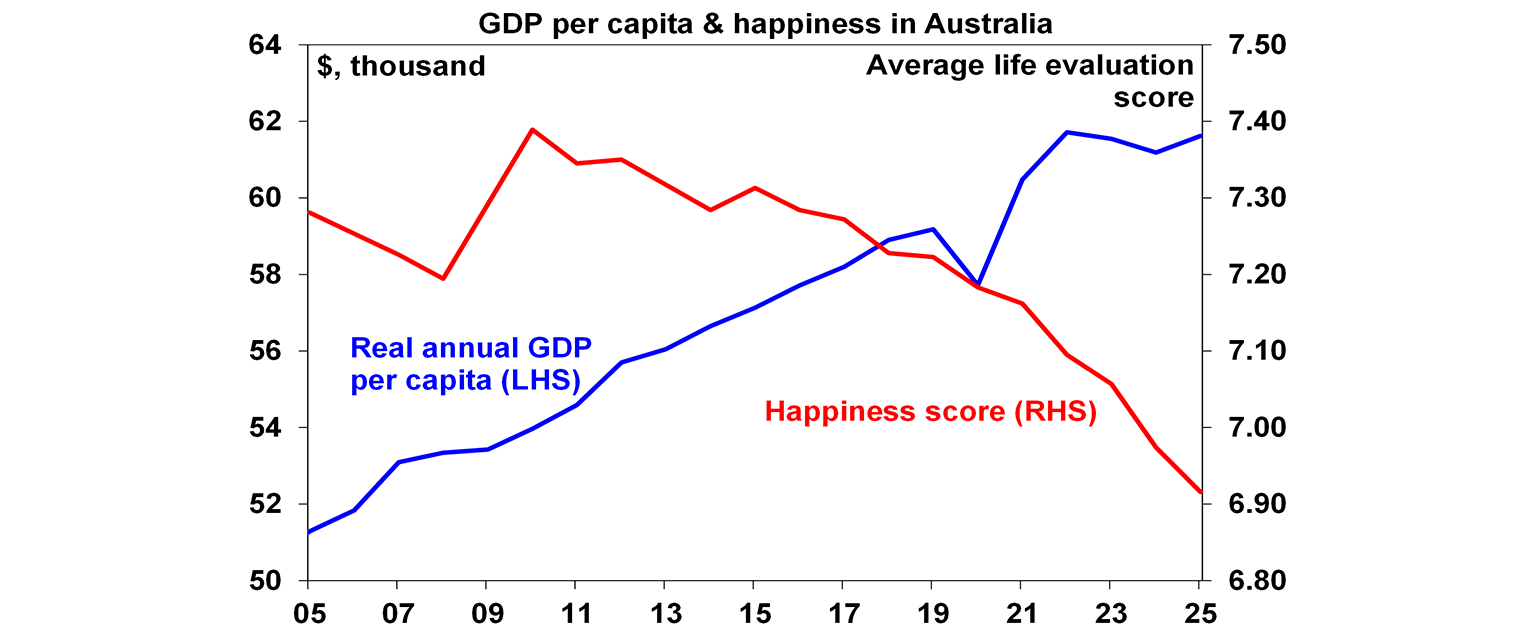
The danger is that the combination of the ramp up in information and opinion, our natural inclination to zoom in on negative news along with expectations rising beyond the ability of the economy to deliver is making us gloomier and more pessimistic. It could also make us worse investors: more distracted, pessimistic, jittery and short term focused.
Three reasons to be optimistic as an investor
There are 3 good reasons to err on the side of optimism as an investor.
Firstly, without optimism there is not much point in investing. As the famed value investor Benjamin Graham pointed out: “To be an investor you must be a believer in a better tomorrow.” If you don’t believe the bank will look after your deposits, that most borrowers will pay back their debts, that most companies will see rising profits supporting a return to investors, that properties will earn rents, etc, there is no point investing.
Secondly, the history of share markets in developed well managed countries has been one of the triumph of optimists. Sure, share markets go through often lengthy bear markets – where pessimists look like winners - but the long-term trend has been up, underpinned by the desire of humans to find better ways of doing things resulting in real growth in living standards. This is indicated in the next chart which tracks the value of $100 invested in Australian shares, property, bonds and cash since 1900 with dividends, rents and interest reinvested along the way. Cash is safe and so fine if you are pessimistic but has low returns and that $100 will have only grown to around $16,000 today. Bonds are better and that $100 will have grown to around $50,000. Shares are volatile, but if you can look through that they will grow your wealth and that $100 will have grown to around $3.8 million. Residential property offers similar returns over the long term – although the line in the chart should be seen as indicative of the average return from property.
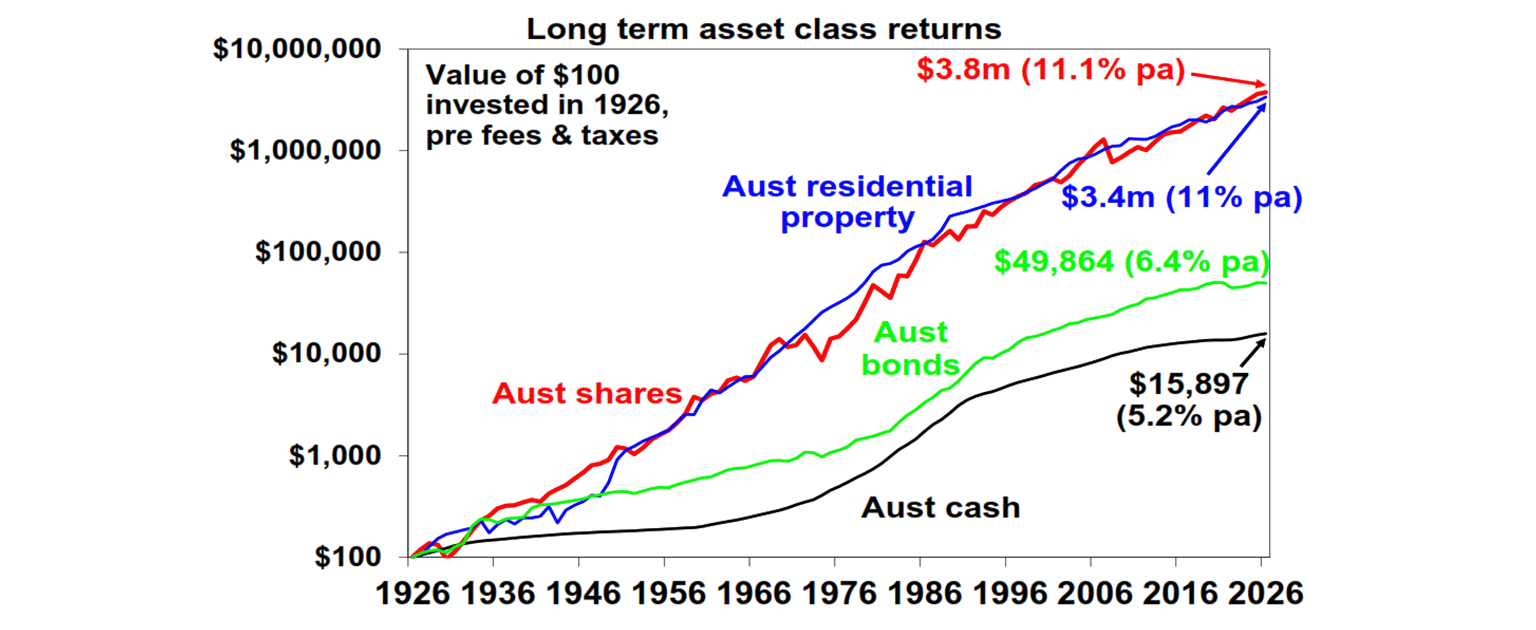
This does not mean blind optimism where you get sucked into every investor mania. If an investment looks too good to be true and the crowd is piling in, then it probably is. So, the key is cautious, not blind, optimism.
Finally, even when it might pay to be pessimistic - and hence to get out of the market in corrections and bear markets - trying to get the timing right can be very hard. In hindsight many downswings like the GFC look inevitable and hence forecastable and so it’s natural to think you can anticipate them. But trying to time the market – in terms of both getting out ahead of the fall and back in for the recovery - is very hard. A good way to demonstrate this is with a comparison of returns if an investor is fully invested in shares versus missing out on the best (or worst) days. The next chart shows that, if you were fully invested in Australian shares from January 1995, you would have returned 9.4%pa (with dividends but not allowing for franking credits, tax and fees).
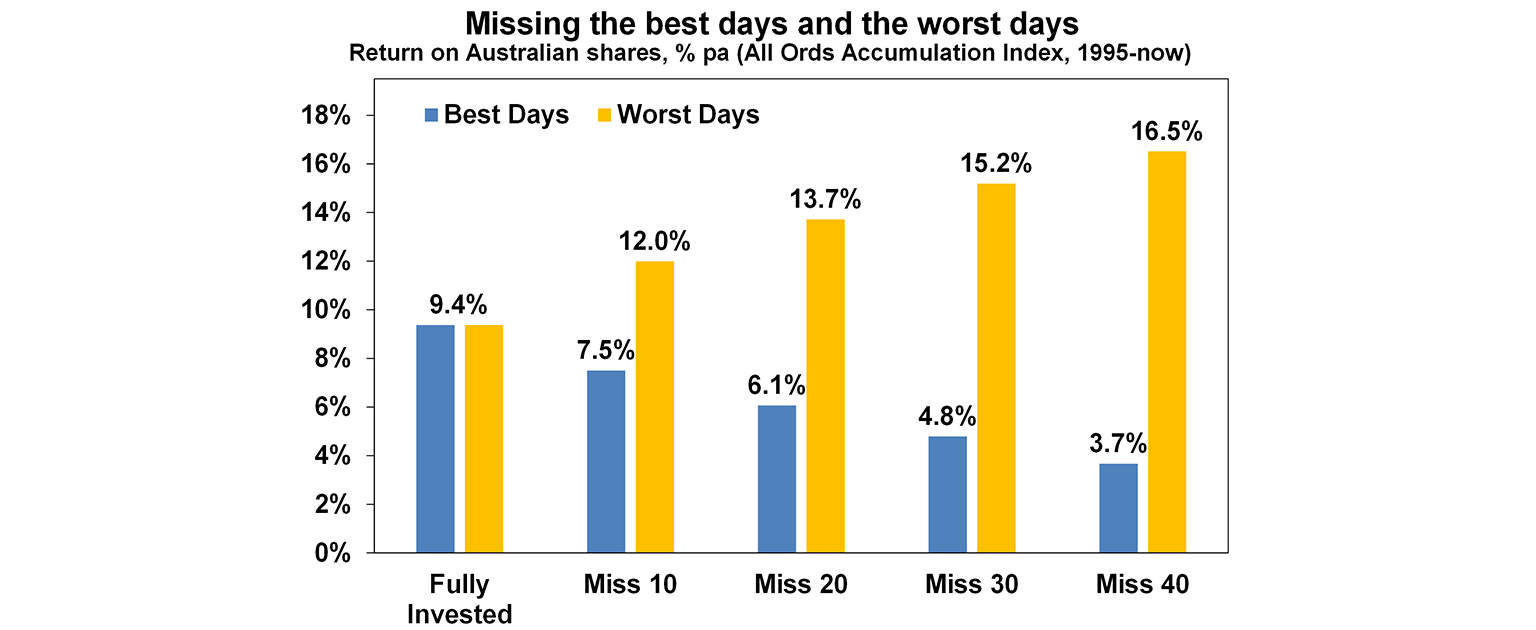
But if you were pessimistic about the outlook and managed to avoid the 10 worst days (yellow bars), you would have boosted your return to 12%pa. And if you avoided the 40 worst days, it would have been boosted to 16.5%pa! But this is very hard, and many investors only get really pessimistic and get out after the bad returns have occurred, just in time to miss some of the best days. For example, if by trying to time the market you miss the 10 best days (blue bars), the return falls to 7.5%pa. If you miss the 40 best days, it drops to just 3.7%pa.
Sure, on a day-to-day basis it’s around 50/50 as to whether shares will be up or down, but since 1900 shares in the US have had positive returns around seven years out of ten and in Australia it’s eight years out of ten.
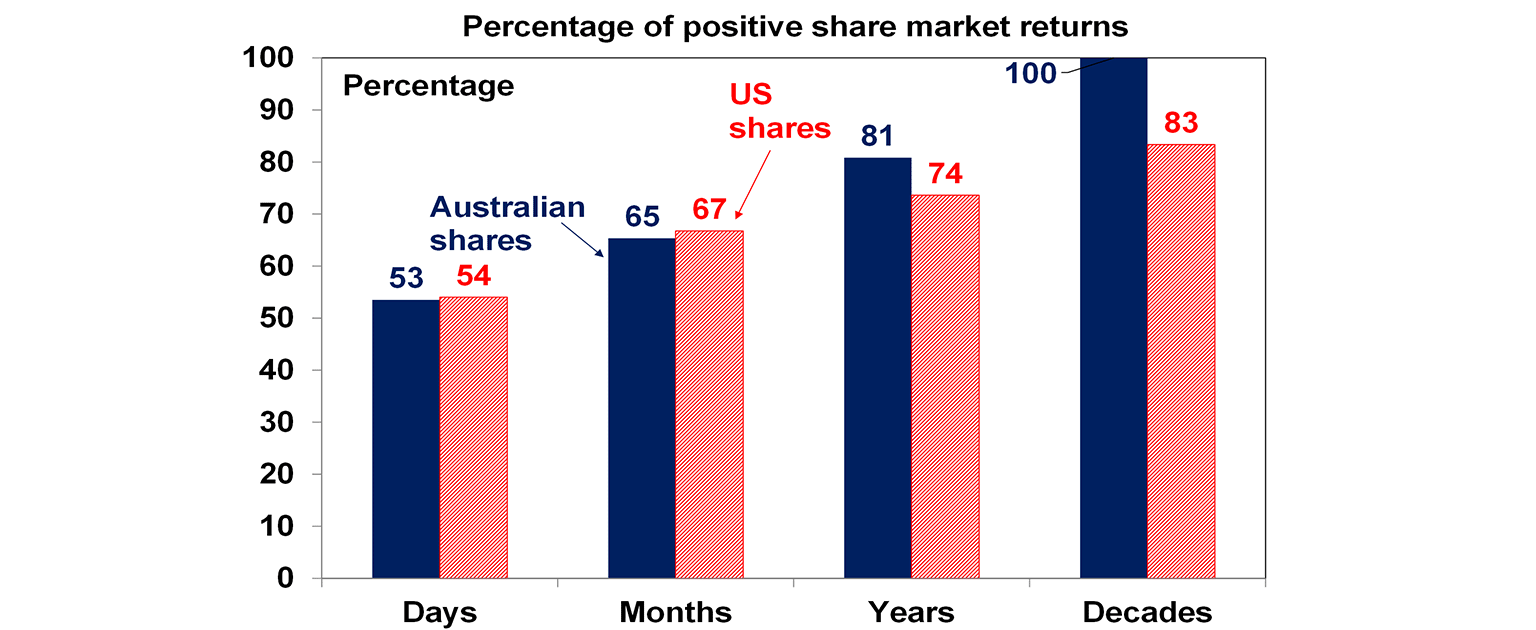
Getting too hung up in pessimism on the next crisis that will, on the basis of history, drive the market down in two or three years out of ten may mean that you end up missing out on the seven or eight years out of ten when the share market rises.
“Choose to be optimistic, it feels better.” The Dalai Lama
Dr Shane Oliver
Head of Investment Strategy and Chief Economist, AMP


Something went wrong. Please try again.
Thanks for subscribing.
We'll keep you up to date with the latest news, insights and information from AMP. Check your inbox for future updates.
You may also like
-

6 New Year resolutions that could improve your finances Six simple financial tips that could help you save more, spend smarter and feel more in control of your finances in the new year. -

Weekly Market Update - 09-10-2026 - AMP Weekly Market Update: US shares near record highs but risks are bubbling, tech rally remains narrow, credit markets turn wary on AI & Firmus IPO shelved, French bond yields surge, and another immigration debate. -

Five things that could stop the data centre boom Discover five major challenges that could slow the data centre boom, from power constraints and regulation to costs, talent and infrastructure.
Important information
Any advice and information is provided by AWM Services Pty Ltd ABN 15 139 353 496, AFSL No. 366121 (AWM Services) and is general in nature. It hasn’t taken your financial or personal circumstances into account. Taxation issues are complex. You should seek professional advice before deciding to act on any information in this article.
It’s important to consider your particular circumstances and read the relevant Product Disclosure Statement, Target Market Determination or Terms and Conditions, available from AMP at amp.com.au, or by calling 131 267, before deciding what’s right for you. The super coaching session is a super health check and is provided by AWM Services and is general advice only. It does not consider your personal circumstances.
You can read our Financial Services Guide online for information about our services, including the fees and other benefits that AMP companies and their representatives may receive in relation to products and services provided to you. You can also ask us for a hardcopy. All information on this website is subject to change without notice. AWM Services is part of the AMP group.