





Econosights
What is really behind the AI boom?
Today’s tech companies are doing everything from the design and manufacture of semiconductor chips used in our devices, expanding cloud platforms and building foundation models that are used for AI applications.
8 min read

Key points
The current AI boom, evident in share prices of major global technology companies, is based on these companies building the digital infrastructure that will power artificial intelligence use in the future. This is different to prior tech cycles, which were much more software driven.
Today’s tech companies are doing everything from the design and manufacture of semiconductor chips used in our devices, expanding cloud platforms and building foundation models that are used for AI applications.
- The tech supply chain is more like an ecosystem or network because the companies are funding and supply each other as well as being competitors.
- The rise in tech share prices looks “bubble like” from a pure price perspective. However, the price is justified by genuine earnings and capital expenditure. We remain optimistic on future growth in tech earnings and prices for now.
- For investors, it is becoming increasingly difficult to avoid tech investment. Australia is one of the least exposed countries to tech in its sharemarket.
Introduction
These days, when you say the word “technology boom” most people think of their favourite AI chatbot like ChatGPT, Microsoft Copilot or data centres.
However, in reality, the tech boom is so much more than this. Behind every AI chatbot, cloud platform or smartphone there is a big network of companies providing semiconductor chips, equipment, software or infrastructure that is powering the technology boom.
The interconnected tech ecosystem is driving huge profit growth and rising share prices in the US market, but also increasingly around the world. It is not just the companies like Apple, Microsoft and Meta benefitting. The gains are flowing through the entire value chain – from semiconductor designers and manufacturers to companies building data centres, supplying power systems, network equipment and specialised software.
What we – the consumer – see every day is the end product: ChatGPT answering our questions or Copilot helping to draft our emails. Yet beneath the surface is a growing range companies that enable these technologies to exist in the first place. In most cases, it is these behind-the-scenes businesses that are the ones driving investment, spending and generating the profit growth.
So, when we talk about the technology sector, what are we really talking about? Where is all the profit growth coming from? And will it continue? We look at this issue in this edition of Econosights.
The tech supply chain
The tech supply chain is more like an ecosystem or network because it is incredibly linked. I never realised what went on underneath the surface until I really looked into it.
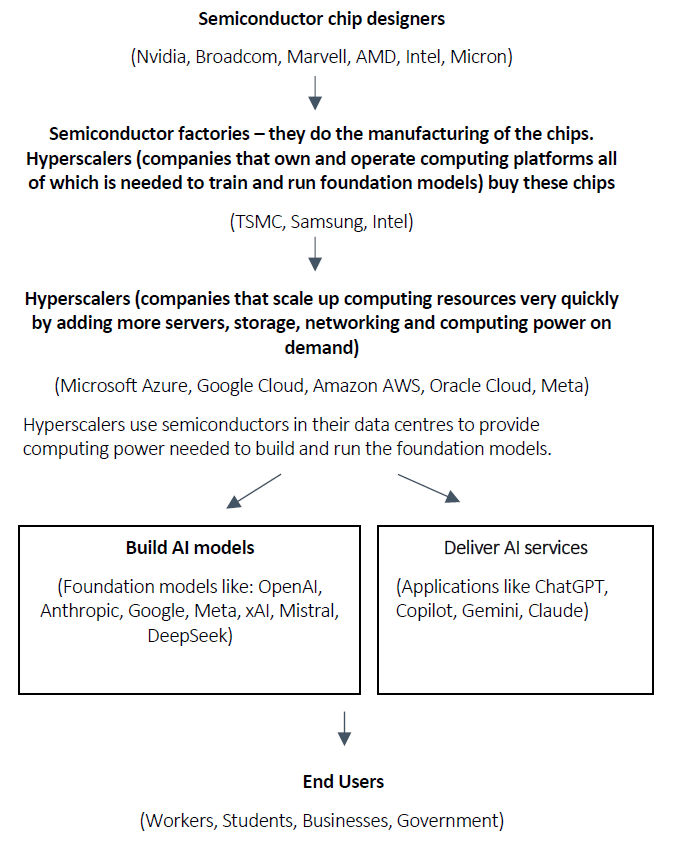
This whole process is powered by: Energy suppliers (utilities, power grids) and data centres (companies like Equinix, Digital Realty, NEXTDC, AirTrunk).
So the whole technology chain might look like:
- Nvidia designs the chips
- TSMC Microsoft/Amazon/Google buy them
- Microsoft/Amazon/Google buy them
- The chips sit in data centres
- The data centres use electricity and water for cooling
- The computer trains and operates the foundation models
- The consumer gets AI to put a presentation together
It’s common for the hyperscalers to have investments directly into foundation model companies. Some hyperscalers are even designing their own semiconductor chips. For example, Microsoft has made an investment into OpenAI. This way, OpenAI can use Microsoft’s cloud system of Azure (which feeds back into Microsoft who earns cloud revenue). So, the whole AI supply chain becomes quite a circular loop and ends up being more of a network or ecosystem because many companies sit across multiple layers. Companies like Google, Microsoft, Amazon and Meta are not just competitors – they also fund and supply each other.
The old tech companies sold software and devices. Now, tech is all about building infrastructure as well as selling goods and services. Today’s tech companies are building the infrastructure that is required for the “AI Economy”.
These days the biggest tech companies are doing 3 main things:
- Building digital infrastructure and selling products
companies like Amazon, Microsoft, Google
- Building and monetising AI
AI data centres, chips
- Selling access to the tech ecosystems
Apple - subscriptions, Google – search, YouTube - Advertising, Meta – Facebook, Instagram, WhatsApp, Advertising, Amazon – E-commerce, Prime, Logistics.
How have tech companies been performing
The initial tech companies were called the FAANG stocks (Facebook, Amazon, Apple, Netflix, Google), a term coined back in 2013. Then it moved on to Magnificent (MAG) 7 - (Apple, Microsoft, Alphabet, Amazon, Meta, Nvidia and Tesla), coined in 2023. And now the biggest tech companies are referred to as the MANGOS (Meta, Anthropic, Nvidia, Google, OpenAI and SpaceX), although SpaceX is only a very recently listed public company and OpenAI is not yet listed.
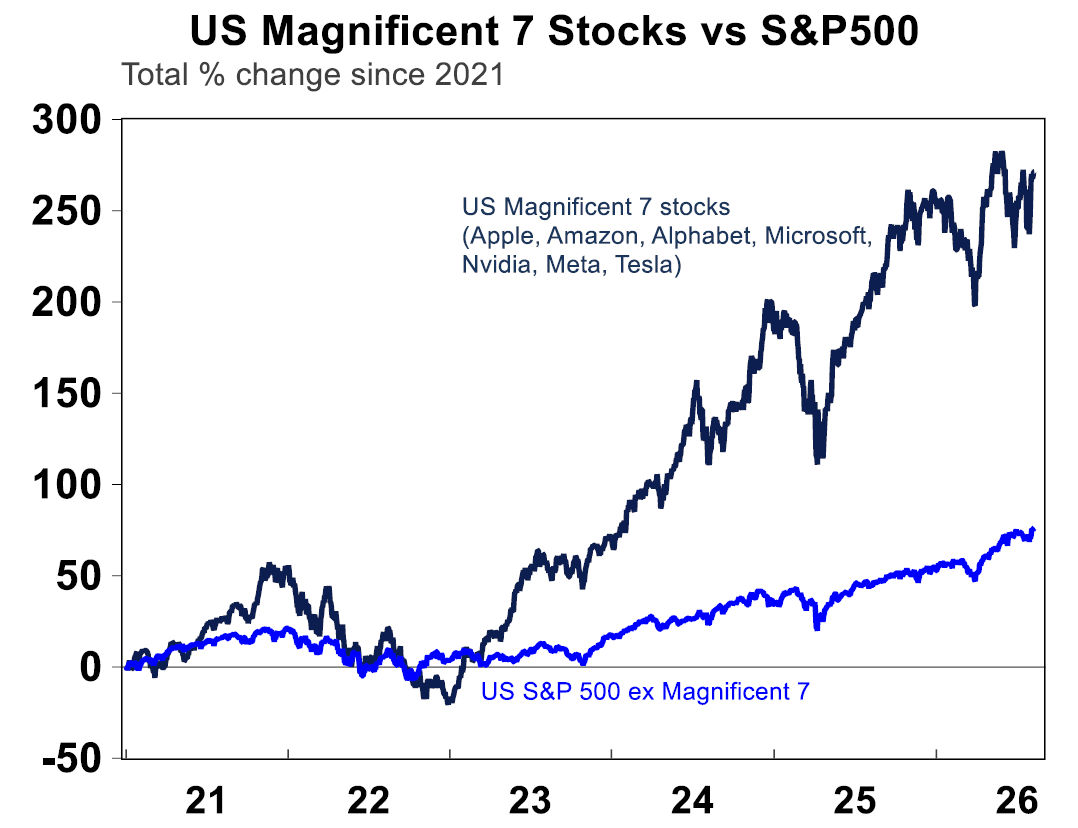
So, for now, it’s easier to look at the performance of the MAG 7 stocks, which have a decent history of performance. These 7 companies (out of 500) make up around a third of the US S&P500. Since 2021, the MAG 7 have nearly tripled, up by 270% while the top 500 companies outside the S&P have returned 76% in the last 5 years.
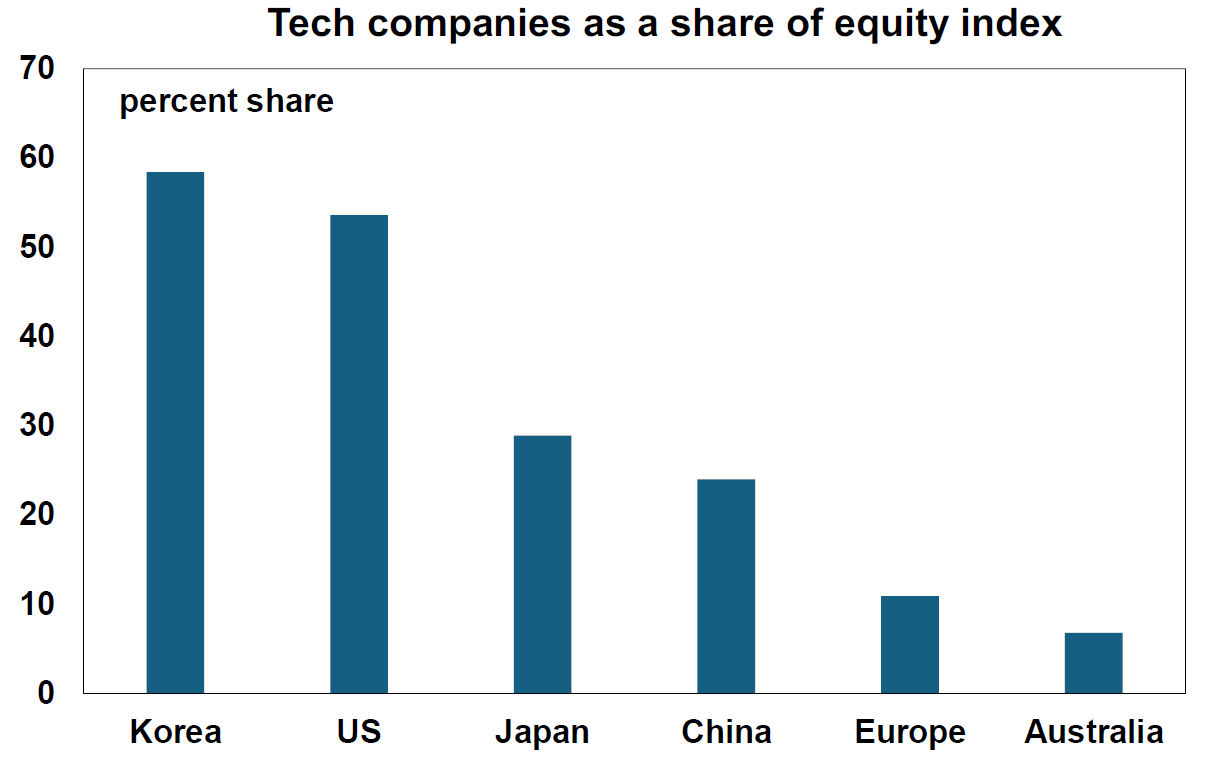
From an investment point of view, it’s becoming increasingly difficult to avoid tech. Technology companies now make up a large share of global equity markets. In the US, tech accounts for more than half of the S&P 500, while in Korea it's closer to 60% (see chart below). This means that even if you're invested in a broad global sharemarket index across multiple countries and sectors, around 40% of your portfolio is likely to be exposed to technology. And that figure doesn't include companies involved in the upstream parts of the supply chain, such as the miners and materials producers that supply the commodities needed to manufacture semiconductors.
The extreme rise in share prices across technology companies reflects two things. First, these companies are already making substantial profits from their existing businesses. Secondly, investors are also betting that AI will unlock another wave of productivity gains and new products. That's why we're seeing an unprecedented surge in spending on AI infrastructure, from semiconductor chips to data centres and cloud computing.
Tech capital spending
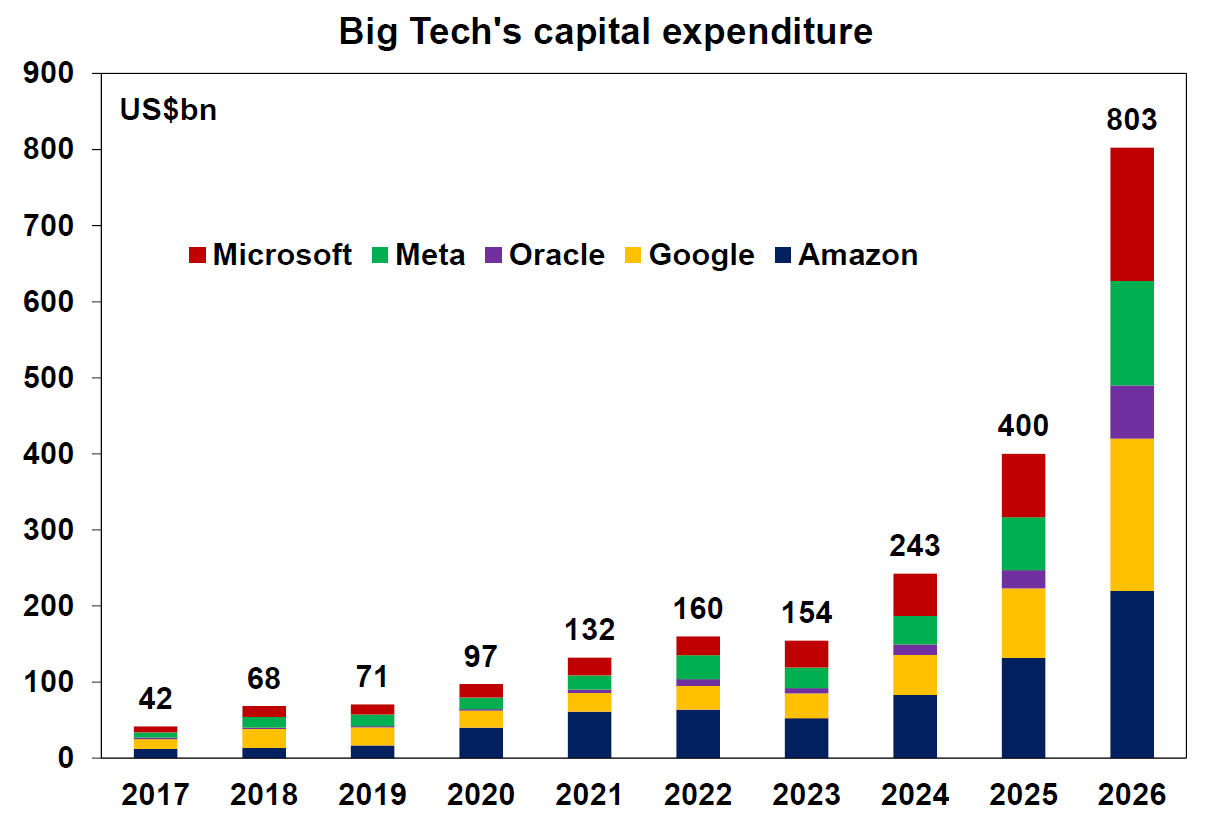
The scale of tech investment is unprecedented. Capital spending by major technology companies is expected to total over US$800 billion in 2026, around double the level seen in 2020. Expectations for 2027 are even higher, with spending forecast to approach US$1 trillion.
The concern with today’s investment is whether this is another case of overinvestment. During the late 1990s tech boom, companies poured money into building internet infrastructure, which ended up being excessive when the dot-com bubble burst. Today, investors are asking a similar question - are we investing too much into semiconductors and data centres?
The money today is flowing into everything needed to build and run AI: chips, servers, data centres, networking equipment, electricity infrastructure, and the land and buildings that support them.
A lot of the attention has focussed on the build out of data centres. These facilities store the AI servers, the networking equipment and power required to do the computing power that trains and operates AI models and cloud computing networks. Building a data centre involves much more than just filling out a warehouse with computers. The costs include the land, buildings, cooling systems, back-up power, substations and fibre connections to keep everything running.
But data centres are only one part of the capital spending story. The other critical part are the semiconductor chips which make anything in our digital world possible. Semiconductor demand is powering Nvidia, arguably the biggest listed company in the world at the moment.
What are semiconductor chips?
Semiconductor chips account for a huge share of tech capital spending. In recent years especially they have featured as a key geopolitical bargaining chip (literally) with Trump’s tariffs on China.
A semiconductor chip is a tiny electronic device, usually built on a silicon base, which controls the flow of electricity. Packed onto each chip are billions of microscopic switches called transistors that process data, store information and perform calculations. These chips are the brains behind almost every modern device, from smartphones, computers and tablets to cars, airplanes, washing machines, fridges, TV’s, medical equipment and industrial machinery.
And it is not just one chip that forms a part of your appliance, it could be dozens. As devices get smarter, chip demand is set to grow.
We hear a lot about data centres lately but less on semiconductors, which is another huge part of spending. Semiconductor chips are a key component into the whole AI story and have also been used as a geopolitical pawn, especially between the US and China.
Semiconductor demand has existed for decades as we have made our lives more digital. However, the rise of AI means a new source of demand for semiconductor chips because of the computing power required for AI, to train and operate.
The semiconductor industry can be broken down into several types of chips, which all have a different role:
- Logic chips (think of this as the brain of the device) – which process data and run computations and includes Graphic Processing Units used in AI training, data centres and gaming and Central Processing Units used in computers and smartphones. Examples of companies that make these are Nvidia, TSMC, AMD.
- Memory chips (literally the short and long-term memory of the device) – these store information which includes DRAM (working memory) and NAND flash (storage). Companies in this space include SK Hynix, Samsung and Micron.
- Analog (nervous system/the translator) – act as the bridge between the physical world (converting sound, light and temperature) and processing this for the digital world. These are used a lot in cameras, industrial equipment and mobile phones.
- Power chips (the electricity managers) – control the power flow and used a lot in batteries, phones, electric vehicles and fast chargers
- Sensors, optoelectronics and discretes (the eyes, ears and electrical plumbing) – sensors that detect things like light, motion and temperature.
- Micro (the reflexes controllers) – these are microprocessors and microcontrollers that run devices and vehicles used in household and industrial appliances.
A chip is mostly based off silicon (base material), encapsulant (a protective material) and copper (the wiring). But, a few other key commodities like rare earths, gallium, germanium and tungsten along with others are also used in tiny quantities. We have seen in recent years that these trace elements can cause bottle necks in the industries if there is a supply issue for one commodity or if these commodities become used as geopolitical-related trade disputes.
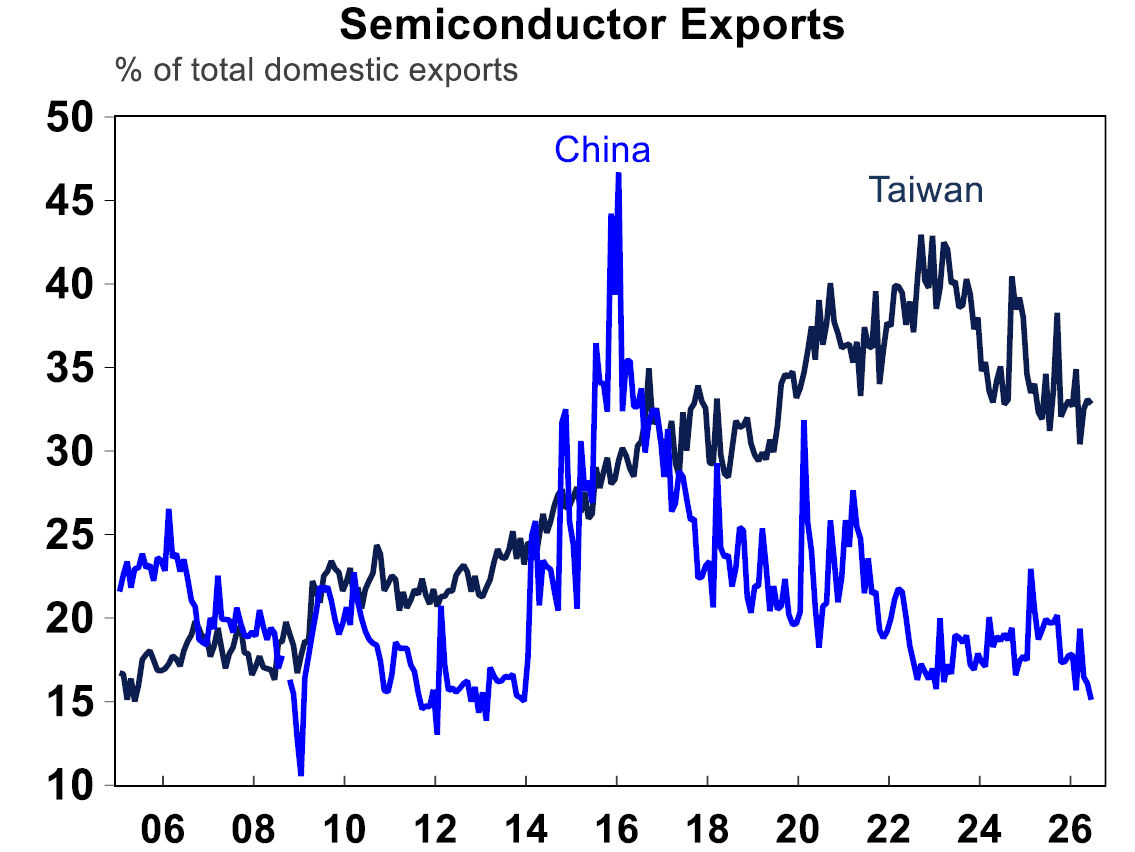
China really dominates the semiconductor chip supply chain from a materials perspective while Taiwan dominates the manufacturing of the chips. Semiconductor exports account for more than a third of Taiwan’s exports. In China, semiconductors have been falling as a share of its exports and now account for ~15%, which has mostly occurred as other exports like electric vehicles, batteries and solar panels have become a larger part of China’s export story.
Is tech in a bubble?
The big concern around the tech sector is that its performance (in higher share prices) has been so extraordinary over a number of years that it must eventually come back down. A sharp decline in share prices could occur for several reasons. AI adoption may prove slower than expected, profit growth may disappoint, capital spending may start to become larger than cash flows leading to surging debt or earnings start to normalise after extreme growth and investors panic.
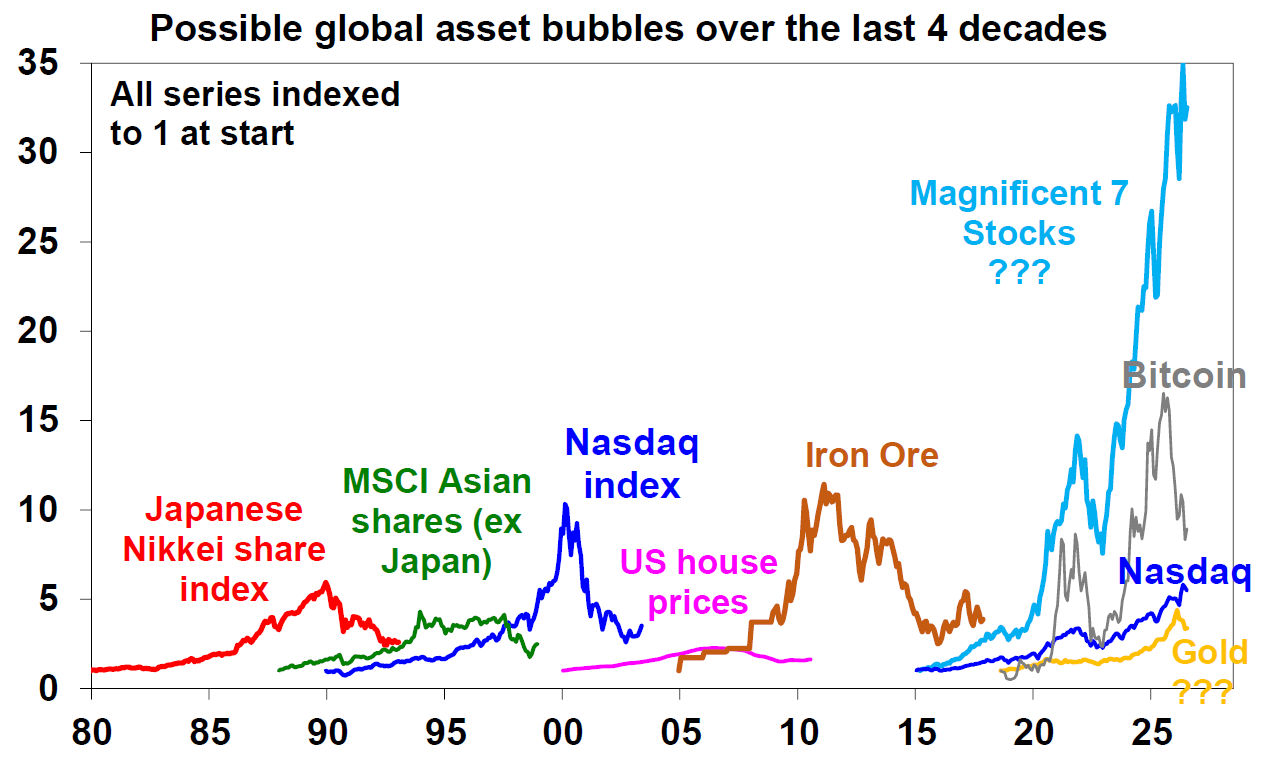
At first glance, the rise in share prices of the Magnificent 7 certainly looks reminiscent of past asset bubbles (and worse) – see the chart below. Their market values have increased at a staggering pace, driven by extreme optimism around what they are delivering and building for the future. Usually, these periods of extreme performance and excitement around new technologies can prove fleeting and push valuations beyond their fundamentals.
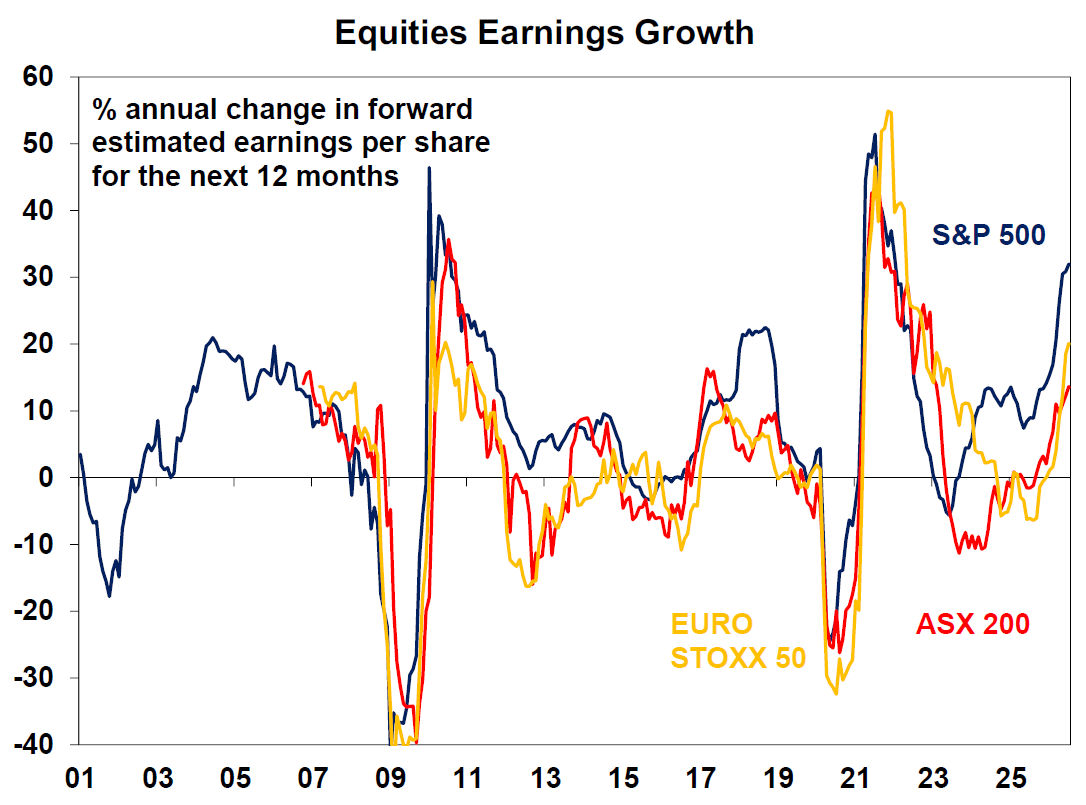
Today’s tech leaders are driving real, sustainable revenue, profits and cash flow. Future expectations are optimistic, but the rise in share price reflects more than just irrational bidding up of prices. In the next 12 months, US earnings growth is expected to be up around 30%, with tech at 50%! These are astonishing numbers and reflect the momentum in the build out of all of the AI infrastructure and demand for AI applications. Source: Bloomberg, AMP
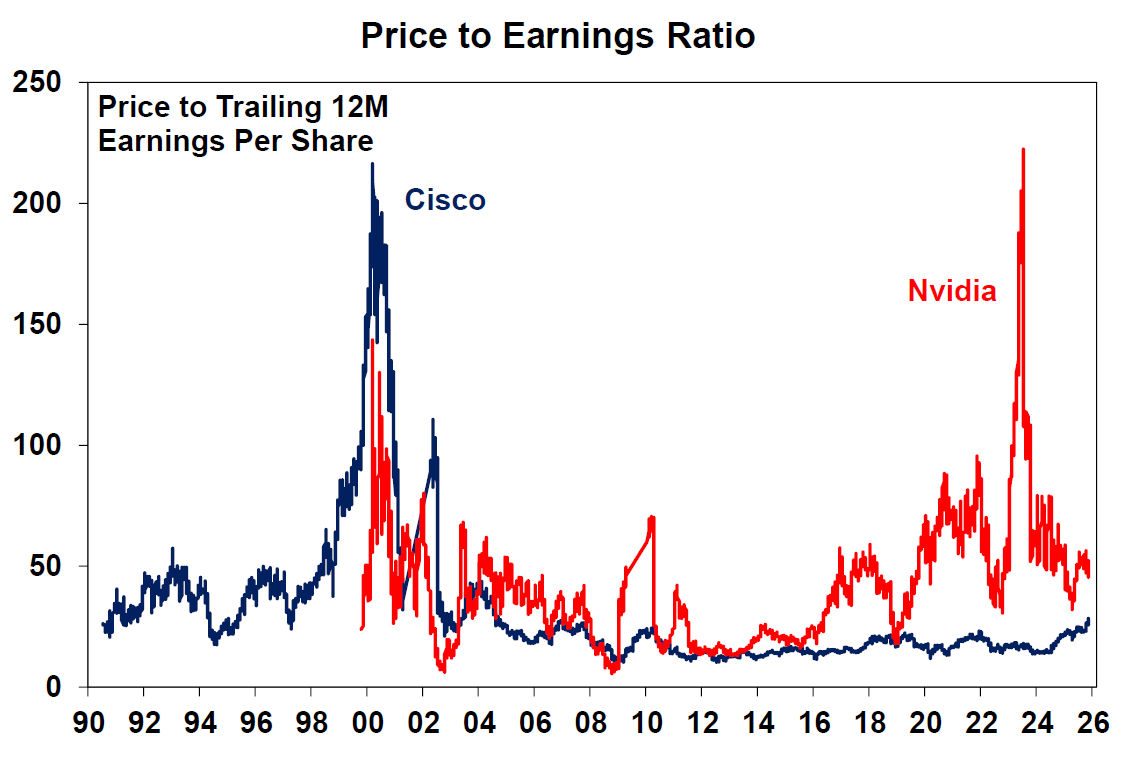
In some ways then, the high prices that people are paying for tech companies are being justified with high earnings. One way to assess this is through the “Price-To-Earnings” (PE ratio), which compares a company’s share price to its earnings. A very high PE can indicate excessive investor enthusiasm and speculation, especially if prices become detached from earnings. Nvidia’s PE ratio is round 36 times now which means that investors are willing to pay $36 for every $1 of annual earnings. This is an elevated PE ratio based on the broad market average (of 26x in the US which is already high) and suggests that investors expect strong earnings growth ahead. But for Nvidia, this PE ratio is in a reasonable range based on its history. Compared to Cisco in the early 2000’s before the dot-com crash, Nvidia’s valuation appears much less extreme. Nvidia’s PE spike in 2023 was justified by a subsequent surge in earnings unlike Cisco’s spike into 2000 which was then corrected by a plunge in share pries
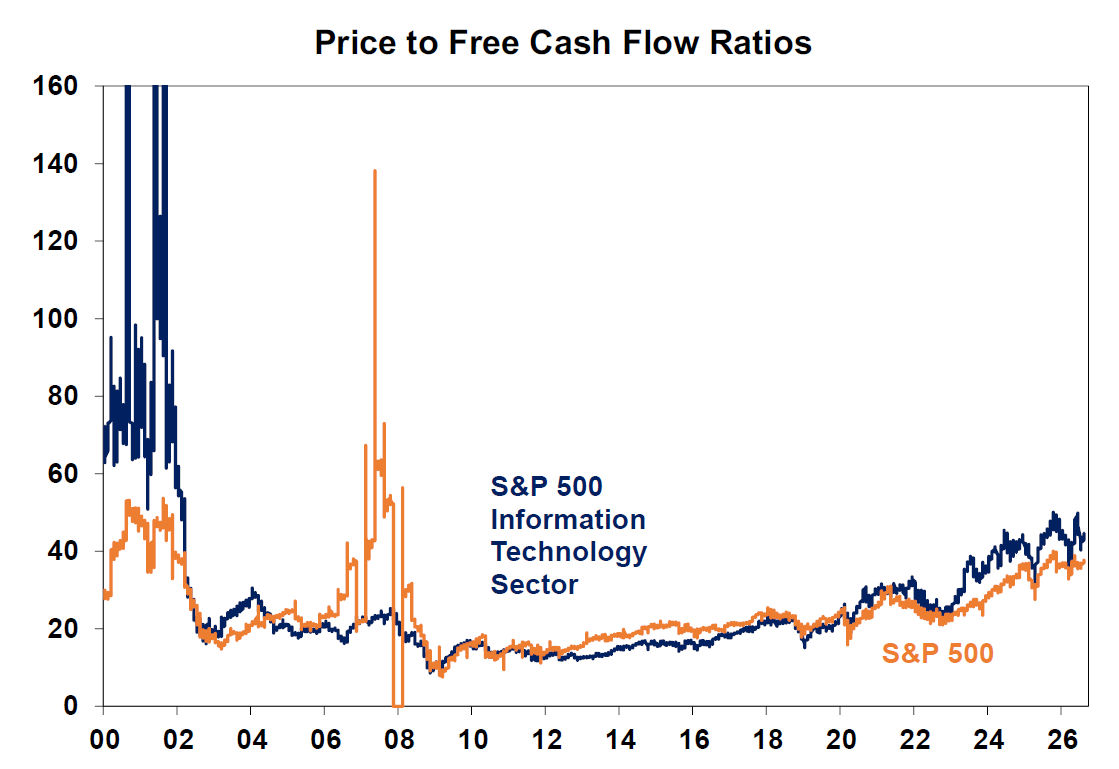
More recently, some analysts have raised concern that enormous capital spending will put pressure on free cash flows. Free cash flow is the cash that a company generates from its operations after deducting capital spending.
One way to assess this is to look at price-to-free-cash flow, which measures how much investors are willing to pay for each dollar of free cash flow generated. For example the current S&P IT sector Price to Free-Cash-Flow ratio is around 42 – just above the broad S&P500 index of 37 times. This is much lower compared to the dot-come peaks in the early 2000’s when there was a crash in IT stocks. This suggests that while investors are willing to pay a premium right now for tech stocks, it is being justified by real cash generated – because they expect that future cash flows will increase even more! It's impossible to know exactly how much AI adoption there will be in the future, but it's difficult to imagine demand falling from here. The real question is whether the profits generated by AI end up being as large as investors currently expect.
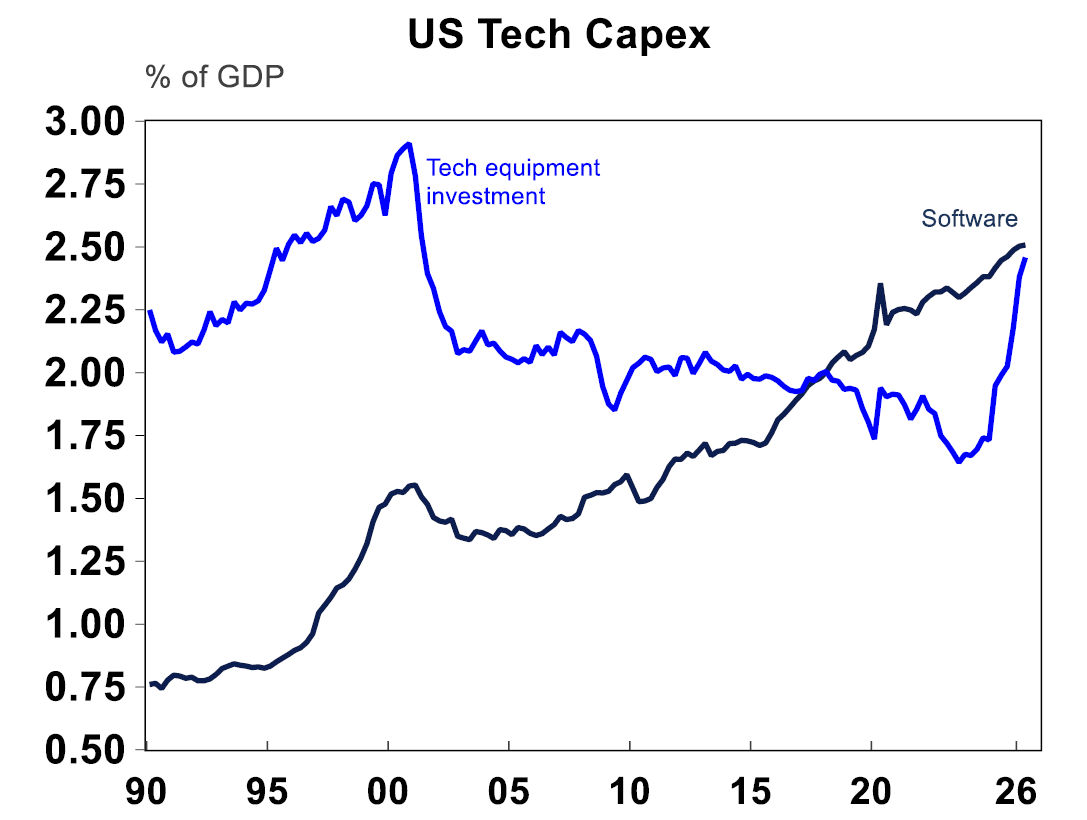
From a GDP perspective, tech equipment investment has not yet reached its 2000’s peak, despite large increases in recent years (see the chart below). This is not the usual signpost of a frothy or overinvested market. With spending on AI infrastructure still rising, there is more upside for its contribution into GDP. If anything, this tells that the build-out of AI infrastructure is still in its early stages rather than approaching speculative excess.
Implications for investors
The fact that the tech sector
.operates more like an ecosystem and network rather than like a traditional
industry may make some investors nervous. If one part of the chain stumbles,
there is a risk that weakness spreads elsewhere. The flip side is that many of
the largest technology companies sit across multiple parts of the ecosystem.
The hyperscalers, for example, are not just building foundation models. They
are also expanding cloud platforms, investing in data centres and, in some
cases, designing their own chips. Their growth is not dependent on a singleproduct or revenue stream.
As consumers, it can be a little difficult to see the payoff from the enormous amount of spending currently flowing into AI infrastructure. But for investors, it is becoming increasingly difficult to avoid technology exposure. Technology companies now account for a large share of global equity markets, and their products and services are becoming embedded across almost every industry.
That does not mean that future earnings growth will continue to remain so high. Profit growth is likely to slow from current levels. Not all tech investments may pay off. But betting against the broad technology trend has become increasingly difficult. The demand for computing power, data storage and digital services continues to grow, and for now the earnings, profits and cash flows suggest there is substance behind the story.


You may also like
-

Weekly Market Update - 09-10-2026 - AMP Weekly Market Update: US shares near record highs but risks are bubbling, tech rally remains narrow, credit markets turn wary on AI & Firmus IPO shelved, French bond yields surge, and another immigration debate. -

Five things that could stop the data centre boom Discover five major challenges that could slow the data centre boom, from power constraints and regulation to costs, talent and infrastructure. -

What are AI shopping agents, and are they safe to use As agentic commerce agents become an increasingly common way to shop, learn the risks that may come with them, and some ways to use them more safely.
Important information
Any advice and information is provided by AWM Services Pty Ltd ABN 15 139 353 496, AFSL No. 366121 (AWM Services) and is general in nature. It hasn’t taken your financial or personal circumstances into account. Taxation issues are complex. You should seek professional advice before deciding to act on any information in this article.
It’s important to consider your particular circumstances and read the relevant Product Disclosure Statement, Target Market Determination or Terms and Conditions, available from AMP at amp.com.au, or by calling 131 267, before deciding what’s right for you. The super coaching session is a super health check and is provided by AWM Services and is general advice only. It does not consider your personal circumstances.
You can read our Financial Services Guide online for information about our services, including the fees and other benefits that AMP companies and their representatives may receive in relation to products and services provided to you. You can also ask us for a hardcopy. All information on this website is subject to change without notice. AWM Services is part of the AMP group.