





Oliver's insights
Was life really better in the good old days?
Lately, there seems to be a heightened level of angst that economic conditions are getting harder and that the two-party political system – and maybe democracy too – is failing voters.
9 min read

Key points
Angst about economic conditions has been running high in recent times. This is evident in chronically low consumer confidence readings and a downtrend in measures of happiness. It’s also arguably evident in the rise of populist parties globally and more recently in Australia.
There is no doubt that some things were better a generation or two ago. Cheaper housing stands out. But most indicators are far superior today.
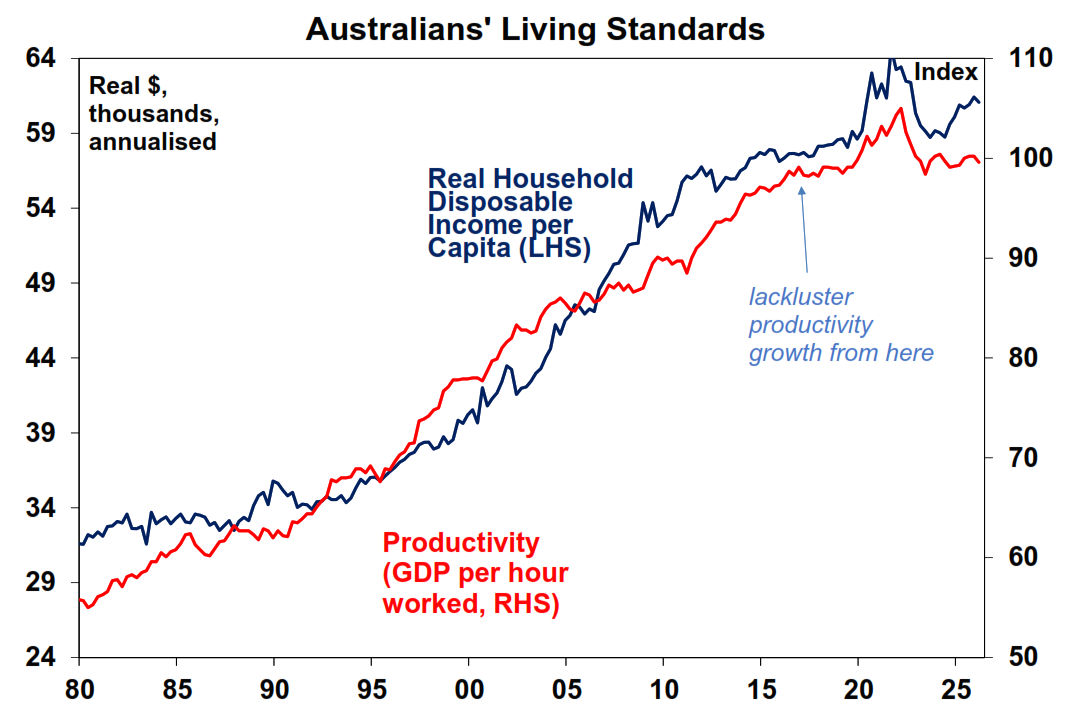
That said there is no denying that “cost-of-living pressures” have been a problem in recent years and a key driver behind this has been poor productivity growth. Unfortunately, there are no quick and easy fixes to this.
Introduction
Lately, there seems to be a heightened level of angst that economic conditions are getting harder and that the two-party political system – and maybe democracy too – is failing voters. There seems to be a hankering for times past that some feels were better. There is no doubt that “cost-of-living” issues have become real in the post-pandemic years. This has been associated with relatively stagnant real household disposable income and poor productivity growth over the last decade. Unfortunately, there are no quick fixes to this. Rather getting productivity up requires hard-nosed economic reforms that may take years to bear fruit. But while the Australian economy does have some real challenges to address, it is worth keeping things in perspective. This note looks at how economic conditions in Australia have changed over the last half century.
Some things are worse today
The table below provides a brief comparison of economic indicators where conditions were better 25 and 50 years ago. These periods were chosen because the 1970s broadly coincided with baby boomers entering the workforce, while Millennials entered in the 2000s and Gen Z in the 2020s.
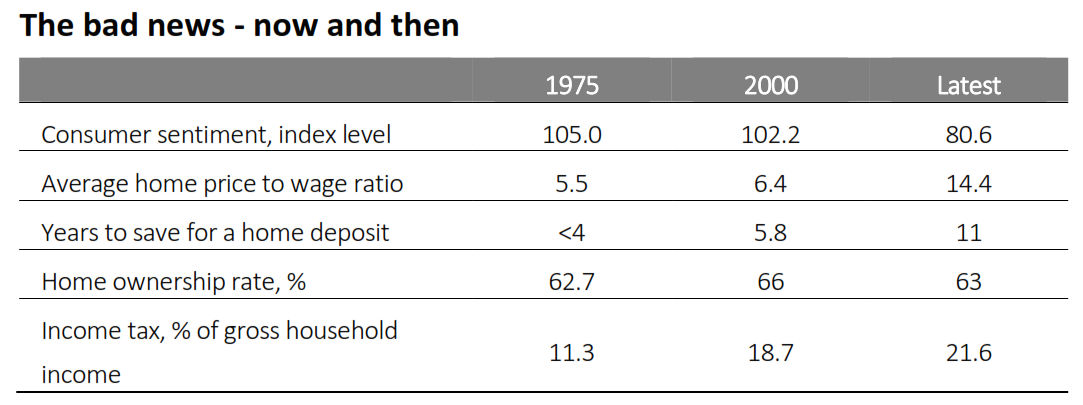
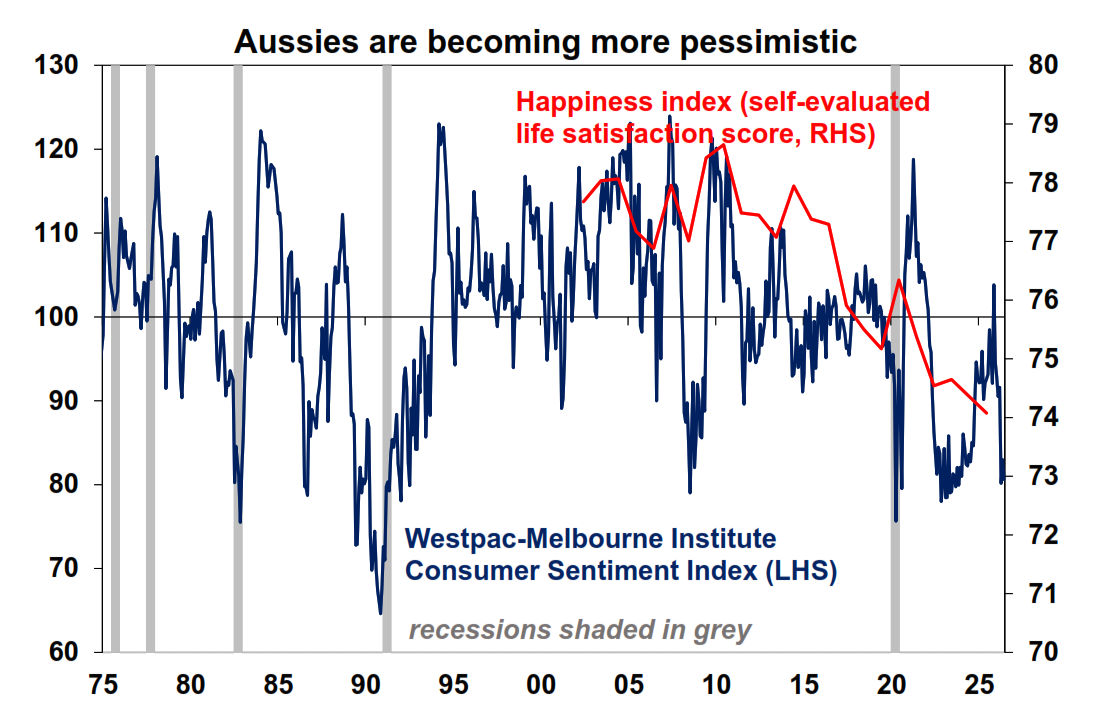
The bad news is that consumer sentiment seems to be stuck around much lower levels, despite the absence of really high unemployment as seen in the recessions of the 1980s and 1990s. And associated with this over the last 20 years happiness has been trending down. From the next chart it can be seen that the trend in both has been down since around 2015, not just the last few years.
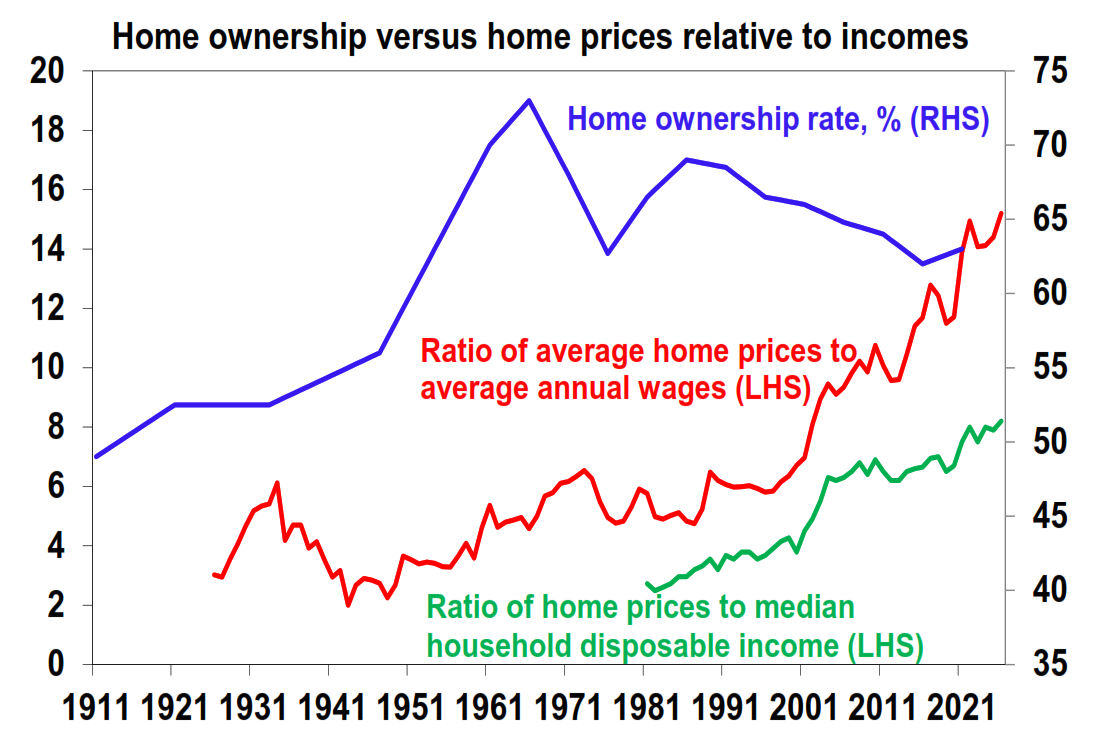
We also paid less tax as a share of our income back then. But housing is the big one - today the ratio of home prices to incomes is way above what it was 25 and 50 years ago, and it takes far longer to save for a deposit. Associated with this has been a down trend in the home ownership rate since it’s mid-1960s peak. And this arguably goes a big way to explain why younger generations may be feeling less happy today as getting a home is seen as too hard.
Of course, in the past things were also less regulated so we may have felt freer, there was a greater sense of community, there was less choice (i.e. four TV channels in the 1960s and 70s versus lots of streaming and TV options now), so less decisions to make, which resulted in less pressure. And there was no social media to bully us, rile us up or create a perpetual sense of FOMO (and in many cases relieve us of our money - though small town gossip was probably worse back then!).
But many economic indicators are far better now
Against this, virtually all other economic indicators are much better today.
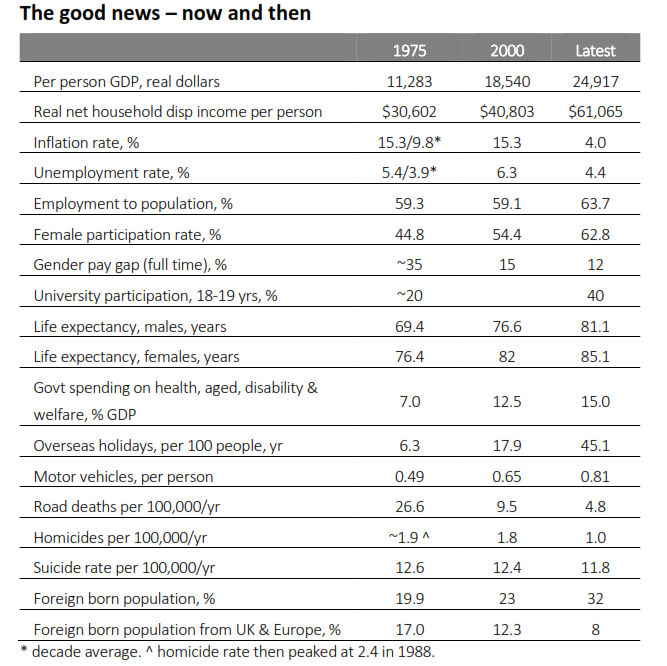
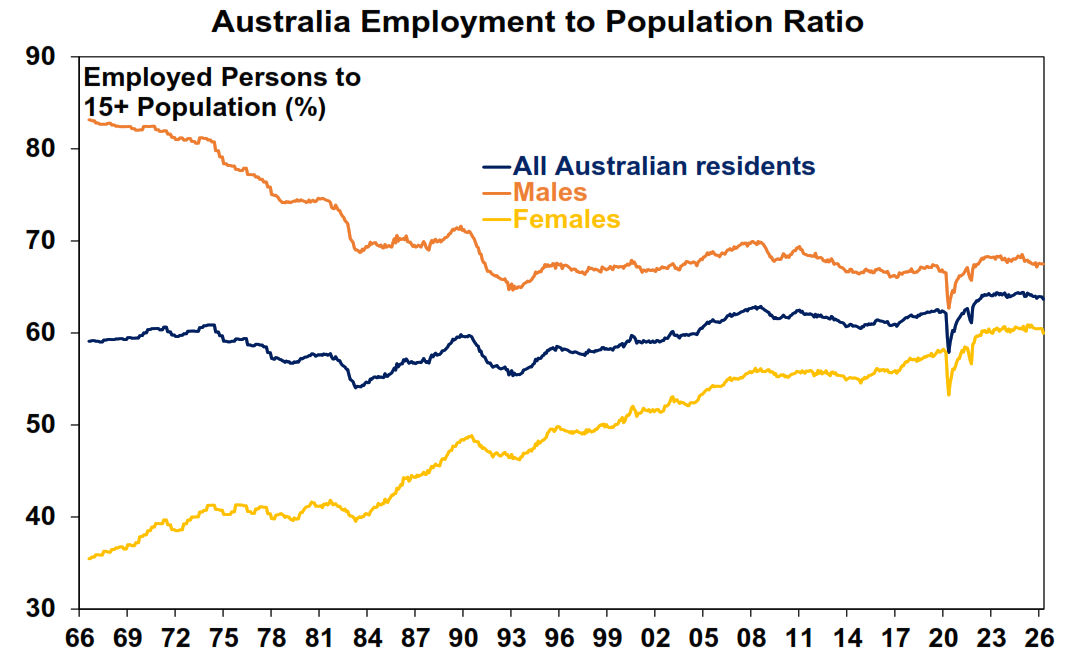
In recent decades the economic cycle has been milder with less severe recessions, generally lower unemployment and generally lower inflation. Today we are far better off materially: real household income is double what it was 50 years ago, there is a greater share of the population in employment (~64% versus 60% in the 70s, reflecting more jobs), and the female participation in the workforce has risen (helped by better education, childcare and attitudes).
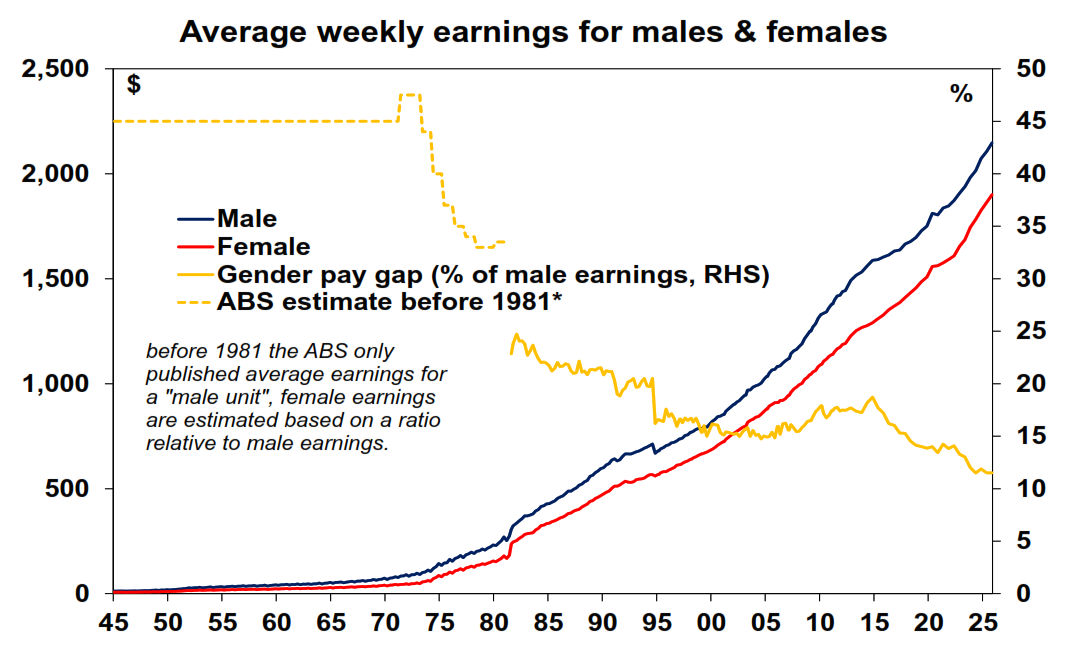
With this wealth has come more discretionary spending power to devote to things like overseas holidays – 50 years ago, an average Australian had an overseas holiday once every 16 years, now it’s just a bit less than once every two years. And more gadgets like cars – where there is now nearly one for every two people – and household appliances like huge flatscreen TVs. And multiple cafes per suburb with endless choice of coffee and food compared to the burgers and instant coffee of a few generations ago.
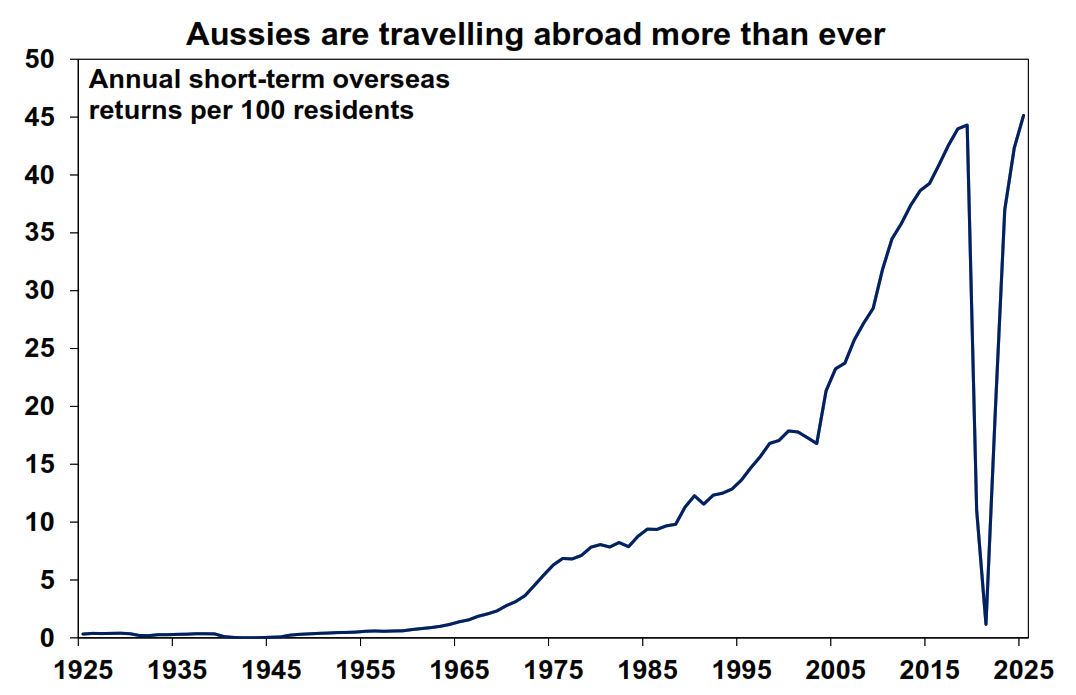
But it’s also a far more equitable society. For example, female participation in the workforce has surged from being way below that of men, more girls now go on to a university education than boys and the gender pay gap has fallen sharply (albeit there is still a way to go). It’s hard to look back a generation or two ago and say things were great when opportunities for half the population (i.e. women) were way below those of the other half. At this point we here the manosphere crowd saying how guys are now discriminated against…and think come on guys “get a grip”! – don’t you realise that manosphere influencers are just telling you what you want to hear so they can get a buck out of you!
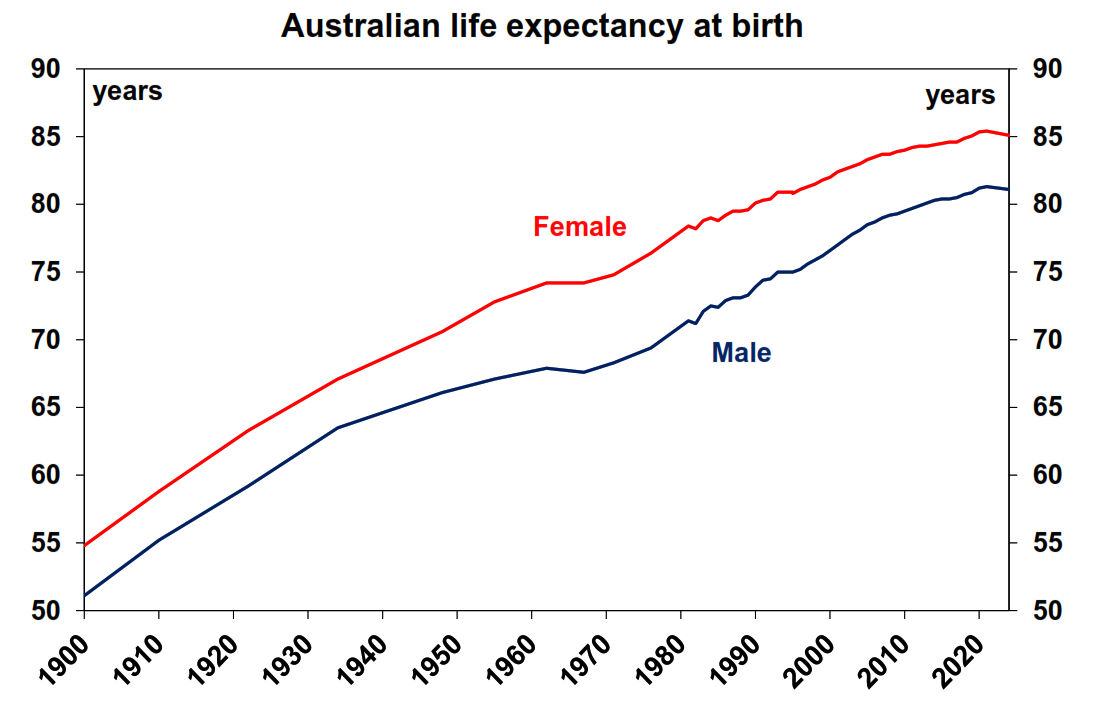
And with this surge in income and wealth has come huge medical advances which means we are living longer, active lives. (Of course, this is not to say there are not issues with obesity and too much sugar which may be starting to take a toll in the last few years!)
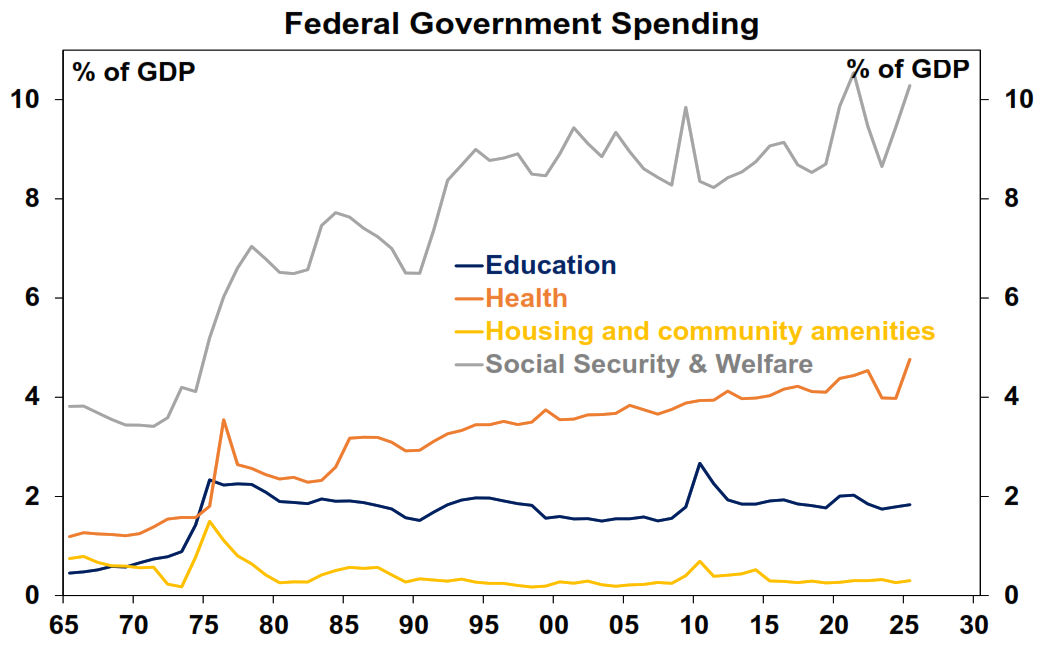
While we pay more taxes as a share of income, and more is demanded of Government, the social safety net is bigger than ever. It’s seen explosive growth in the provision of spending on welfare, health, aged and disability care – which have each more than doubled as a share of GDP. And Government is mostly doing a good job of protecting us from ourselves and each other, with for instance, a collapse in road death and homicide rates.
Australia is now also a far more diverse country with far more born overseas and less of those that are from a UK/European background. This has led to a richer society (e.g. more restaurants to choose from), a more innovative society and relief from the pressures of an aging population and labour shortages.
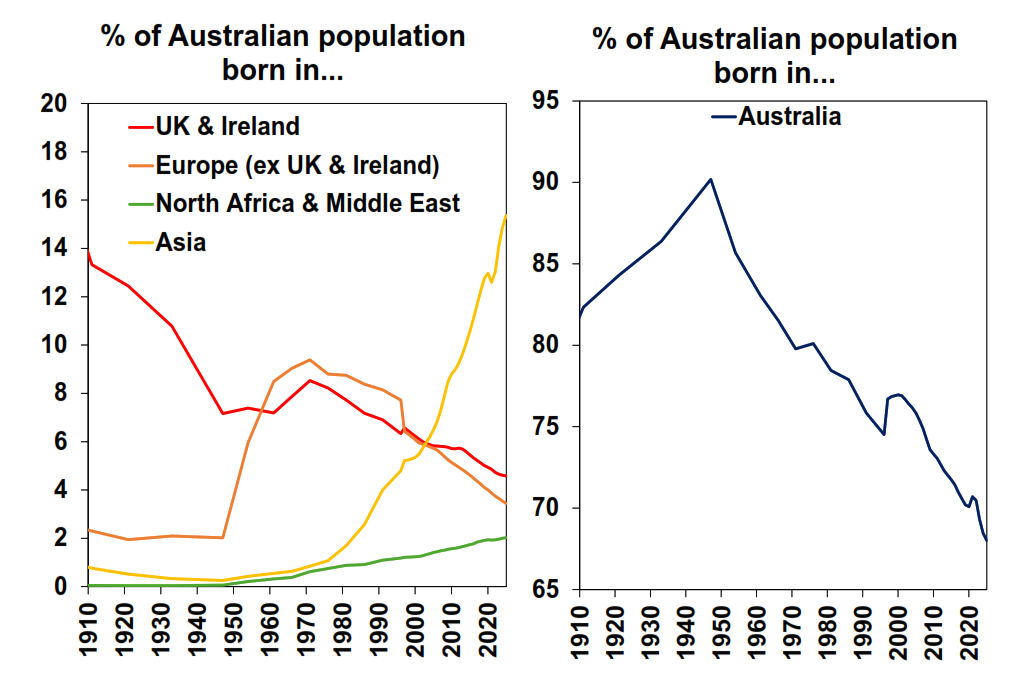
Of course, immigration is once again a hot topic – it has been periodically for as long as I can remember – but for most this seems to reflect a concern about poor housing affordability.
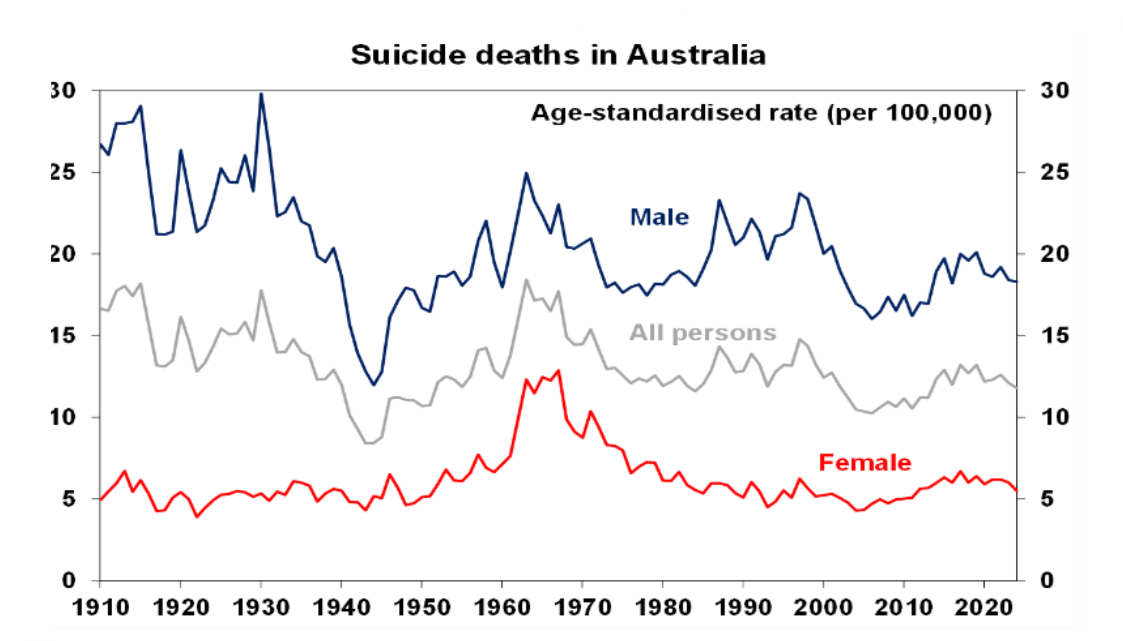
And finally, despite all the talk to the contrary, it’s still too high but the suicide rate is around where it was 25 and 50 years ago and is in fact below its level in the pre-WW2 years, the 1960s and the late 1980-90s.
So why do people still feel miserable even with all these economic achievements?
Simply because most people nowadays weren’t around back then! Around 65% of the population was born after 1975, and 78% were either not born or too young in the 1970s to remember it clearly, so much of the hardship discussed in this note sits outside most people’s lived experience. And recency bias means that even for those who were around “back then”, the tougher times they might have had can be hard to recall after three decades of economic growth and virtually no recessions in Australia.
Recency bias and higher baseline expectations also make comparisons with 25 or 50 years ago less meaningful. At the same time, things have indeed gotten a bit worse in the last 5 years.
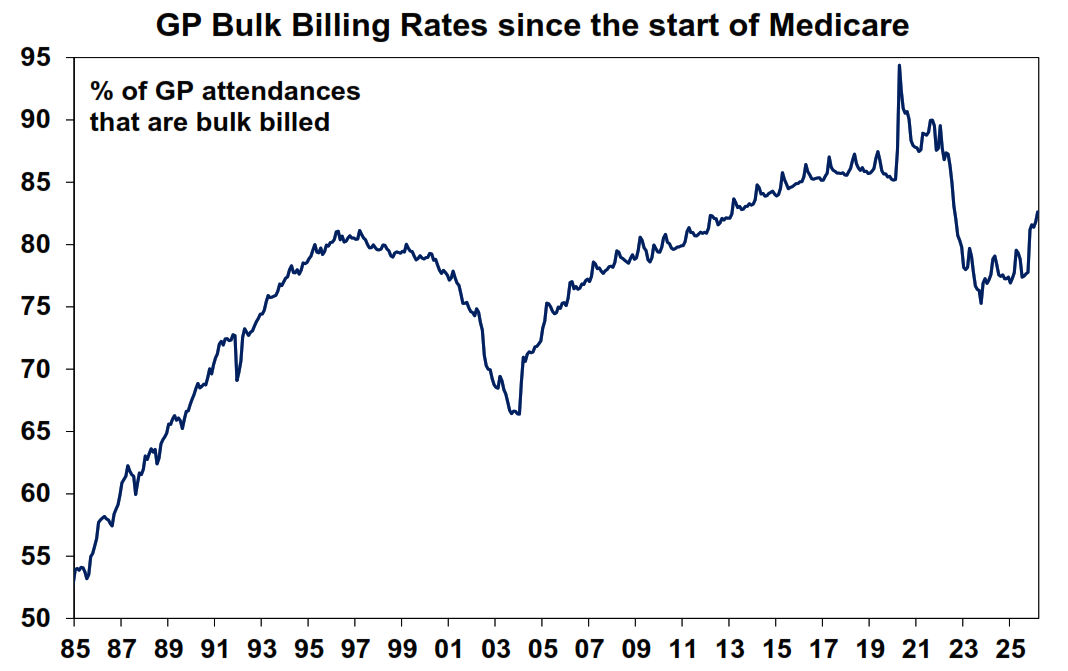
For example, health outcomes have improved over the long term, helped by medical advances, increased government health spending and better access to health care with e.g. higher bulk billing rates. But bulk billing fell sharply from 2022 until late last year as medical goods and services costs rose, with some surveys suggesting many people delayed medical appointments because of affordability. That marks a clear regression from 2020-2022, when the average bulk billing rate was 89%.
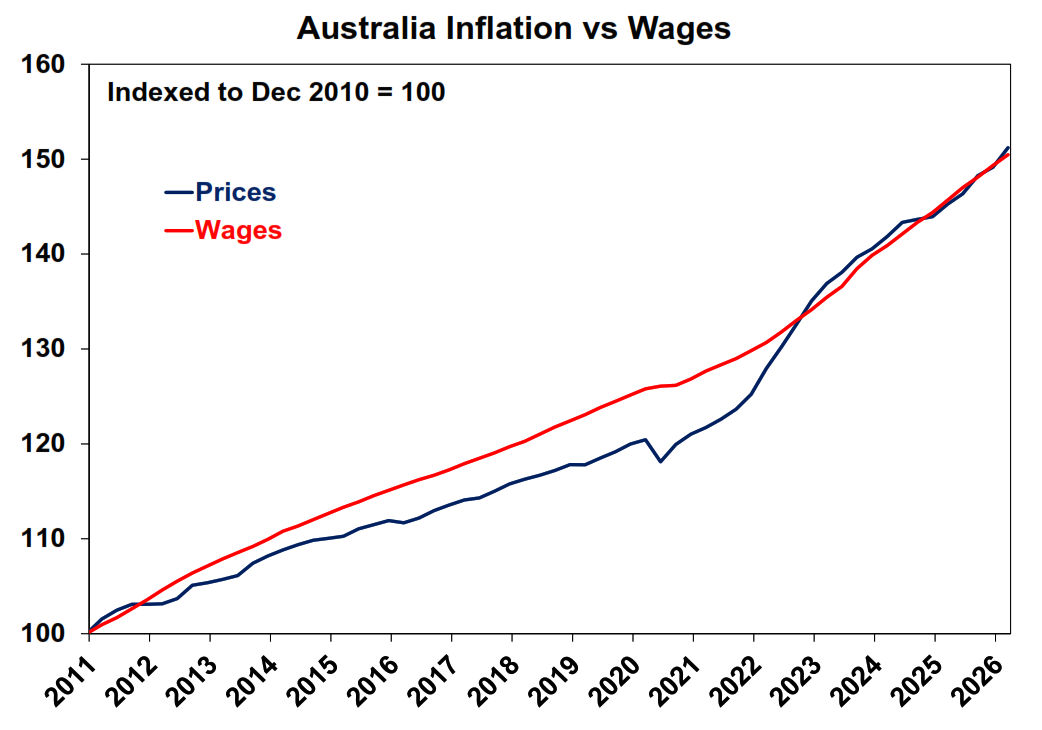
In addition, real wages have gone up significantly over the last 25 and 50 years, but the average wage earner (if they have not upskilled or changed jobs) has seen their pay lag inflation since 2021.
The root core of this is low productivity growth. Coincidentally, the structural decline in happiness in 2015 started around the same time productivity started stagnating.
Concluding comments
None of this analysis is to deny that many are struggling with “cost of living” issues and that there is a wider malaise of dissatisfaction. Government’ need to do more to boost productivity and hence grow living standards and avoid the delusion that the answer is even more government. But we suspect a big part of the problem is poor housing affordability which leads to a growing wealth gap between the haves and the have nots – fix that with a fundamental rebalancing of underlying housing supply and demand, and a lot of the angst will likely fade. This likely involves getting the balance right on immigration but not slashing it such that it just leads to labour shortages and the economy struggling with an aging population.
Finally, we need to recognise that part of the malaise associated with poor happiness and confidence reflects a problem of success. The rise in affluence has led to higher expectations than the economy can at times deliver upon. And social media – itself a product of technological success – may be contributing to the malaise via its focus on grievance and quick hits. Finding better ways to live with this success – and recognise more “things” won’t necessarily make us happier - is probably key.
Dr Shane Oliver, Head of Inv Strategy and Chief Economist, AMP
Diana Mousina, Deputy Chief Economist, AMP
My Bui, Economist, AMP


You may also like
-

Weekly Market Update - 09-10-2026 - AMP Weekly Market Update: US shares near record highs but risks are bubbling, tech rally remains narrow, credit markets turn wary on AI & Firmus IPO shelved, French bond yields surge, and another immigration debate. -

Five things that could stop the data centre boom As agentic commerce agents become an increasingly common way to shop, learn the risks that may come with them, and some ways to use them more safely. -

What are AI shopping agents, and are they safe to use As agentic commerce agents become an increasingly common way to shop, learn the risks that may come with them, and some ways to use them more safely.
Important information
Any advice and information is provided by AWM Services Pty Ltd ABN 15 139 353 496, AFSL No. 366121 (AWM Services) and is general in nature. It hasn’t taken your financial or personal circumstances into account. Taxation issues are complex. You should seek professional advice before deciding to act on any information in this article.
It’s important to consider your particular circumstances and read the relevant Product Disclosure Statement, Target Market Determination or Terms and Conditions, available from AMP at amp.com.au, or by calling 131 267, before deciding what’s right for you. The super coaching session is a super health check and is provided by AWM Services and is general advice only. It does not consider your personal circumstances.
You can read our Financial Services Guide online for information about our services, including the fees and other benefits that AMP companies and their representatives may receive in relation to products and services provided to you. You can also ask us for a hardcopy. All information on this website is subject to change without notice. AWM Services is part of the AMP group.