





Oliver's insights
The economics of happiness – why it’s been falling & what to do about it?
This is where economics comes in. The basic “economic problem” which economics is focussed on solving is: how to maximise utility or satisfaction when human wants are unlimited but resources available to satisfy those wants are limited. Of course, utility is basically happiness, so economics is all about happiness.
8 min read

Key points
Despite rising GDP per person, measures of happiness have been flat to falling in western countries including Australia.
Key drivers are likely to be rising expectations, the rise of social media and falling housing affordability.
It may be driving the rise of extreme political parties.
Some suggest we are on an “hedonic treadmill” and want a broader policy focus on something like Gross National Happiness, but by suppressing individual freedom and achievement this could in turn depress happiness.
Introduction
The pursuit of happiness is at the centre of our existence. Along with life and liberty it’s even a central idea upon which the US was founded. And rightly so because happiness is good for us – happy people live longer, are healthier, more resilient, more creative, better leaders and more sociable. And happy countries are less likely to wage war with other countries.
This is where economics comes in. The basic “economic problem” which economics is focussed on solving is: how to maximise utility or satisfaction when human wants are unlimited but resources available to satisfy those wants are limited. Of course, utility is basically happiness, so economics is all about happiness. To borrow from the Dalai Lama, it may be said that economics is really the “art of happiness”. But in the absence of definitive measures of happiness, economists long assumed that consumer spending per person or GDP per person are good proxies which ultimately led economics down a path of focussing on material wellbeing.
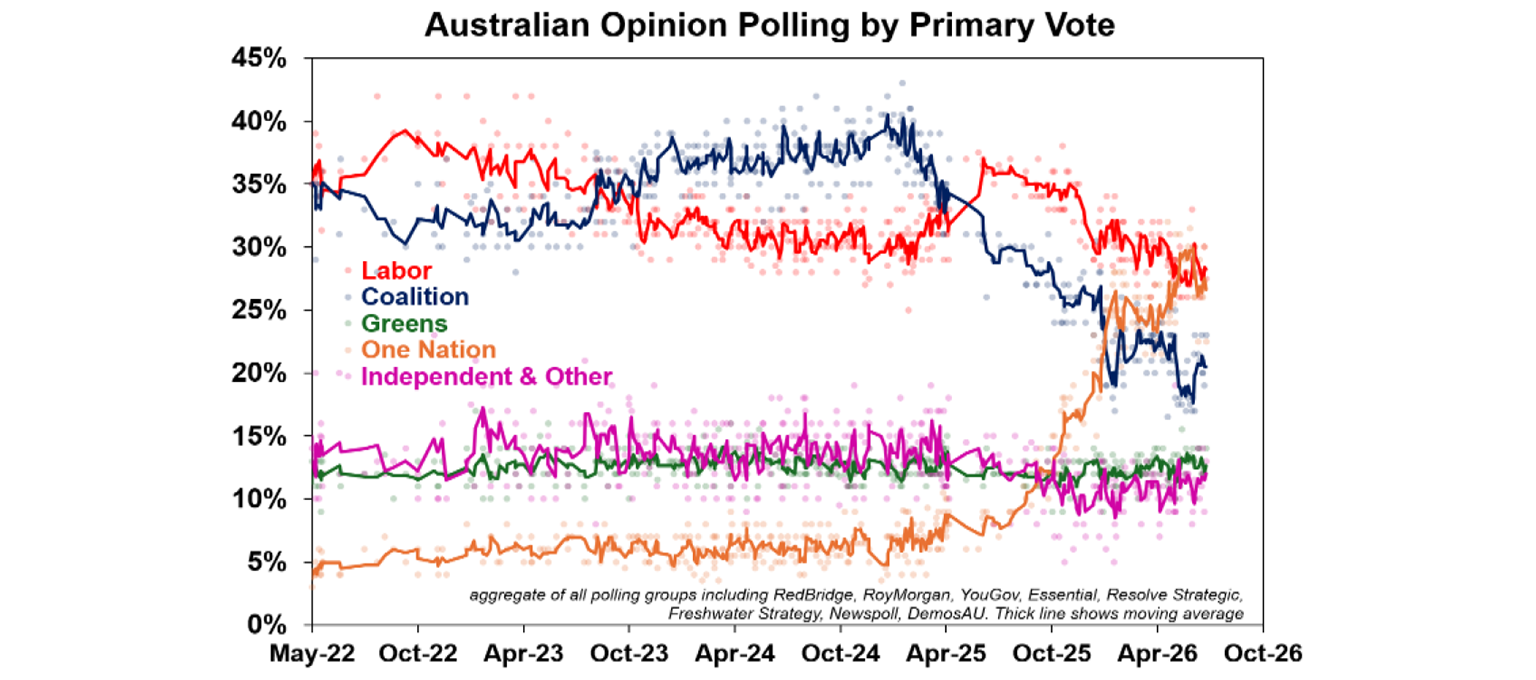
The problem is that over the last two decades, despite rising measures of material well-being, measures of happiness have been flat or falling in many developed countries. Indeed, the decline in happiness may be contributing to the rise in support for populist more extreme political leaders, like Trump in the US, and parties like in Australia with One Nation.
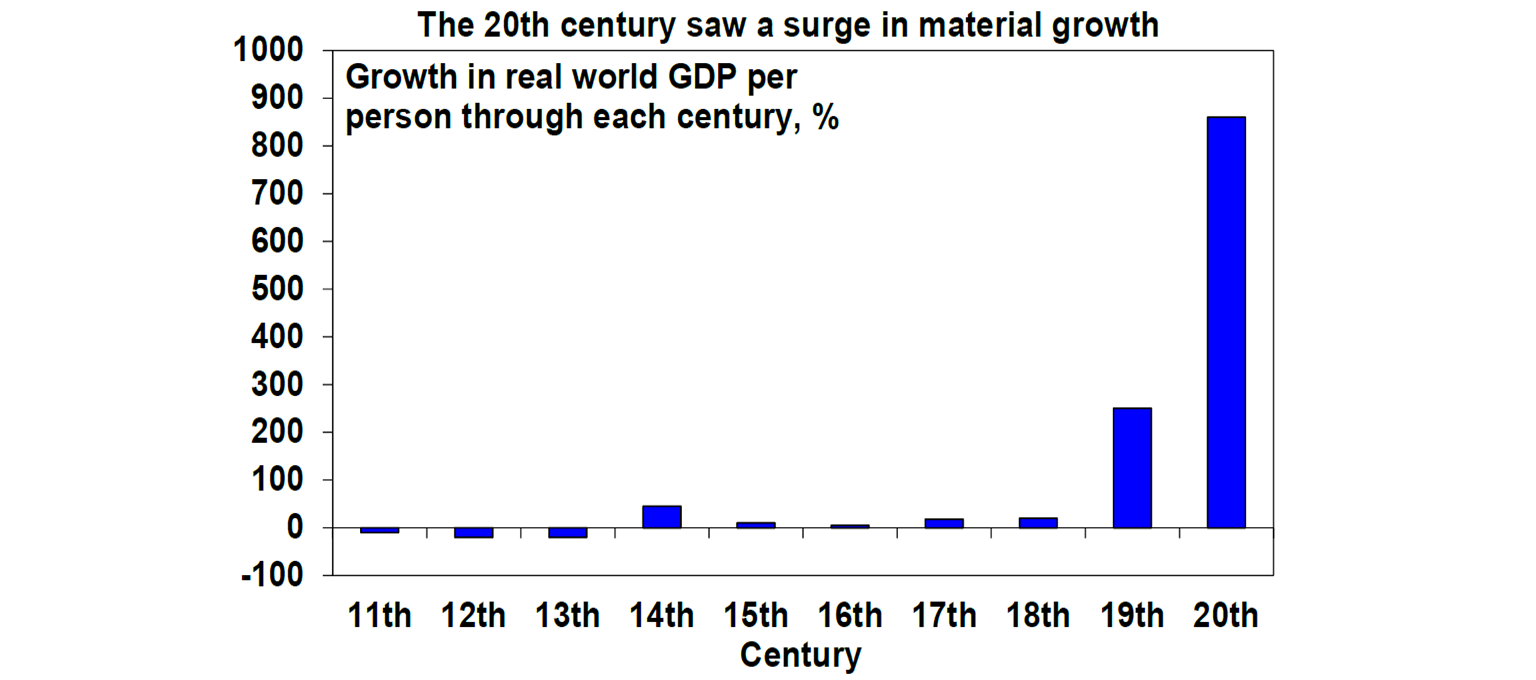
Material prosperity has surged
The 19th century saw the start of rapid global economic growth. This really took off in the 20th century as innovations such as electricity, the internal combustion engine and silicon chips came together to rapidly boost productivity. Consequently, real income or Gross Domestic Product (GDP) per person surged. This in turn led to a massive rise in material prosperity, eg, with: big climate-controlled homes; high speed affordable travel; a high quality and variety of food; a huge array of goods; much longer lives; and instant communication & entertainment. While living standards in Australia may have fallen in the last five years, Australians are substantially better off materially compared to 25 or 50 years ago (see here).
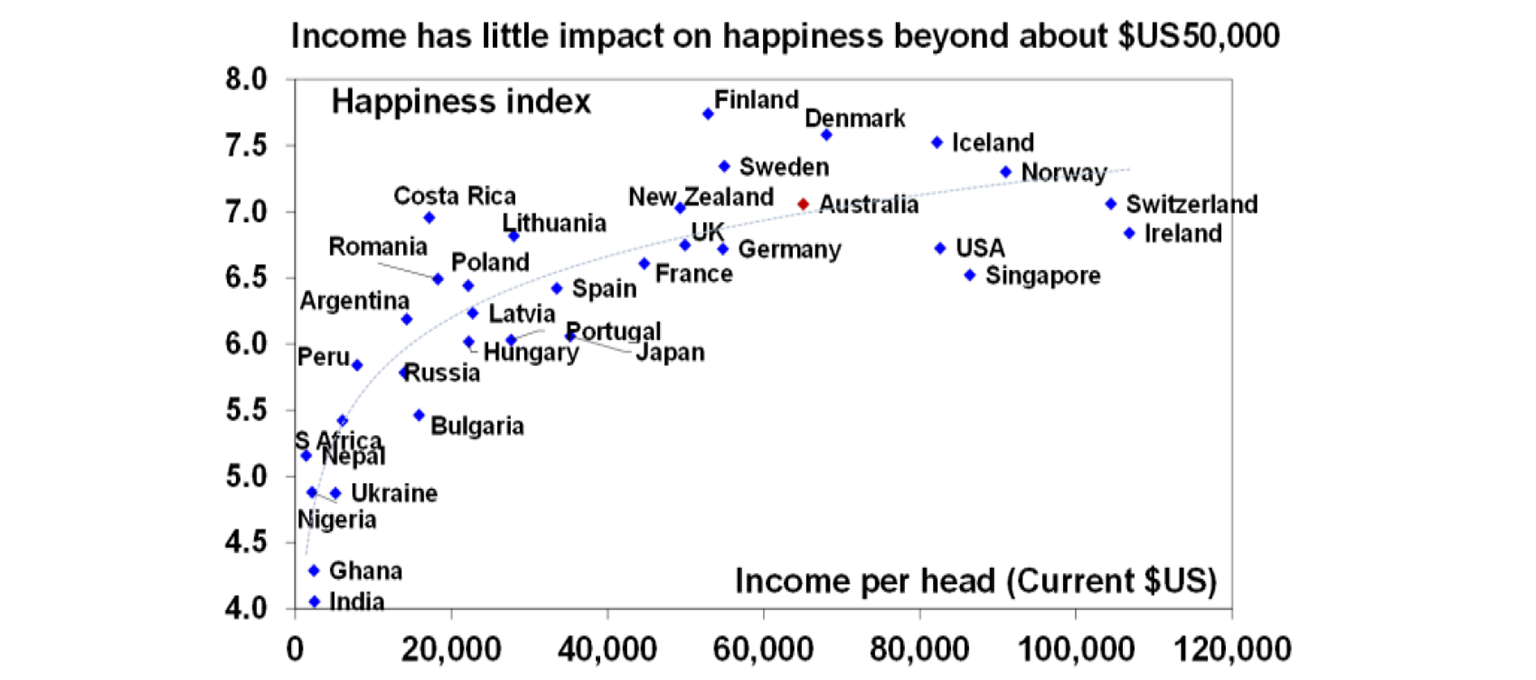
But happiness has been stagnant in recent decades
The next chart compares income and happiness – as measured by surveys of how people see the quality of their lives. People in rich countries are mostly happier than those in poor countries. According to the 2026 World Happiness Report Finland ranks #1 as the happiest, Australia ranks #15 with the US at #23. Lebanon, Zimbabwe and Afghanistan are at the bottom. However, there are diminishing returns to income. At lower levels, extra income can have a big positive impact. But for countries beyond a certain level (around $US50,000), extra income has little impact. Eg, income levels in Switzerland are nearly double NZ but happiness is the same.
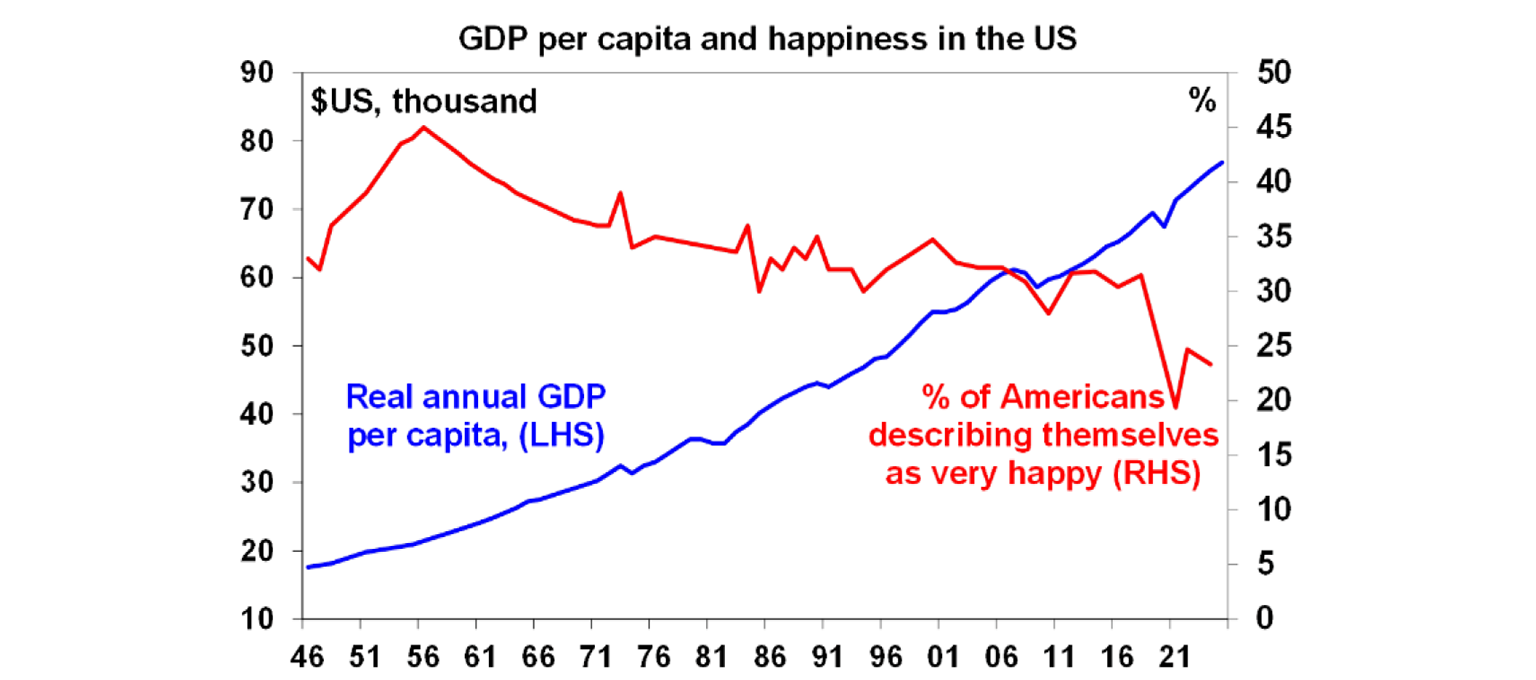
What’s more, despite a huge surge in material prosperity there is little evidence that happiness levels in developed countries have improved in the last fifty years. This is illustrated in the chart below for the US which shows the percentage of people who say they are “very happy”, versus real GDP per person. As income has gone up, happiness has gone down.
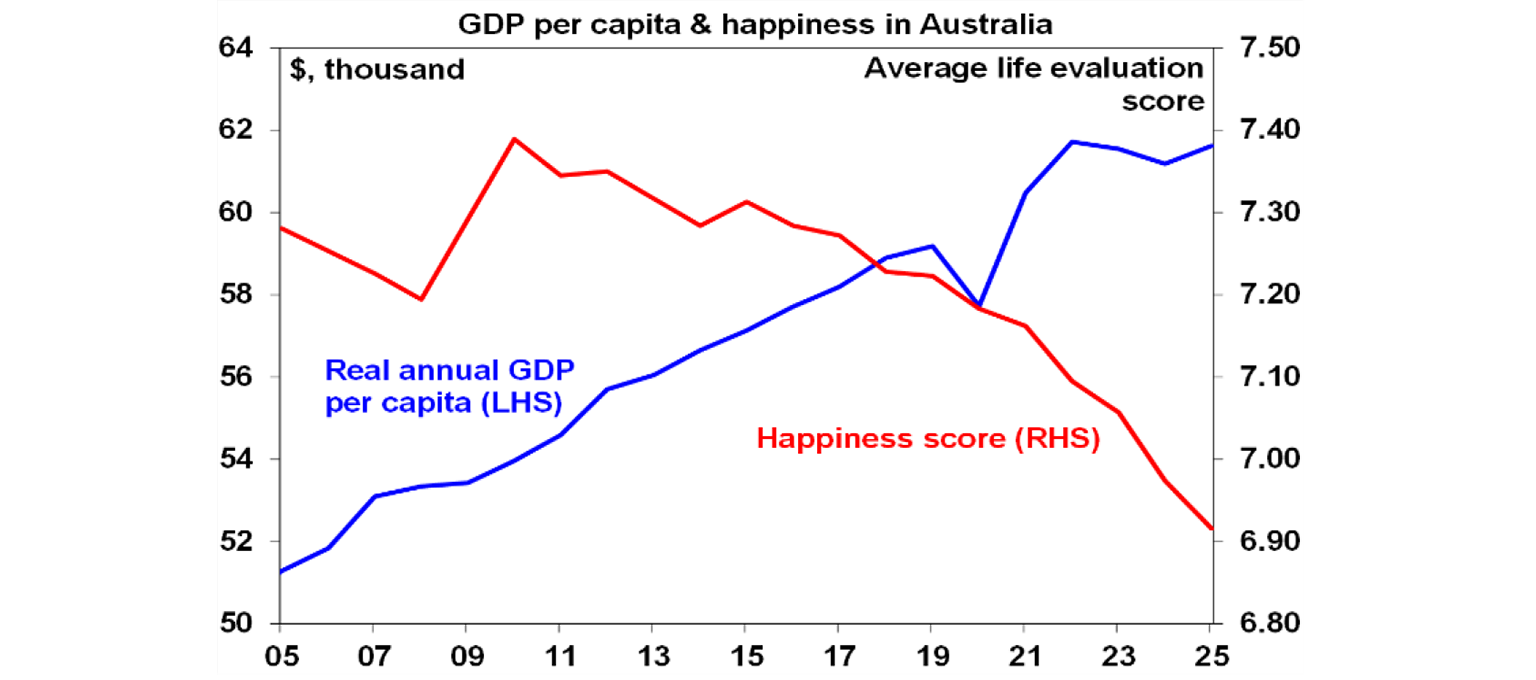
It’s a similar for Australia – a rising trend in income but falling happiness.
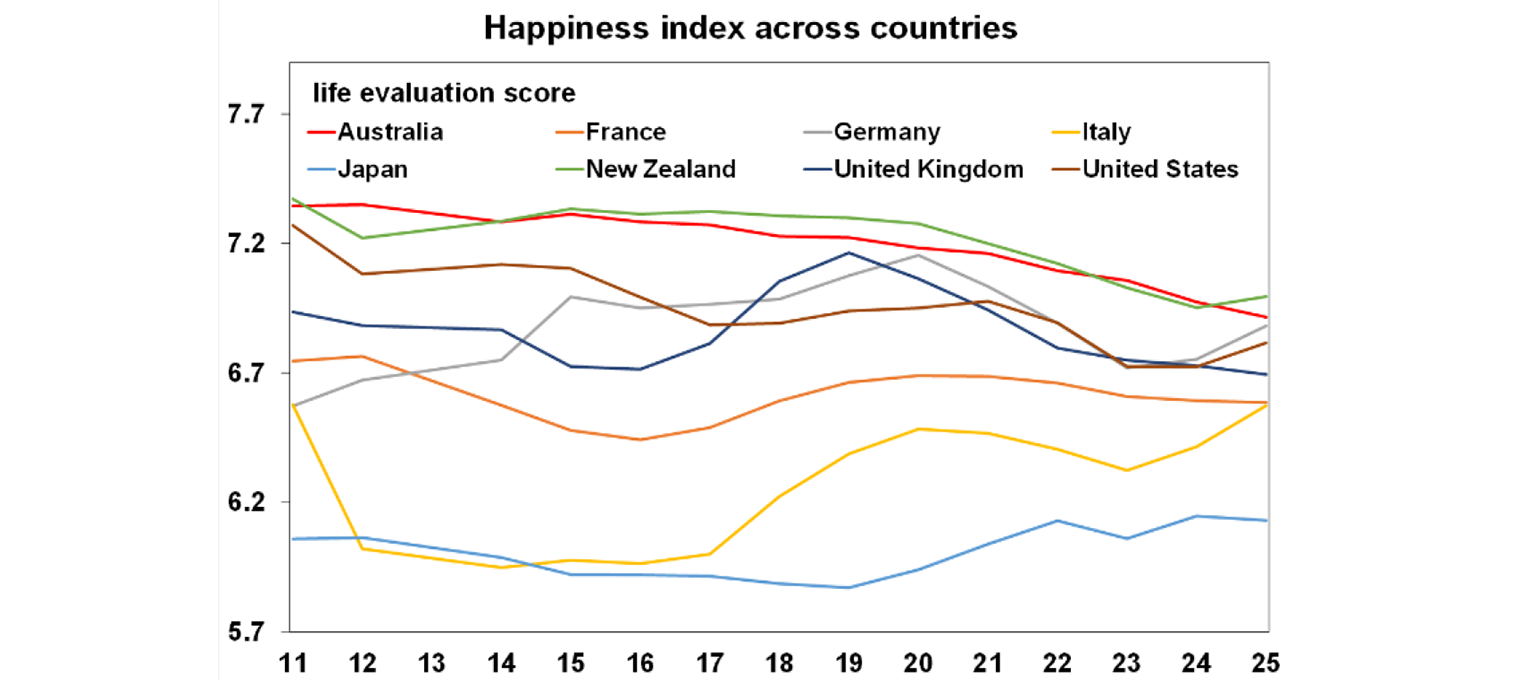
In general, the 2026 World Happiness Report finds that several western countries have seen flat to declining happiness over the last 15 years.
Other findings from the happiness studies are as follows:
Rich people are happier than poor people, but people compare themselves to others (“keeping up with the Joneses”) so if average incomes rise, they may be no happier.
Younger people in anglo countries are the least happy. This appears due to the rise of social media driving more anxiety and depression.
Physical and outdoor leisure, shopping, reading books, seeing relatives, listening to music and attending sporting and cultural events are associated with higher happiness. Time on the internet is not - the higher the rate of social media use the lower the level of happiness.
Freedom to make life choices contributes to happiness.
People adapt to their situation: evidence shows we are born with a genetically pre-set level of happiness to which we return to after good events (like winning the lottery) and bad (like having an accident).
Why has happiness fallen?
Explanations for the declining trend in happiness over the last twenty years include: increasing stress associated with the rising complexity of life (e.g. more choices); increasing pressure to “keep up with the Joneses”; rising expectations; falling housing affordability; the rising use of social media contributing to a decline in real human interaction and magnifying grievance and feelings of inadequacy. In particular, some have claimed that most people are on an “hedonic treadmill” of working ever harder to attain material wealth in the belief this will make them happier only to find it doesn’t but resolving to work even harder!
Why not ditch GDP for Gross National Happiness?
These findings present a challenge for economists. If GDP, income and consumption are positively correlated with happiness, then policies to boost economic growth will boost happiness. But, if not, this may be misplaced so some argue economic policy needs to be refocused on broader measures of wellbeing such as Gross National Happiness. This would mean a radical change in economic policy with proposals to boost happiness like: taxing or banning excessive work; re-distributing more income and wealth (because inequality leads to envy and keeps people on the “hedonic treadmill”); reducing the focus on competition and rivalry; spending more money on public goods such as parks; refocussing on community; limiting advertising to information to avoid creating demand for stuff we don’t need; and regulating access to social media.
However, in reality it’s never that simple and there are good reasons to be sceptical of proposals for government policy to target happiness:
Nationally determined concepts of happiness could be used to justify religious or ethnic persecution and to advance authoritarian aims.
Just because we get used to something doesn’t mean we should stop doing it. Rising material wealth may not permanently boost happiness beyond a certain level as we adapt to it. But just because the huge increase in healthy lifespans or overseas holidays hasn’t boosted happiness does not mean we should cut health spending & ban travel.
While material progress may not be boosting happiness, it is doubtful stagnation will either. Curiosity and the desire to advance are fundamental to humanity. Policies to supress them may reduce happiness, by taking away satisfaction derived from achievement.
Restricting choice in favour of officially mandated happiness guidelines may actually reduce happiness as evidence suggests that freedom to make life choices contributes to happiness.
Finally, we are partly dealing here with the outworking of success including the rise of social media. Affluence has given people in rich countries the time and money to think about things which can sometimes make them less happy (“too much time on their hands!”) Finding better ways to live with the success, including social media – a bit like the rules around driving cars – is better than reversing it.
There is a danger in trying to legislate for happiness. There is nothing new in the concept that material wealth beyond basic needs won’t lead to lasting happiness. Most religions have long been pointing it out. Buddha observed that most human suffering comes from desire (the Four Noble Truths) and this has to be controlled (with The Eightfold Path) to achieve happiness. But seeking happiness and enlightenment is up to individuals, not the state (or government). Maybe as Thomas Jefferson implied, happiness is something we have to “pursue”! And the state’s role is to enable that pursuit, while protecting the rights of all other citizens to the do the same.
Dr Shane Oliver
Head of Investment Strategy and Chief Economist, AMP


Something went wrong. Please try again.
Thanks for subscribing.
We'll keep you up to date with the latest news, insights and information from AMP. Check your inbox for future updates.
You may also like
-

Weekly Market Update - 16-10-2026 - AMP Weekly Market Update: AI credit fears hit shares, Investors flocking to safe haven (because of CoreWeave?), Oil still high but global growth still resilient, and Weak jobs data gives RBA room to pause. -

6 New Year resolutions that could improve your finances Six simple financial tips that could help you save more, spend smarter and feel more in control of your finances in the new year. -

Weekly Market Update - 09-10-2026 - AMP Weekly Market Update: US shares near record highs but risks are bubbling, tech rally remains narrow, credit markets turn wary on AI & Firmus IPO shelved, French bond yields surge, and another immigration debate.
Important note
While every care has been taken in the preparation of this document, neither National Mutual Funds Management Ltd (ABN 32 006 787 720, AFSL 234652) (NMFM), AMP Limited ABN 49 079 354 519 nor any other member of the AMP Group (AMP) makes any representations or warranties as to the accuracy or completeness of any statement in it including, without limitation, any forecasts. Past performance is not a reliable indicator of future performance. This document has been prepared for the purpose of providing general information, without taking account of any particular investor’s objectives, financial situation or needs. An investor should, before making any investment decisions, consider the appropriateness of the information in this document, and seek professional advice, having regard to the investor’s objectives, financial situation and needs. This document is solely for the use of the party to whom it is provided. This document is not intended for distribution or use in any jurisdiction where it would be contrary to applicable laws, regulations or directives and does not constitute a recommendation, offer, solicitation or invitation to invest.