





Weekly market update
Investment markets and key developments
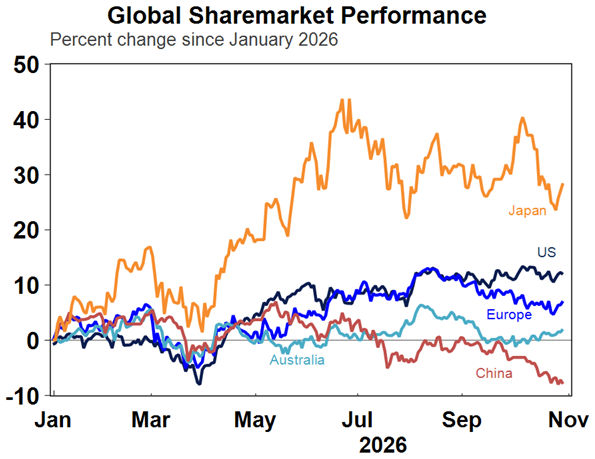
Global share markets mostly rose over the last week as Anthropic’s filing for a roughly $US100bn IPO boosted enthusiasm for AI, profit results have mostly been strong and the Fed and ECB left rates on hold.
10 min read

Global share markets mostly rose over the last week as Anthropic’s filing for a roughly $US100bn IPO boosted enthusiasm for AI, profit results have mostly been strong and the Fed and ECB left rates on hold. Chinese shares were the exception and saw a near 3% fall. Following the positive US lead Australian shares also rose solidly with around a 1.5% gain despite worse than expected inflation data. While consumer shares fell sharply on the ASX this was more than offset by strong gains in resources, property & bank shares.
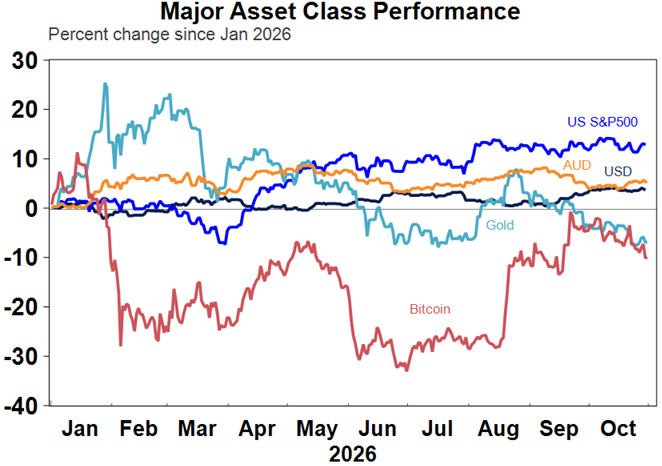
Gold managed a small rise over the week but both gold and Bitcoin have been trending down with the broader back up in bond yields and central bank hikes not helping. Metal & iron ore prices rose slightly over the last week and the $A & $US were little changed.
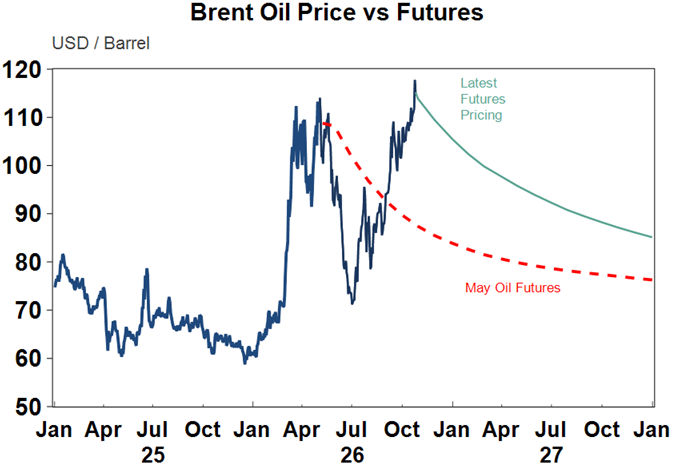
Oil prices fell slightly from a week ago but remain around May highs. Ongoing attacks on shipping in the Strait of Hormuz, worries that US attacks on Iran could recommence once the political constraint of the midterms are out of the way – with Trump suggesting as much - and the drawdown in oil reserves since March are helping keep oil prices up.
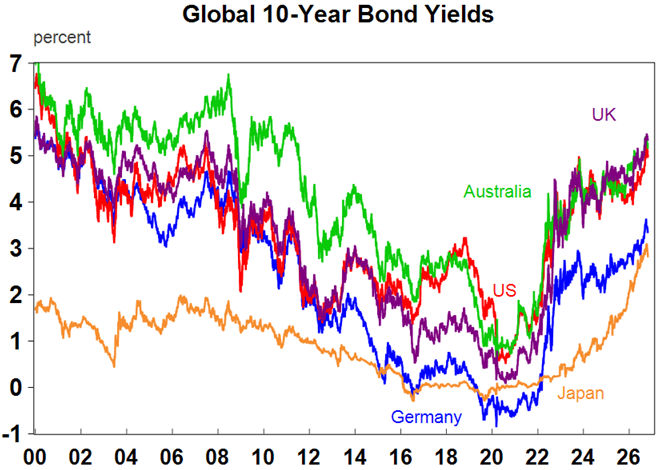
Bond yields have fallen over the last few weeks partly due to safe haven buying in response to wobbly share markets - but it looks more like a correction from oversold levels for bond prices. The longer term risks for bond yields are on the upside thanks to a combination of: high energy prices adding to inflation worries; expectations for more central bank rate hikes; stronger US economic data adding to concerns that maybe the neutral short term rate has moved up; worries about big budget deficits in the US, UK, France, Brazil and elsewhere; increased corporate borrowing to fund data centre investment; erratic US policy marking; and a rising trend in Japanese bond yields leading to a reversal of the so-called carry trade.
The worry list for shares remains high, and includes: high and sticky inflation; the likelihood of more central bank rate hikes; a likely resumption of the rising trend in bond yields; excessive public debt including in the US, France and Brazil; ongoing signs of stress in particularly in the low rated (CCC) credit market; the ongoing oil supply shock; worries that the data centre build out will prove unjustified and that the US share market and economy have become overly dependent on AI related activity with sharp falls in share prices for Alphabet and Amazon in the last week highlighting these concerns; political uncertainty associated with the US midterms which could see Trump ramp up the Iran War once it’s over and investors start to fret about tax hikes if as expected the Democrats do well; and in Australia increasing signs of stagflation with more RBA rate hikes. For now, a rotation from tech to non-tech and more defensive shares is yet again providing support for the US share market and hence for global shares and strong US earning and economic data are providing an offset to the worries, but the worry list is long and is worth keeping an eye on posing the risk of a correction at some point.
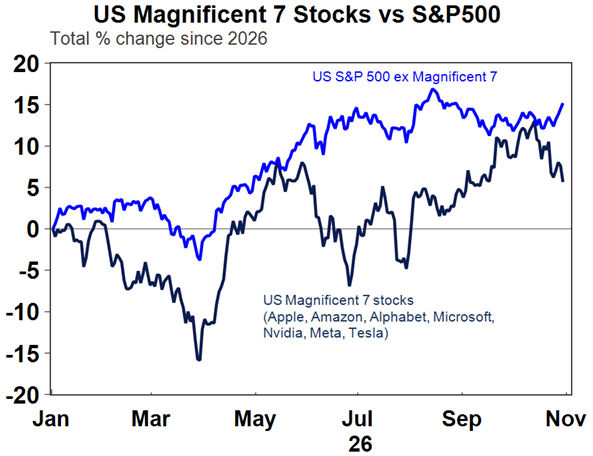
The past week was dominated by central bank meetings with most on hold partly due to tightening financial conditions, but all on track for more gradual rate hikes ahead.
- The Fed left rates on hold at 3.75-4% as widely expected opting to wait for more information. While it now sees growth as strong it doesn’t think the economy is overheating. However, it continues to lean towards further rate hikes with Fed Chair Warsh noting that inflation remains elevated and that the job is not yet done, with two dissents favouring a hike. The move to seven rate setting meetings next year and six from 2028, from eight at present means the risk of bigger moves at times going forward.
- The ECB also left rates on hold at 2.5% noting upside risks to inflation from the energy shock but downside risks to growth with tightening financial conditions flowing from the rise in bond yields and French spreads. But the bias remains towards more rate hikes with President Lagarde noting another hike had been debated and that the direction of travel is clear. Lagarde’s impending exit from the ECB in February is unlikely to impact ECB policy.
- The Reserve Bank of New Zealand also left rates on hold at 2.75%, which surprised most economists and the money market which expected a hike. This was in order to assess the impact of past hikes but three of the seven policy committee members and all members agreed higher rates are likely required.
- The Bank of Japan left rates on hold having hiked last month but signalled a continuing normalisation in rates.
- The Bank of Canada though hiked by 0.25% to 2.5% revising its growth and inflation forecasts up and noting that there could be a need for further cautious hikes.
As can be seen in the next chart money markets expect further rate hikes in advanced countries. This includes in New Zealand which is not shown in the chart.
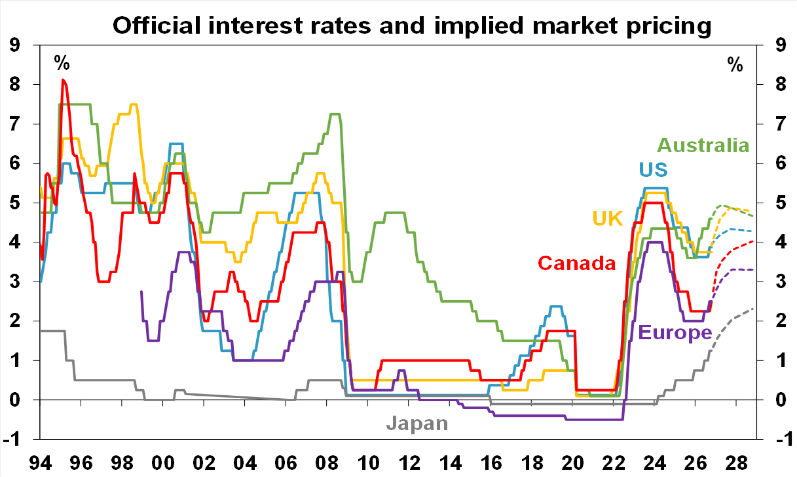
The RBA has had to be more aggressive in hiking than other central banks because it has a bigger underlying inflation problem and so the money market is still expecting the Australian cash rate to stay at the high end of the range of comparable countries into 2028. For example, core or underlying inflation measures in Canada and New Zealand are around 2% and 3% respectively compared to 3.7% in Australia and both have higher unemployment (of 6.5% and 5.6% respectively) than Australia (4.7%) enabling a bit more flexibility for their central banks.
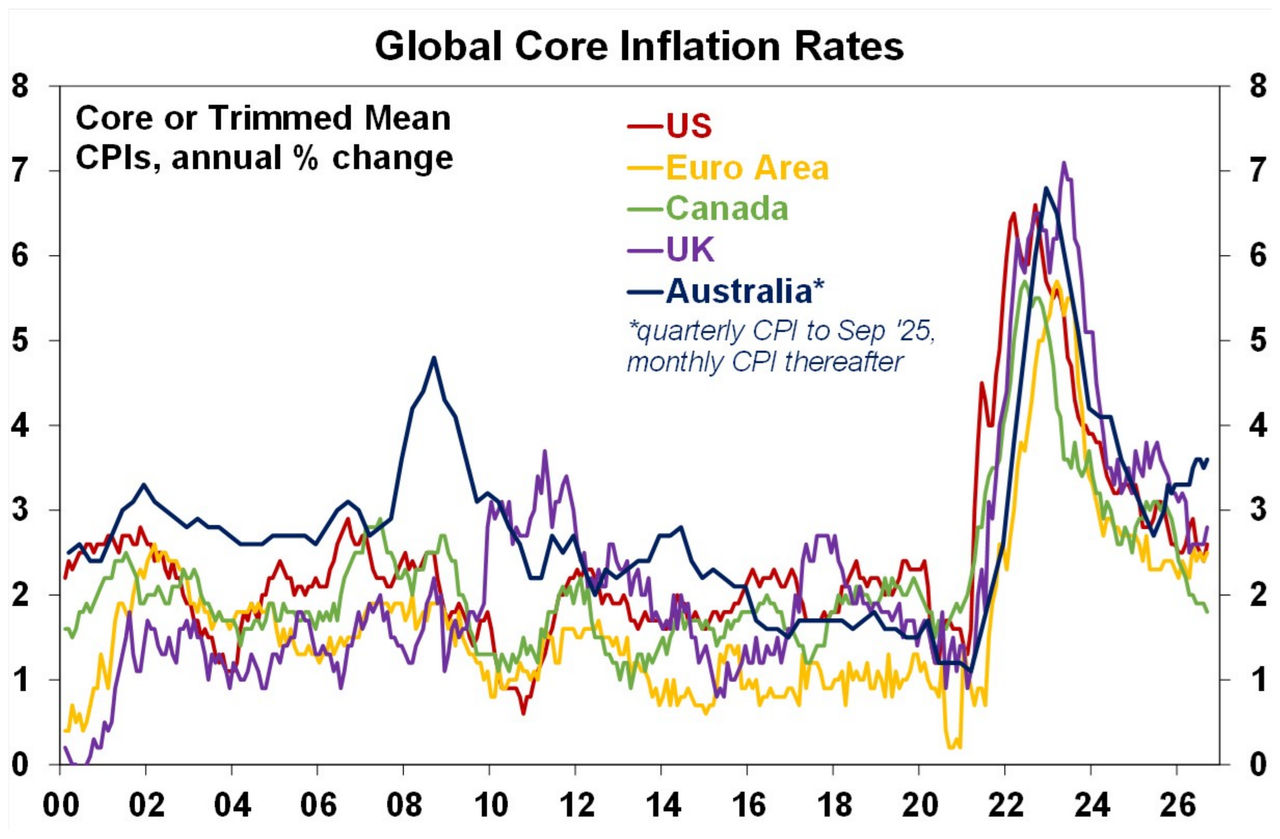
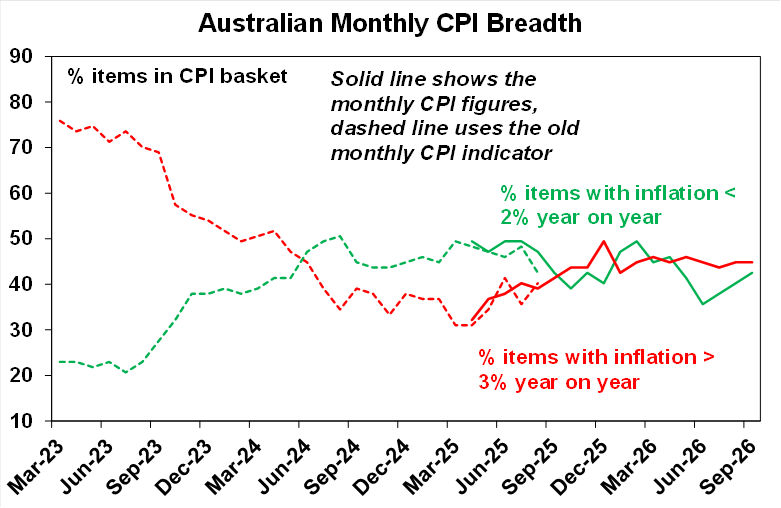
Which brings us to the latest inflation data in Australia for September which unfortunately yet again came in on the high side. Sure a 9.4% rise in auto fuel prices drove the inflation rate up to 4.3%yoy in September. But more importantly the trimmed mean inflation rate, which strips out such volatile moves to focus on the underlying trend in inflation, rose to 3.6%yoy in September. And it rose to 3.7%yoy in the September quarter, which was “materially above” RBA expectations for a 3.5%yoy rise and well above the RBA’s 2-3% target.
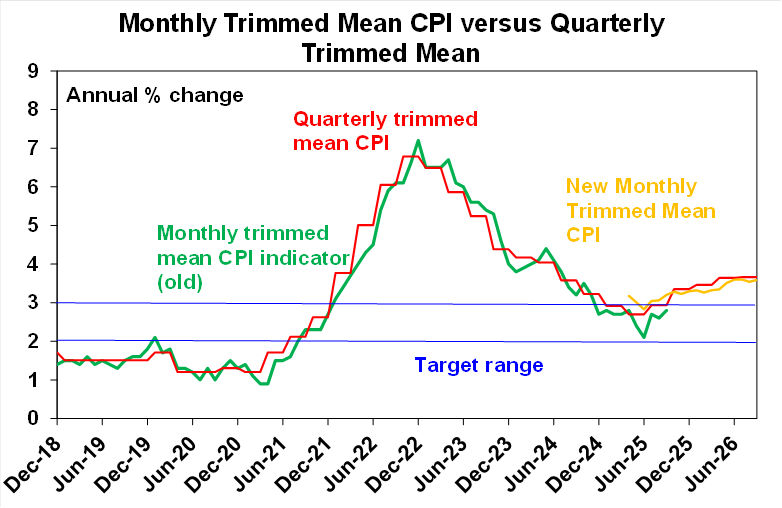
The September monthly inflation data did contain some tentative signs of cooling – with slower monthly growth in prices for consumer durables and new dwellings – but this could just be monthly volatility and there are still more CPI items seeing inflation above 3% than below 2%. And the trimmed mean seems stuck well above target, rather than trending back to target as might have been hoped. Sure the Iran War and the AI boom which is driving up prices for computer games and equipment are playing a role but the broad based nature of the inflation problem indicates that the economy remains up against capacity constraints. There is also a danger that the longer this continues high inflation will become embedded in the economy making it even harder to get back down.
As a result, the RBA (Tuesday) is expected to hike the cash rate by 0.25% for the fifth time this year, taking it to 4.85%, its highest level since November 2008. Following the September RBA hike we had been hopeful that – with weaker business and consumer surveys, rising unemployment, faltering consumer spending as now being confirmed by various retailers and weak housing indicators – the RBA would be able to “wait and assess” at its November meeting, albeit the risk of another hike was still seen as high. But now with inflation surprising further on the high side, increasing upside risks to inflation around excess demand, rising energy prices and AI demand along with signs of rising inflation expectations after more than five years of inflation being above target, the RBA will have to raise the cash rate again. This is also consistent with relatively hawkish commentary from the RBA over the last two weeks. Indeed, a failure to hike on Tuesday after the RBA’s recent hawkish commentary and the higher than expected inflation data would threaten RBA credibility in terms of its commitment to the inflation target.
While Tuesday’s RBA Board meeting will no doubt see lots of debate about whether or not it has done enough and the expected decision to hike may not be unanimous, we expect RBA commentary to continue to warn that it may have to raise interest rates further. At this stage while there is still a high risk of a sixth high to 5.1%, our base case is that 4.85% will be the peak with an extended hold out to the December quarter next year when rates are likely to start coming back down again. The money market has priced in an 80% probability of a hike on Tuesday.
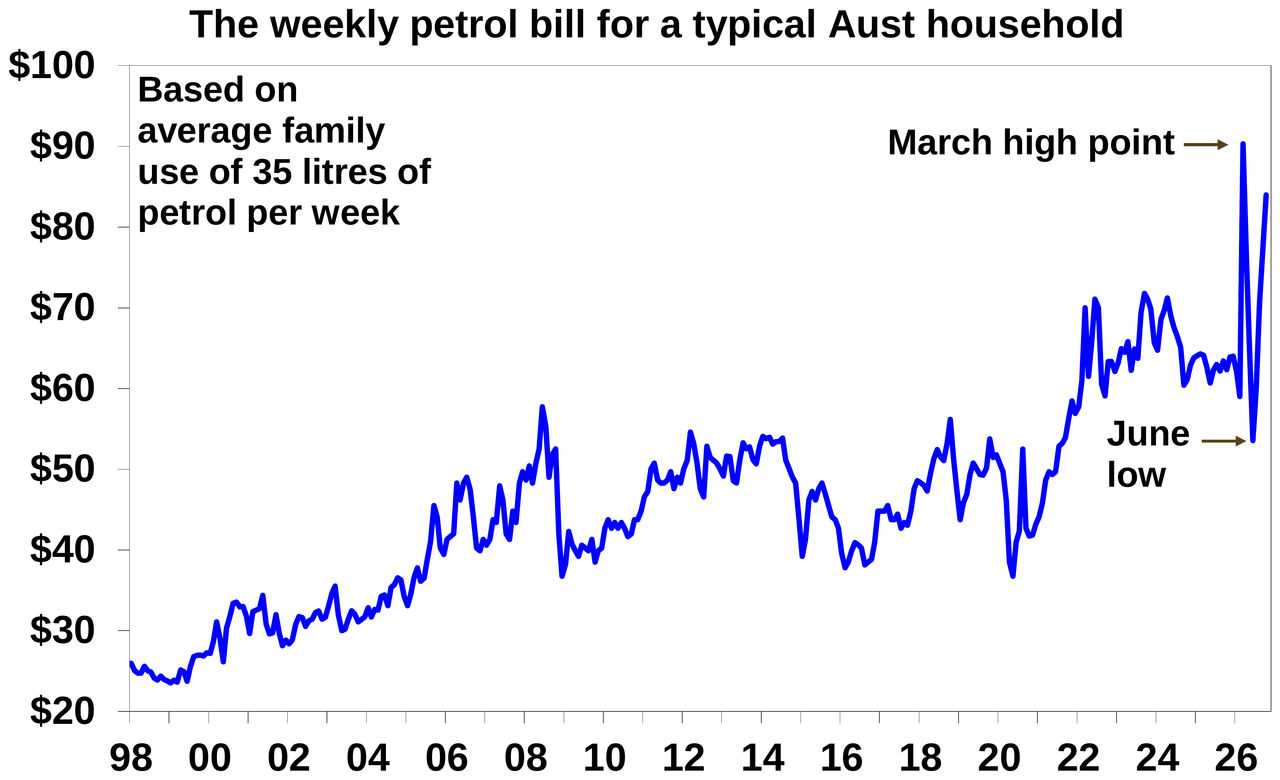
Another double whammy hit for households. For mortgage holders another 0.25% rate hike would mean roughly an extra $110 a month in mortgage interest payments. This would bring the increase since January to around $550 a month or $6600 a year. At a time when petrol prices are near their March record high the cost to the average household to fill up the car is pushing around $84 a week, up around $94 a month from where it was back in January. So around a $640 a month extra impost since January for those with a mortgage and petrol car which is quite a hit.
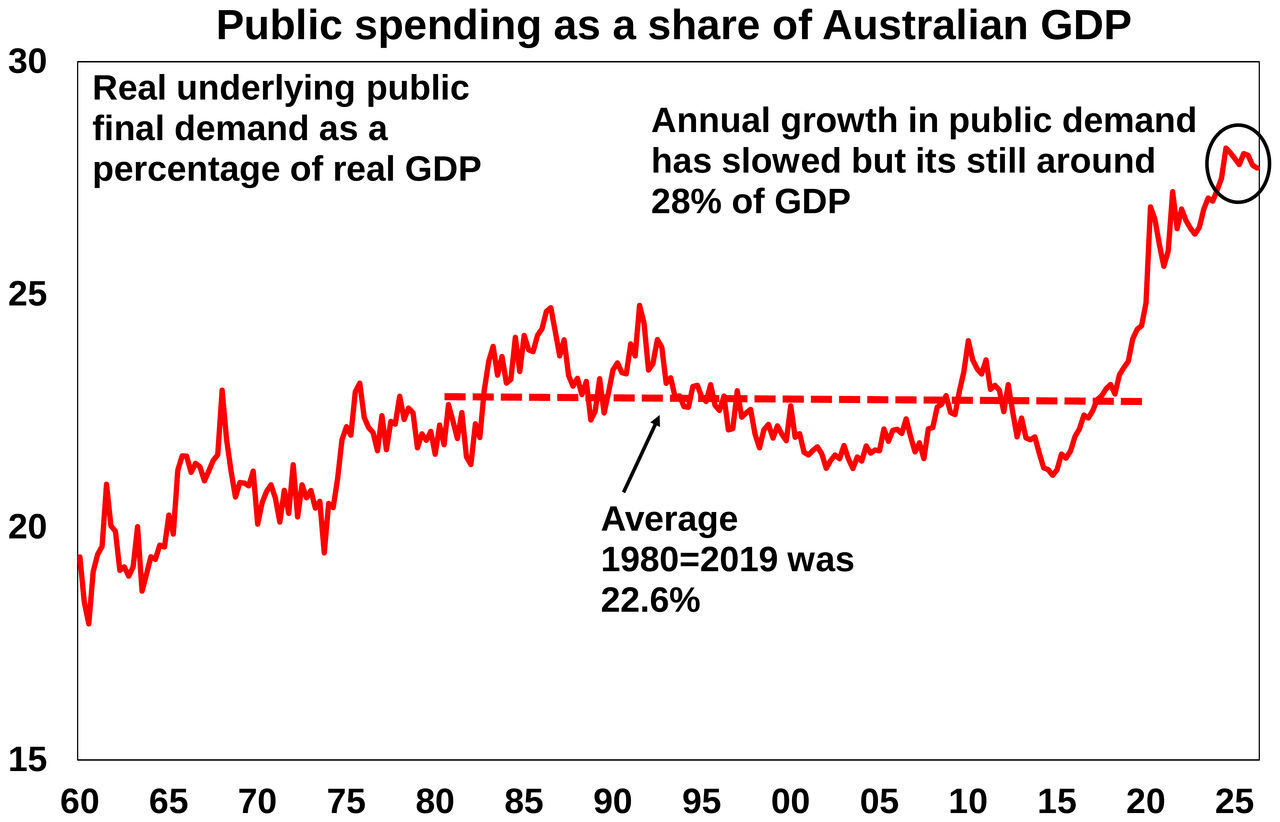
The Treasurer’s comments taking responsibility for the role of fiscal policy in relation to the inflation challenge and his reiteration that the December Budget update will have a “savings package” is welcome. But as in the first eight budgets and budget updates which also had “savings packages” it’s unclear whether net savings will actually be achieved and whether they will significantly reduce public spending. In fact, over the last four years public final demand across all levels of government rose to record levels as a share of GDP and this by contributing to total demand in the economy is a significant part of the inflation problem.
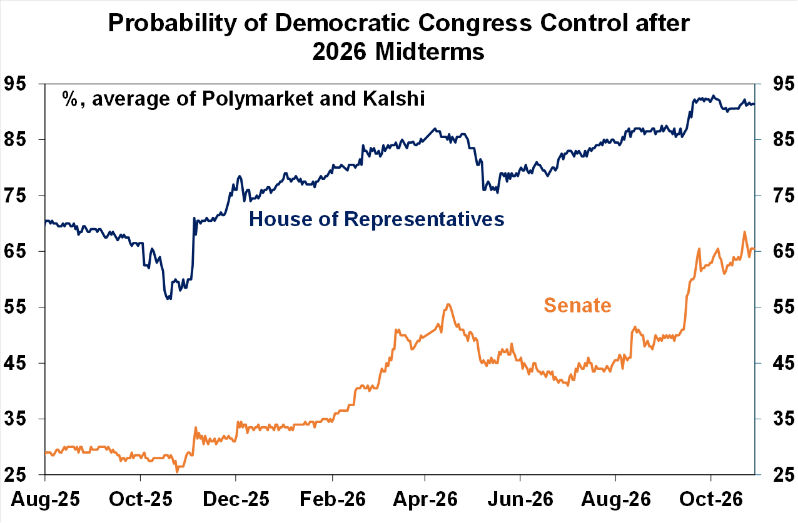
Brace for the US midterm elections (Tuesday). Betting markets now see a more than 80% probability of the Democrats taking control of the House (which would be normal in a midterm election with a GOP president), but also a 65% probability of taking the Senate (which is tougher as the key seats the Democrats need are in red states). The loss of both would be a real blow to Trump. Normally the period after midterm election uncertainty is out of the way sees share markets rally. The risks this time are a bit higher as the removal of a key political constraint and Trump moving into being a lame duck president following a likely loss of control of Congress could see him become more aggressive in foreign policy by in particular recommencing the war on Iran resulting in a further surge in oil prices and returning to the tariff war which this time could see more countries retaliate (like China and Canada have already done). Even more importantly for markets a strong Democrat victory in the midterms will likely shift market focus towards worrying about tax hikes in the run up to the 2028 presidential election.
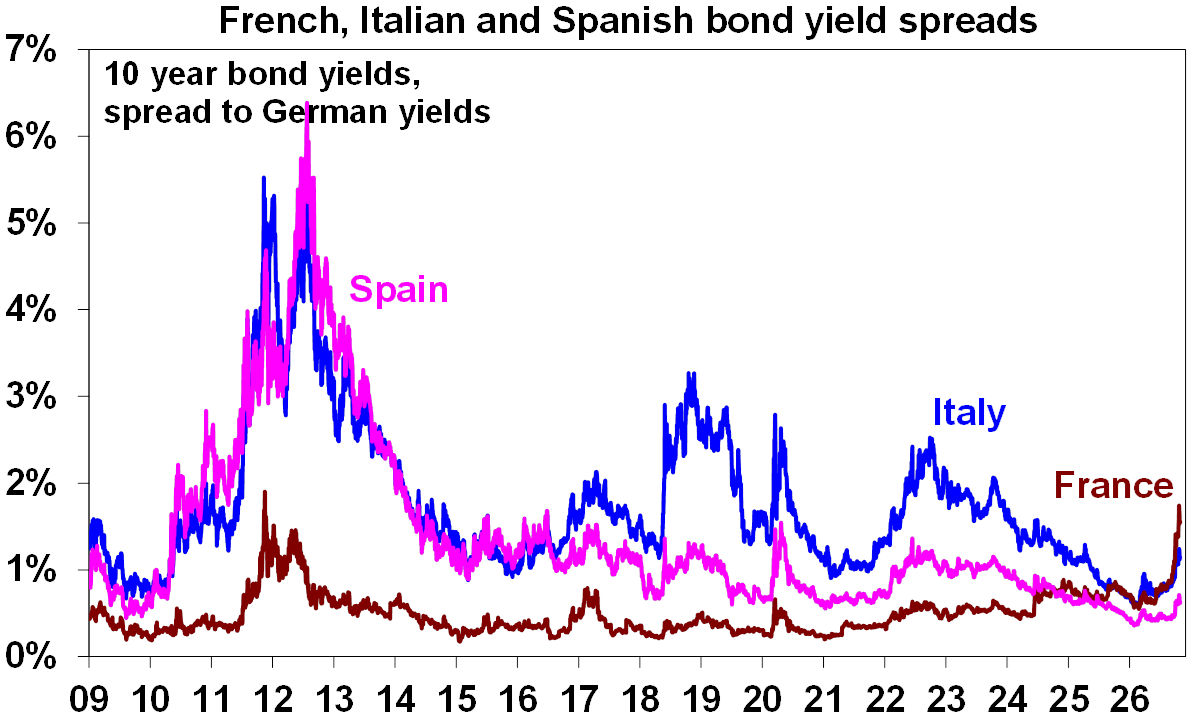
Is the Eurozone headed towards another crisis on the back of French debt? The past week saw French bond yields fall back a touch and bond yield spreads in Italy and Spain are up but far below their Eurozone crisis highs early last decade. A return to the Eurozone crisis – which saw a fear that pressure from high debt levels would prompt countries to leave the Euro resulting in its unravelling and blowing out losses for investors in exiting countries’ bonds - is unlikely as: popular support for the Euro is high including in France where 72% see it as good for France; populist right wing parties have had to become supportive of the Euro to attain power; far right and far left parties have had to govern more as centrists supporting the Euro once they attain power, eg Georgia Meloni in Italy and the same would likely apply to Le Pen in France; and the ECB now has in place a mechanism called the Transmission Protection Instrument that it can deploy to prevent disorderly increases in bond yields in individual countries – basically by buying their bonds. However, while another Eurozone crisis is unlikely France is still at risk given its budget deficit and debt blow out and fears that a victory by the populist National Rally at next year’s presidential election could worsen the situation. This could all mean a further rise in French bond yields relative to German yields necessitating an ECB intervention under the TPI at some point. In the interim markets will worry about it which could weigh on the Euro.
Major global economic events and implications
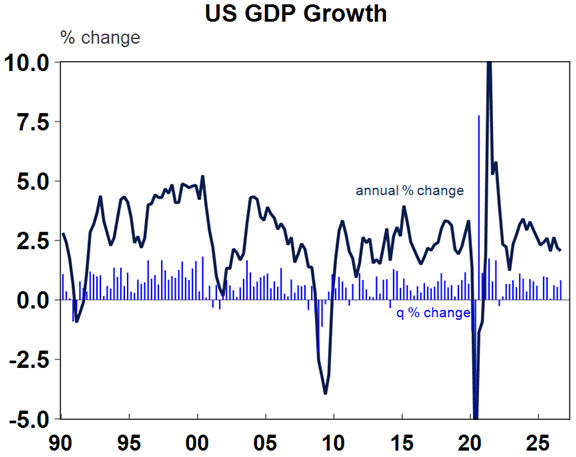
US economic data was a mostly strong. September quarter GDP growth came in at a robust 3.4% annualised pace with strong consumer spending and capex, the trend in personal income and spending is solid, underlying capital goods orders continue to rise, consumer confidence rose, there was a slight improvement in consumer perceptions of the US jobs market and jobless claims remain low.
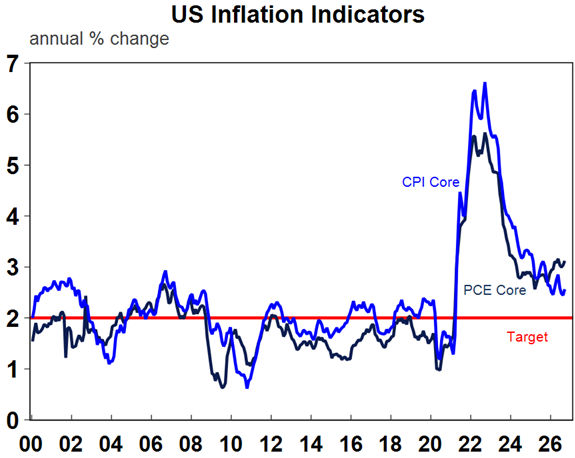
On the US inflation front, core private final consumption inflation rose as expected by a too high 0.3%mom seeing the annual rate rise back to 3.1%yoy which will maintain pressure on the Fed to hike rates again.
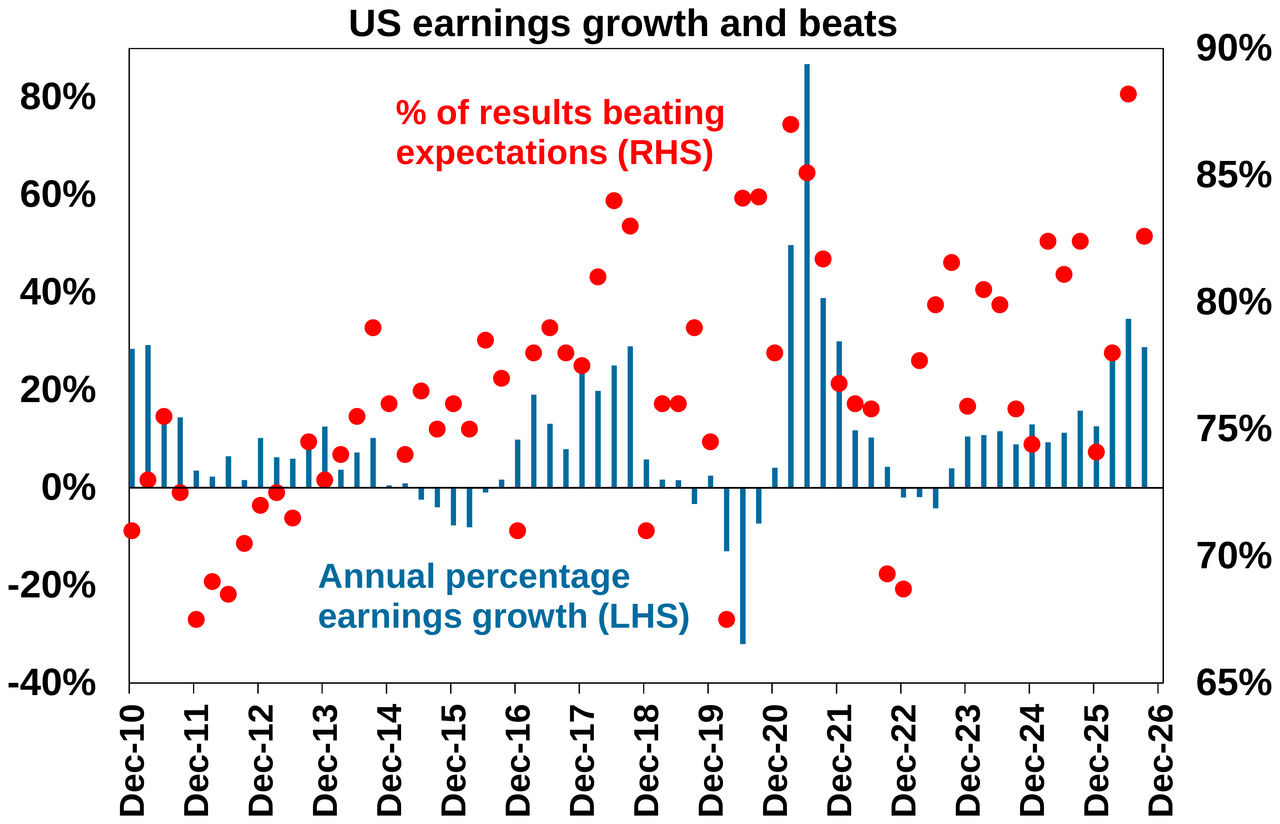
The US September quarter earnings reporting season is now around 60% done with 83% beating expectations and earnings growth now running around 29%yoy and likely to end up over 30%yoy. Earnings growth is concentrated in tech (+47%yoy) and energy (+142%yoy) but the rest of the market is still seeing earnings up a solid 9%yoy.
Japanese data was mixed with stronger than expected growth in industrial production and lower than expected unemployment but softer than expected retail sales.
Australian economic events and implications
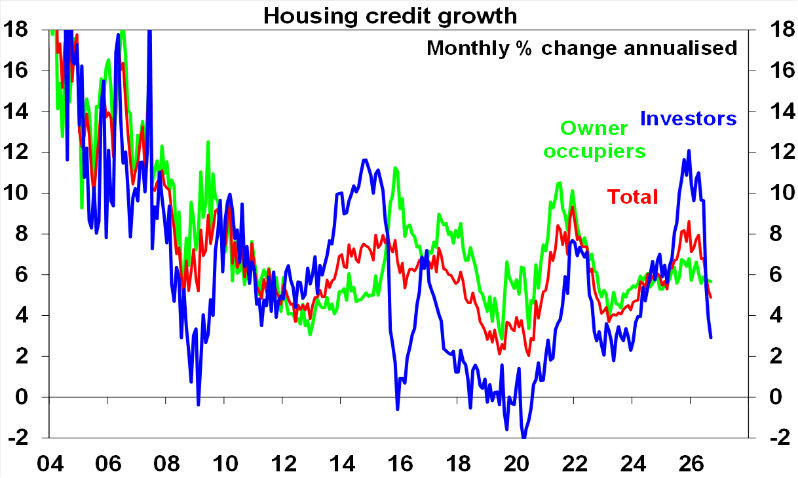
Overall credit growth remained solid in September up 8.4%yoy thanks to ongoing strong lending to business, but there was a further slowing in housing credit to investors reflecting the impact of the tax changes and rate hikes.
What to watch over the next week?
In the US, the focus will be on the mid-term elections (Tuesday) which will likely see the Republican’s lose control of the House and probably the Senate. On the data front, expect the ISM manufacturing and services conditions indexes (Monday and Wednesday respectively) to remain solid, job openings and quits data (Tuesday) to remain consistent with an okay jobs market and October jobs data (Friday) to show a 70,000 gain in payrolls, unchanged unemployment at 4.2% and a fall in wages growth to 2.9%yoy. The US earnings reporting season will continue.
Eurozone inflation data for October is expected to show CPI inflation rising to 3.9%yoy but with core inflation remaining around 2.5%yoy.
The Bank of England (Thursday) is expected to raise its policy rate by 0.25% to 4%.
In Australia, as noted earlier the RBA (Tuesday) is expected to hike for the fifth time this year raising the cash rate by another 0.25% taking it to 4.85%. Its Statement on Monetary Policy is also likely to see upwards revisions to the RBA’s inflation forecasts pushing out the timing of the return to target, but also see weaker for longer economic growth and a slightly higher profile for unemployment. On the data front, expect a 5% bounce in building approvals (Monday) but the trend to remain soft, a 0.5% rise in household spending (Wednesday) with increased spending on fuel and maybe help from the new iPhone, but other discretionary spending down and a rise in the trade surplus (Thursday) to $1.2bn. Cotality home price data for October (Monday) is expected to show a further 1.2% or so fall in property prices with prior months prices revised lower as the combination of rate hikes, tax hikes on investors and poor confidence continue to impact. Sydney, Perth and Brisbane are likely to lead the fall with falls slowing in Melbourne.
Outlook for investment markets
Global and Australian share markets are at risk of a correction given the lack of any resolution to the Iran War and high oil prices, rising bond yields and stretched valuations, sticky inflation and central bank rate hikes, political uncertainty associated with the midterm elections and worries about the impact of AI and whether there is an AI bubble. However, returns should still be okay for a while yet thanks to continuing economic growth with recession likely to be avoided, albeit it’s a rising risk in Australia, and strong global profit growth and likely rate cuts next year.
Bonds are likely to see subdued returns.
Unlisted commercial property returns are likely to be solid helped by strong demand for industrial property associated with data centres. Rising bond yields are a constraint.
Australian home prices are expected to fall around 10-15% top to bottom, of which they have already done 5.2%, out to mid next year as a result of poor affordability, RBA rate hikes, reduced investor demand flowing from the winding back of negative gearing and the capital gains tax discount and poor confidence. Rising distressed sales risk also becoming a drag.
Cash and bank deposits are expected to provide returns around 4-5%.
The $A is likely to rise reflecting the wider interest rate differential to the US, although Fed hikes may limit this. Fair value for the $A is around $US0.72.


You may also like
-

Weekly market update - 23-10-2026 It was another rocky week across markets. For most of 2026, the narrative has been that investors have benefitted from strong earnings and AI investment. But now, rising oil prices, rising bond yields and central bank rate hikes are making the outlook more fragile. -

Baby budgeting: How to financially prepare for a baby Learn how to budget for a baby, prepare for parental leave, estimate childcare costs and build a financial buffer before becoming a parent. -

Weekly Market Update - 16-10-2026 - AMP Weekly Market Update: AI credit fears hit shares, Investors flocking to safe haven (because of CoreWeave?), Oil still high but global growth still resilient, and Weak jobs data gives RBA room to pause.
Important information
Any advice and information is provided by AWM Services Pty Ltd ABN 15 139 353 496, AFSL No. 366121 (AWM Services) and is general in nature. It hasn’t taken your financial or personal circumstances into account. Taxation issues are complex. You should seek professional advice before deciding to act on any information in this article.
It’s important to consider your particular circumstances and read the relevant Product Disclosure Statement, Target Market Determination or Terms and Conditions, available from AMP at amp.com.au, or by calling 131 267, before deciding what’s right for you. The super coaching session is a super health check and is provided by AWM Services and is general advice only. It does not consider your personal circumstances.
You can read our Financial Services Guide online for information about our services, including the fees and other benefits that AMP companies and their representatives may receive in relation to products and services provided to you. You can also ask us for a hardcopy. All information on this website is subject to change without notice. AWM Services is part of the AMP group.