





Oliver's insights
Why free markets drive higher living standards
Free market economies generate higher living standards as prices allocate resources to their best uses; competition and incentive drive innovation; they result in creative destruction; and markets respond to consumer preferences.
4 min read

Key points
Free market economies generate higher living standards as prices allocate resources to their best uses; competition and incentive drive innovation; they result in creative destruction; and markets respond to consumer preferences.
This is evident in countries with higher levels of economic freedom having higher per capita GDP and by comparing East & West Germany in the Cold War, North & South Korea and China under Mao to Taiwan, HK & modern China.
- There is still a role for government in setting basic rules, a social safety net and supplying public goods but stagnant productivity in Australia suggests that the balance has swung too far to government in recent years and needs to be reversed to get living standards rising sustainably again.
Introduction
After the fall of the Berlin Wall and the integration of China into the global economy free market democracies were seen as the way to go for a country to generate the best outcome for its citizens. But there is a cycle in many things – including economic thought - and in the last three decades the thought pendulum has been swinging against free markets in favour of more government intervention. The drivers have been varied but run through the GFC, perceptions of rising inequality, increasingly unaffordable housing, a backlash against high immigration, the rise of social media (where rage against the system generates lots of likes), a decline in politicians willing to communicate that there is “no free lunch” and more recently the view that government should protect us from AI.
There is now much talk of Gen Z socialism. This is a long way from Marxist dialectical materialism and, as one commentator observed, is arguably more about getting free stuff, but its core tenets appear to be little faith in trickle-down economics (where growth benefits even the poor), a focus on redistribution by taking from the richest and scepticism of private business & capitalism. Of course, the backlash against free markets is not just on the left but also evident in the statist policies advocated by right wing populists, for instance President Trump with his focus on industry protection and government involvement in the economy, eg, with a share in Intel.
Following the “success” of government policies protecting us from the pandemic era lockdowns there seems to be a high level of faith in the ability of governments to fix things – eg, with more regulation or more spending. At its core is arguably a dimming of memories regarding the problems with socialism and heavy state involvement in economies. The USSR is now a distant memory as is the malaise of the 1970s and early 1980s that flowed from heavy state intervention in favour at the time. As a result, the benefit of free markets and freedom more generally have been lost in debate about how to divide up the pie.
This is particularly relevant in Australia today. The last few years has seen much debate and anger about the rising cost of living, the resultant slump in real incomes and interest rate hikes to slow demand. At the core of the problem has been stagnant productivity – or output per hour worked – which has slowed the growth in the supply of goods and services relative to the demand for them making the economy more inflation prone.
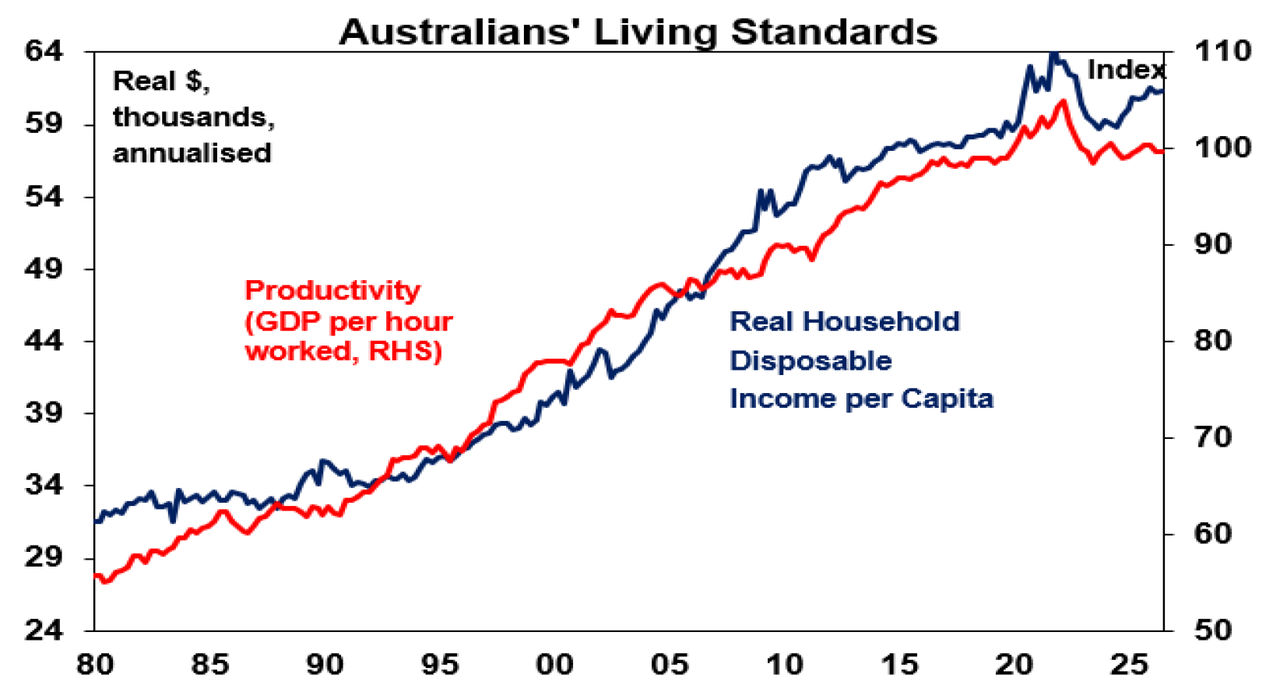
Economists have been warning for years about the slump in productivity growth and that it would mean lower than otherwise living standards with the solutions being economic reforms designed to boost free market forces and incentive in the economy. This is not a right-wing plot on the part of economists to enrich the already wealthy but reflects basic economics and historical evidence. So, here’s a defence of free markets and why they generate more material prosperity than government diktat. Of course there are qualifications, but we’ll talk about them at the end.
Five reasons free markets generate higher wealth
- Prices transmit information and this allocates resources efficiently. When the supply of a product falls, its price rises, consumers buy less and producers boost production or innovate to supply alternatives. The price mechanism signals where resources are most needed, effectively coordinating millions of decisions far better than a government planner can because the planner lacks the information inherent in prices. But when a government intervenes to say cap rents, fuel or grocery prices the outcome will be less supply, a slower adjustment to the shortage and an even worse problem. NY Mayor Mandani’s grocery stores offering a 30% discount are doomed to failure unless backed up by endless subsidies from taxpayers. The end result is likely to be shortages and queues outside stores which was a standard feature of old eastern bloc command economies.
- Competition and incentives drive innovation. Competition does so by forcing businesses to lower costs, improve quality, develop better products, adopt new technologies and respond to consumer preferences. If firms fail to innovate, they lose market share to competitors. State owned or protected firms tend to be less innovative as they are shielded from competition.But incentives also drive innovation. This is because in a free-market workers can earn more by upskilling or being more productive. Businesses earn profits making things people want and doing so better. Entrepreneurs can get rich by meeting unmet needs. Because innovation is rewarded with profit it provides the incentive to start new businesses, invent, invest, or use new products and ways of doing things and to take risks. Many of the new technologies that dramatically drove higher living standards were developed or deployed in free market economies, such as the steam engine, mass production, computers, internet services, health technologies, etc. But in a government directed economy rewards are often less connected to performance, reducing the incentive to innovate.
- Free markets result in “creative destruction”. This process sees new firms and technologies emerge replacing inefficient old ones. Think on-line retailing and David Jones, streaming replacing the video store or the combine harvester that boosted farm sector productivity. This can be disruptive but boosts living standards over time.
- Savings or capital flows to its most productive uses. In a free-market economy investors seek the highest return available, and this pushes savings to towards ventures with the best opportunities, boosting economic growth. By contrast, in heavily government-controlled economies, the allocation of capital is often based on political rather than economic considerations. A bit like the allocation of community grants ahead of elections. This can result in overinvestment in favoured sectors, white elephants and poor returns.
- Markets respond to consumer preferences. By allowing consumers to decide what they want to buy, where to live and how to allocate their income and businesses to respond to that, consumer satisfaction is higher in contrast to state directed economies, where governments often decide what consumers want and sets targets.
So, by: incentivising investment, innovation, gaining a better education and better management; allocating scarce resources more efficiently to productive uses; and respecting what consumers want, free markets drive higher productivity and hence stronger growth in real wages and incomes.
By contrast, heavy government involvement in an economy invariably leads to underperformance as it leads to a misallocation of resources, slow decision making via bureaucracy, weak incentives to innovate and take risks, reduced competition, more resources spent obtaining government favours rather than creating value, similarly more resources complying with regulation and costly subsidies.
But where’s the evidence that free markets work better
There is plenty of evidence that free market economies deliver higher living standards. The next chart shows a clear rising relationship between the degree of economic freedom and GDP per person across countries.
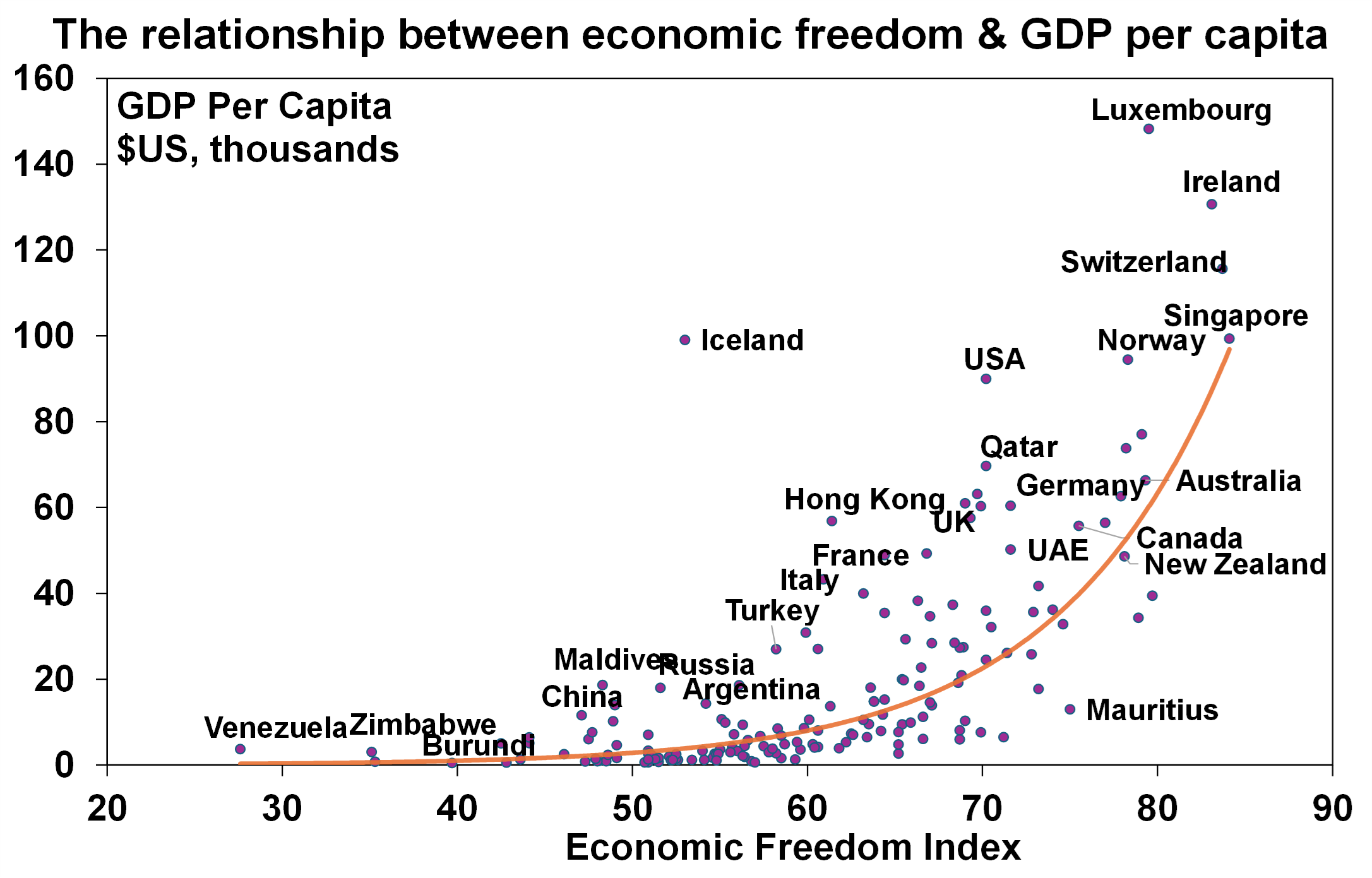
Key aspects of this are competitive markets, an unfettered price mechanism and free trade along with property rights, the rule of law and strong institutions. With higher per capita GDP tends to come longer life expectancy and less extreme poverty.
- East and West Germany in the Cold War with the West becoming far richer – just think of Trabants v BMWs, Mercedes & VWs. Prior to the collapse of the Berlin Wall per capita GDP in market dominated West German was roughly double that in state controlled East Germany.
- North and South Korea – GDP per capita in market oriented South Korea is 30-50 times greater than that in the state-controlled North.
- China pre 1978 compared to Taiwan and Hong Kong – similarly market oriented Taiwan and Hong Kong far outperformed China with its command economy in the Mao era.
- China pre and post 1978 – Deng Xiaoping’s market reforms from 1978 saw Chinese economic growth and living standards rise almost exponentially as state ownership and central planning was replaced with private ownership, competition and market pricing.
However, free markets are not perfect
Of course, unfettered markets can fail in many ways:
- They fail to account for “externalities” like the cost of pollution.
- They can fail to optimally provide public goods – like roads and other infrastructure like safe water & sewage, defence, basic research, legal systems and standard setting and arguably education and vaccines.
- They can result in monopolies which can result in worse outcomes for consumers.
- They can result in financial instability particularly given the role investor psychology plays in exacerbating swings in investment markets, and this can lead to economic slumps like the GFC.
- They can lead to high levels of income inequality and unfair advantage, eg, in access to education and information.
For this reason there is a role for government in market economies to: protect the environment; provide a legal system that enforces property rights and the rule of law, etc; provide defence, security and police; support basic research; provide infrastructure and essential public goods – like clean water, good roads and universal education; regulate monopolies and ensure fair competition; minimise financial stability risks by limiting excessive regulation; use fiscal and monetary policy to try and maintain economic stability; and provide a social safety net to guard against extreme poverty and inequality.
The key is to get the balance right
So, it’s not simply a matter of completely free markets versus government control and planning of everything, but getting the balance right. The best outcomes appear to arise where governments provide the basic rules of interaction, essential public goods and a social safety net, but free markets determine most production, investment and consumption decisions.
In Australia, the balance has likely swung too far in terms of government involvement in last 20 years: with increasing labour and product market regulation hamstringing businesses; an increasing and inefficient tax burden dampening incentive; increasing government direction of resources hampering creative destruction; rising levels of middle-class welfare going well beyond a social safety net; and public spending taking up a record share of economic activity. These are the things that need to be reversed to help get productivity and living standards back on track.
Dr Shane Oliver
Head of Investment Strategy and Chief Economist, AMP


Something went wrong. Please try again.
Thanks for subscribing.
We'll keep you up to date with the latest news, insights and information from AMP. Check your inbox for future updates.
You may also like
-

Weekly Market Update - 13-11-2026 There is a danger in exaggerating the economic impact of the outage – as many of the affected activities will be made up for later and some may claim they got more work done due to the absence of email distractions. However, the global cost is still likely to run into many billions of dollars as email is central to economic activity these days. -

Oliver's Insights - US Midterm Elections The implications for investors of the blue wave in the US midterm elections -

Weekly market update - 06-10-2026 US shares fell sharply over the last week as the Democrat wins in the midterm elections renewed fears about tighter regulation of AI adding to worries about an AI bubble and leading to a sharp rout in AI related tech shares leaving the US share market on track for 2.7% fall. This also dragged Japanese and other Asian share markets down sharply. Eurozone shares managed a small rise though. Australian shares also rose managing a gain of around 0.8% helped by its relatively low exposure to AI related shares and less hawkishness from the RBA after its latest rate hike. While energy shares fell on the back of lower oil prices this was offset on the ASX 200 by gains in tech, consumer and property shares.
Important information
Any advice and information is provided by AWM Services Pty Ltd ABN 15 139 353 496, AFSL No. 366121 (AWM Services) and is general in nature. It hasn’t taken your financial or personal circumstances into account. Taxation issues are complex. You should seek professional advice before deciding to act on any information in this article.
It’s important to consider your particular circumstances and read the relevant Product Disclosure Statement, Target Market Determination or Terms and Conditions, available from AMP at amp.com.au, or by calling 131 267, before deciding what’s right for you. The super coaching session is a super health check and is provided by AWM Services and is general advice only. It does not consider your personal circumstances.
You can read our Financial Services Guide online for information about our services, including the fees and other benefits that AMP companies and their representatives may receive in relation to products and services provided to you. You can also ask us for a hardcopy. All information on this website is subject to change without notice. AWM Services is part of the AMP group.