





Oliver's insights
The implications for investors of the blue wave in the US midterm elections
Democrat wins in the US midterms signal: Trumpism has peaked; Congress will now be a check on him; more regulation on AI; a return to debt ceiling brinkmanship; the risk Trump refocuses on foreign policy including the War and tariffs; and fears of tax hikes and bigger government.
9 min read

Key points
Democrat wins in the US midterms signal: Trumpism has peaked; Congress will now be a check on him; more regulation on AI; a return to debt ceiling brinkmanship; the risk Trump refocuses on foreign policy including the War and tariffs; and fears of tax hikes and bigger government.
The blue wave is probably negative for bonds, ambiguous for shares with correction risk remaining but the 6-12-mth outlook looking okay and a small negative for crypto.
- For Australia, a risk is a renewed Trump focus on disruptive foreign policy in the near term (tariffs and/or War) but this should recede as Trump’s power wanes.
- Lower oil prices reduce the chance of another rate hike, but our view remains for RBA to be on hold out to late next yr.
Introduction
The US midterms saw a resounding rebuke of President Trump’s policies, with Democrats taking control of the House and the Senate, with big wins and various governorships in Republican states. Naturally Trump has tried to deflect - arguing if “I was on [the ballot] we would have won in a landslide”. Ironically, he’signoring the fact that he had asked people to assume he was on the ballot. Maybe they did! But, as always “it’s the economy, stupid”. Trump won in 2024 because “cost of living” pressures turned people against the Democrats, but his crazy tariff and War policies made them even worse causing those who swung to him then to swing back to the Democrats. This wasn’t helped by the ICE raids, the Epstein files, attacks on democracy, perceptions of graft & corruption & Trump’s crazy focus on things like his ballroom, triumphal arch and gold trinkets in the Oval Office.
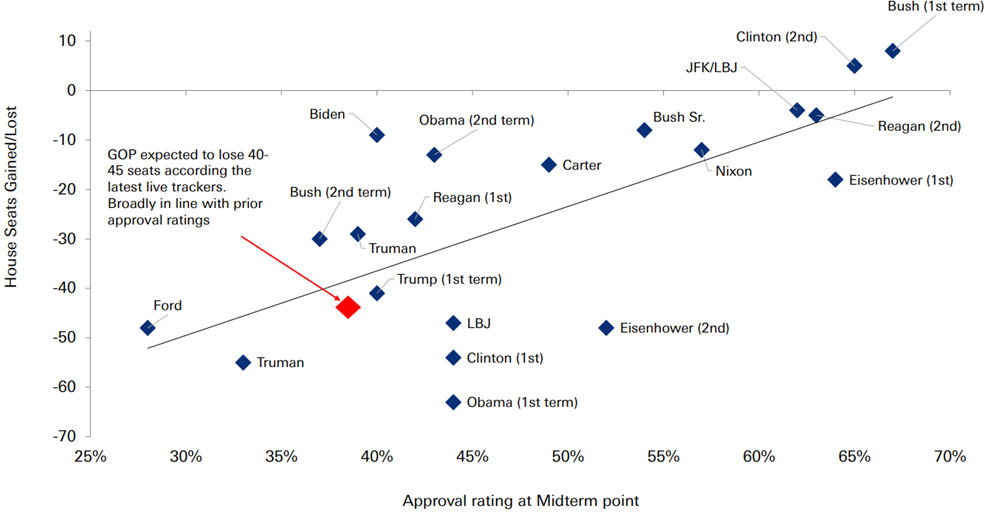
There is a danger in reading too much into it as presidents often lose Congress in midterms. Clinton & Obama lost more seats in their first term midterms & went on to win second terms (not that Trump can run again).
Presidential approval rate versus House seats lost in Midterms
Implications for US economic policy
However, the blue wave does have significant implications particularly given Trump’s sensitive character. In particular:
- Trumpism has probably peaked, having been rejected even in several red states. People like Majorie Taylor Green just recognised the problem early. That said Trump is still President for two more years so there is still plenty of opportunities for him to create mayhem.
- However, Congress will now be a check on Trump and in particular there are now likely to be significant inquiries into his and the Administration’s actions including a possible attempt at impeachment of Trump or at least his team. Democrat control of the Senate also means Fed independence will be protected. At a high level this once again highlights that US governance and democracy remains strong – a slide into strong man dictatorship is not going to happen as US voters won’t permit it. Some surveys showed democracy as just as important an issue for voters as the economy.
- More regulation of AI – particularly on data centres in states where Democrats won the governorship (Texas, Ohio, Iowa and Georgia). There is danger in exaggerating this though. Trump can veto regulations from Congress, but the states may matter more. That said there are still plenty of states that may welcome data centres.
- A return to brinkmanship over raising the debt ceiling (necessary by around June quarter next year and funding the US Government (which currently expires on 11th December) – in some ways this may be a good thing if it leads to a smaller budget deficit. However, hopes for lower budget deficits may prove in vain as Trump may agree with Democrats to increase some social benefits if they support more defence spending, and he is likely to veto tax hikes
- Trump moving into being a lame (or angrier) duck President could see him become more aggressive in foreign policy by, eg, ramping up the war on Iran and returning to the tariff war. So far markets seem relaxed, with oil prices down on hopes Congress will bring an end to the War, VP Vance & other Republicans blaming the War for the election loss and reports that the US and Iran may be edging closer to a deal again. And both tariffs and the War are self-evidently not popular so Republicans may cut him adrift if he pushes heavily down this path again. That said he could still have a go just to prove who’s in charge – so another spike in tariffs and/or oil prices remains a high risk. His replacement of Susie Wiles with hardliner Stephen Miller suggests Trump may not be about to moderate his policies.
- Fears that tax hikes and bigger government are on the way particularly if a Democrat wins the 2028 presidential election. However, the risks on this front are overstated. Sure, the numbers of DSA (Democrat Socialists) in Congress will increase but most of the wins owed to moderate centre left Democrats particularly in must win (for 2028) red states, suggesting the US has not lurched to Bernie Sanders/AOC style democratic socialism. The failure of the 5% billionaire wealth tax proposal in California also supports this view although not strongly as one reason for opposing it was that it wasn’t national (so risked a loss of billionaires out of California).
Implications for major asset classes
Oil – ambiguous near term/negative over the medium term
Sure, oil prices have fallen since the midterms on hopes Trump has got the message that the War is unpopular, hopes a Democrat Congress will end it and hopes talks will lead to a deal. But the talks have been going in circles since April, & he may ramp the War up again to show whose boss – driving one last spike in oil prices. However, on a medium term view the US is likely to wind down the War under pressure from Congress and many Republicans who are likely to be far less supportive of Trump now.
Bonds – negative
Again, bond yields have fallen since the midterms on the fall in oil prices and hope political gridlock will lead to a lower budget deficit. However, there is a high risk Trump will have one last go in the Iran War which could push oil prices up. And Trump may agree with Democrats to increase some social benefits if they support more defence spending and he is likely to veto tax hikes – which could worsen the deficit.
Shares – ambiguous
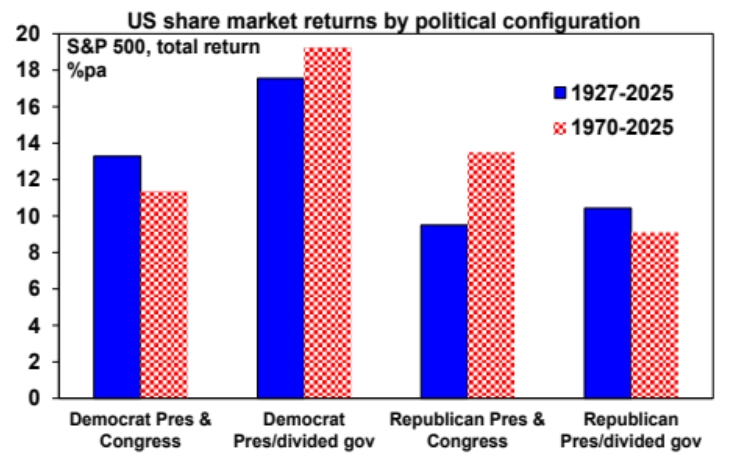
The bad news is that the combination of a Republican president and Democrat control of one or both houses of Congress has been the worst outcome for US share returns on average since 1970, with an average return of 9.1%pa compared to 13.5%pa when there is a Republican president and congress. Of course, 9.1% is still okay!
The good news is that US shares have risen following all midterm elections since 1950 given the removal of a source of uncertainty.
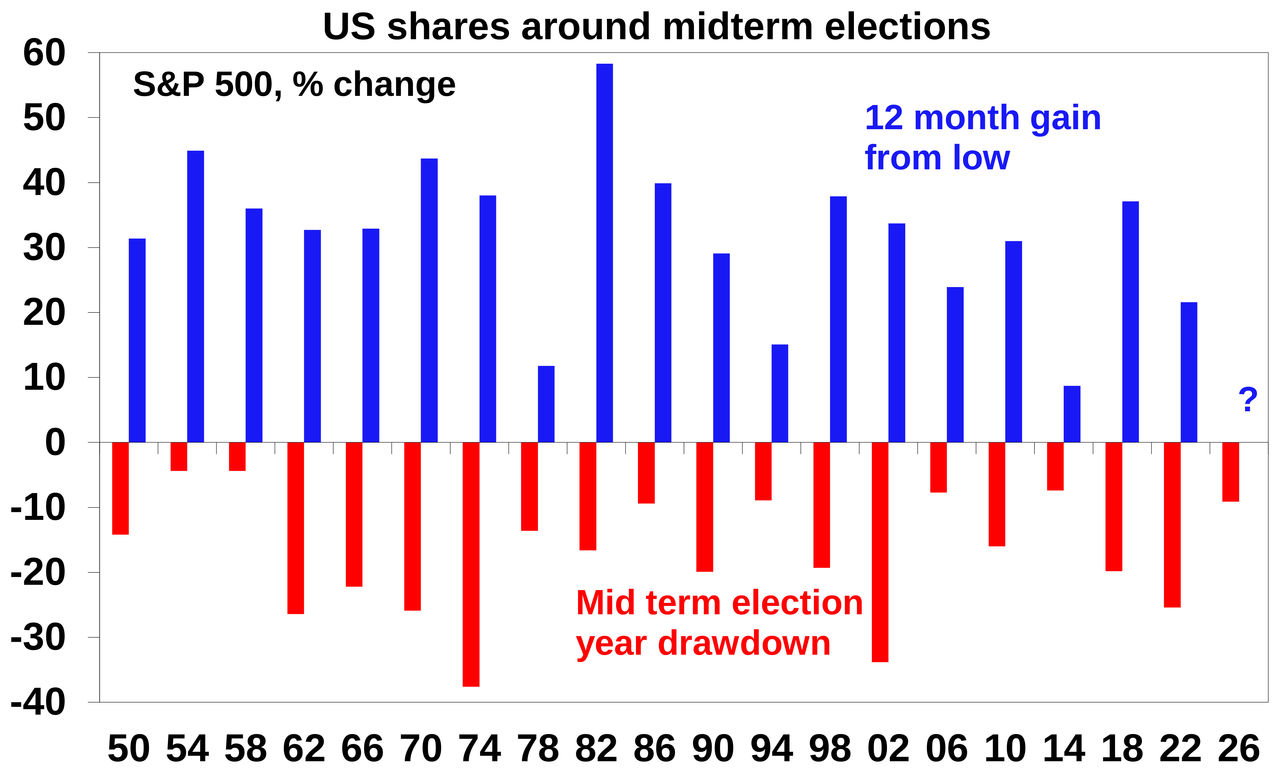
However, there may be more uncertainty this time around given the risk for the AI trade and its high weight in the US share market and recent US economic growth along with Trump’s unpredictability and the risk he could go rogue for a while now that the election is out of the way.
So far, the US share market has had a roller coaster reaction to the midterms – up 1.6% initially on the back of lower oil prices then down 4.4% on Thursday. And share investors are a bit schizophrenic around data centres – yes, they sold off heavily on Thursday on fears that Democrat wins will constrain them but earlier they had been selling off on fears that hyperscaler AI capex was excessive and uneconomic. So, if it’s the latter then constraints on data centre buildouts may do investors a favour! In any case while more regulations may be put around data centres its unlikely to fundamentally stop their build out. Since Thursday there has been a recovery in US shares leaving them around where they were before the midterms!
Overall, the risk of a further correction in sharesremains high given the threats from high and sticky inflation, ongoing central bank rate hikes, excessive public debt driving rising bond yields, the risk of one last spike in oil prices, AI bubble and data centre worries, and slowing growth and rising rates in Australia. And despite some fall in price to earnings ratios and more recently a pullback in bond yields both US and Australian shares remain expensive relative to bonds as measured by the gap between forward earnings yields and bond yields which is a proxy for the risk premium shares offer over bonds. Of course, the risk premium has been low for years now so it’s not a great timing guide for shares.
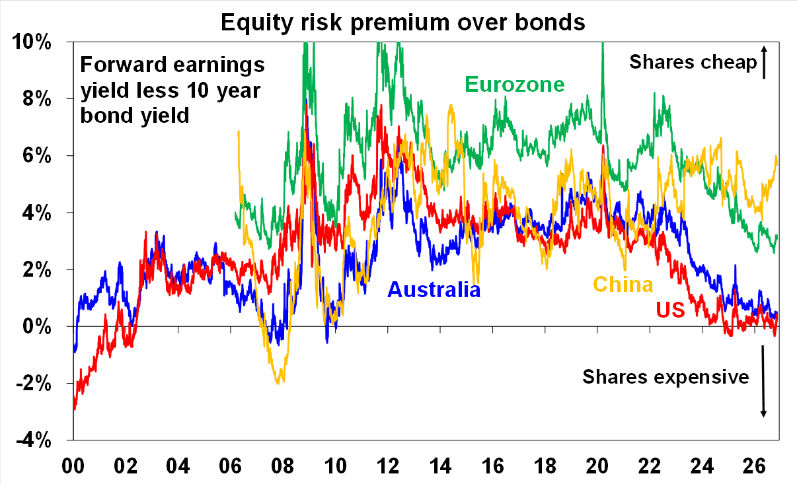
However, at this stage strong US earnings growth (even outside tech) and no indications of a US recession suggest that any pull back in shares is more likely to be a correction rather than a new bear market. So, we continue to see shares providing okay returns on a 6-12 month horizon.
Cryptocurrencies – negative
With Democrats likely to look closely at the Trump family’s links to the sector the tide may be turning back towards tougher crypto regulation. Bitcoin will likely retain support though as an inflation hedge.
Gold and the $A – ambiguous
Much here will depend on oil and how much further the Fed has to hike but the midterms are unlikely to have a decisive impact here.
Implications for Australia
While the fall in oil prices may mean less pressure on the RBA for another hike, it’s uncertain as to whether this will stick in the short term and we see no reason to alter our assessment that the RBA will leave rates on hold out to late next year.
At a broader level, a risk for Australia is a renewed Trump focus on disruptive foreign policy in the near term (tariffs and/or the Iran War) but this should recede as Trump’s power wanes over the next two years.
Dr Shane Oliver
Head of Investment Strategy and Chief Economist, AMP


Something went wrong. Please try again.
Thanks for subscribing.
We'll keep you up to date with the latest news, insights and information from AMP. Check your inbox for future updates.
You may also like
-

Weekly market update - 06-10-2026 US shares fell sharply over the last week as the Democrat wins in the midterm elections renewed fears about tighter regulation of AI adding to worries about an AI bubble and leading to a sharp rout in AI related tech shares leaving the US share market on track for 2.7% fall. This also dragged Japanese and other Asian share markets down sharply. Eurozone shares managed a small rise though. Australian shares also rose managing a gain of around 0.8% helped by its relatively low exposure to AI related shares and less hawkishness from the RBA after its latest rate hike. While energy shares fell on the back of lower oil prices this was offset on the ASX 200 by gains in tech, consumer and property shares. -

Are higher interest rates working in Australia Higher interest rates are impacting Australian households, spending, housing, investment and the broader economy as the RBA works to bring inflation under control. This Econosights report explores how interest rate rises flow through the Australian economy, including the impact on mortgage repayments, consumer spending, household savings, asset prices, business investment, unemployment and the Australian dollar, and considers whether monetary policy is working as intended to ease inflation. -

Oliver's insights - House Price Slump Australian home prices continue to slide and look likely to see a 15% fall. The home price slump will weigh on economic growth via negative wealth effects, but it’s not significant enough yet for the RBA to shift gears toward cutting rates given high inflation is the more pressing problem. But it likely will be by the second half next year.
Important information
Any advice and information is provided by AWM Services Pty Ltd ABN 15 139 353 496, AFSL No. 366121 (AWM Services) and is general in nature. It hasn’t taken your financial or personal circumstances into account. Taxation issues are complex. You should seek professional advice before deciding to act on any information in this article.
It’s important to consider your particular circumstances and read the relevant Product Disclosure Statement, Target Market Determination or Terms and Conditions, available from AMP at amp.com.au, or by calling 131 267, before deciding what’s right for you. The super coaching session is a super health check and is provided by AWM Services and is general advice only. It does not consider your personal circumstances.
You can read our Financial Services Guide online for information about our services, including the fees and other benefits that AMP companies and their representatives may receive in relation to products and services provided to you. You can also ask us for a hardcopy. All information on this website is subject to change without notice. AWM Services is part of the AMP group.