





Weekly market update
Investment markets and key developments
Weekly economic and market update - share correction likely has more to go, AI worries despite good Nvidia earnings & Anthropic IPO, high recession risk in Aust but Sahm is a furphy, RBA may be slow to cut, why the Fed Gov should still cut spending.
12 min read

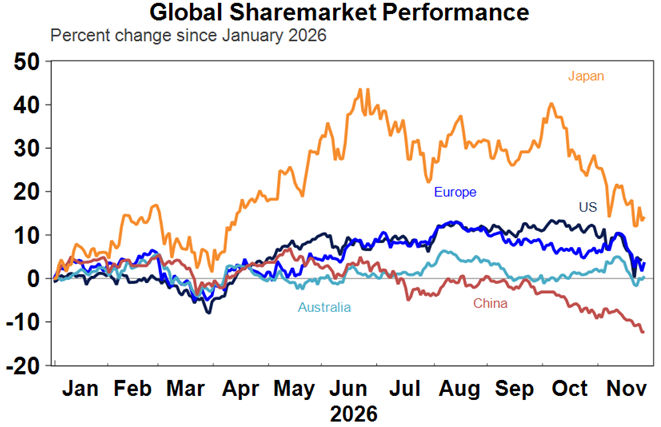
Shares rebounced over the last week after Jensen Huang was reinstated as Nvidia’s CEO. US shares are up about 3.9% for the week reversing part of their 11.6% plunge from the October high. Japanese and Eurozone shares also rose, but Chinese shares fell slightly. The highly computer chip exposed Korean share market was little changed not helped by another rate hike by the Bank of Korea and is down nearly 50% from its June high. Reflecting the global lead Australian shares also rebounded by around 2.7%, but just as they didn’t go down as much as US shares they haven’t gone up as much reflecting their relative low exposure to AI related shares and another hot Australian inflation report didn’t help either. The gains on the ASX were led by resources, health, IT and industrial shares.
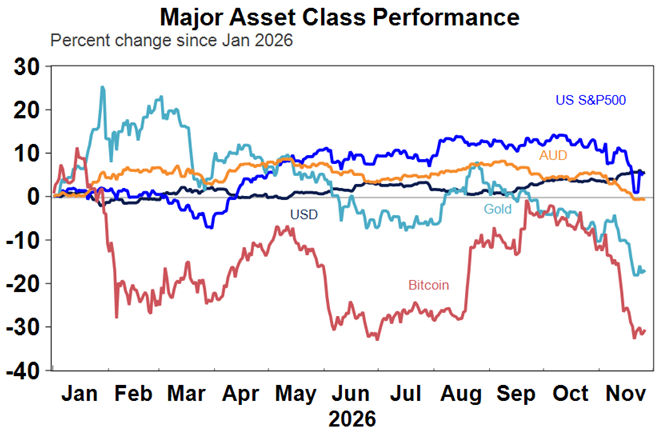
Consistent with the bounce in shares, gold, Bitcoin, iron ore prices and the $A rose slightly over the last week, but copper prices slipped a bit. The overall impression is a week of stabilisation after sharp falls, but nothing to get too excited about just yet.
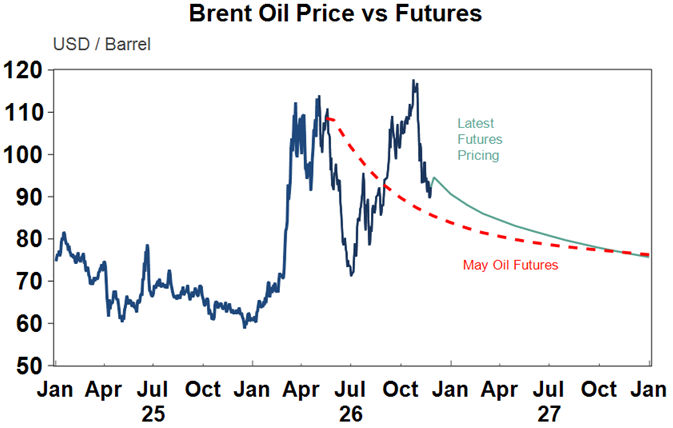
Oil prices rose slightly as tensions with Iran and around the Strait of Hormuz remain high.
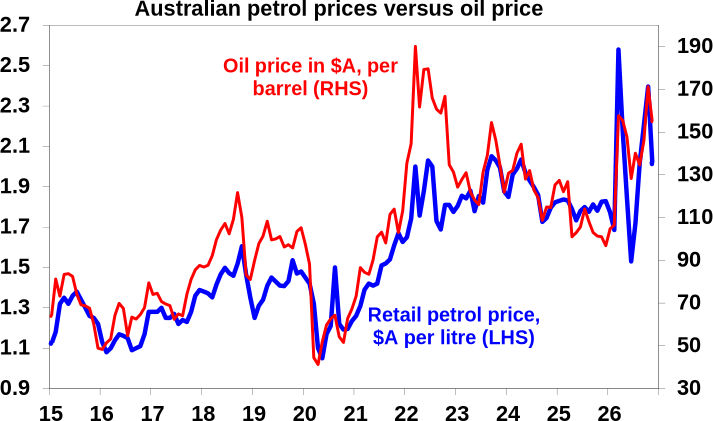
Reflecting the slump in oil prices from their levels last month Australian petrol prices have fallen back to around $2 a litre which is good news but looks like a bit of another overshoot relative to the fall in the oil price so unless oil prices keep falling petrol prices are at risk of some rebound.
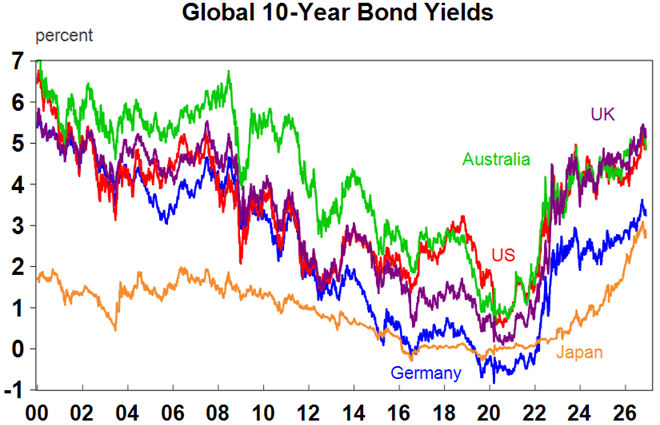
Bond yields fell slightly further over the week. Unfortunately, barring a recession the longer-term risks are still to the upside given sticky inflation, the oil shock, central bank rate hikes, high public debt and data centre borrowing, and a rising trend in Japanese bond yields.
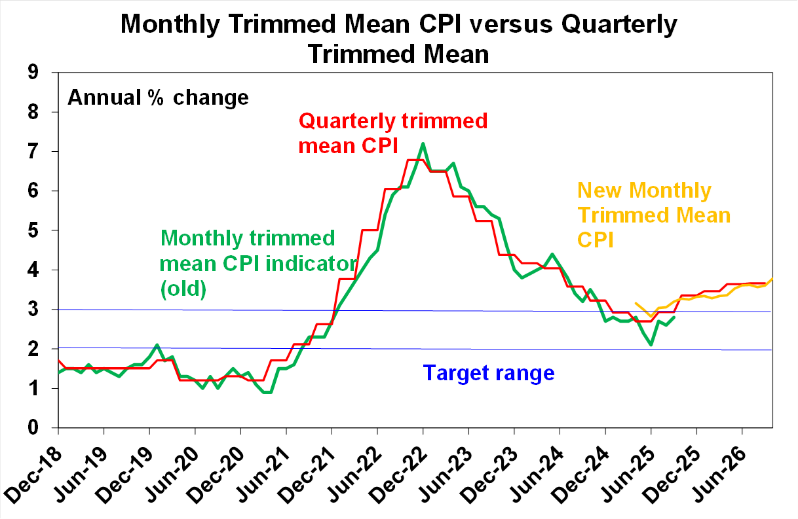
In Australia, the bad news on the economy continued with more hot inflation data and overall business conditions falling further in November providing another warning of recession. Sure, capex data is booming on the back of AI data centre building and should keep growth positive for now but it’s worth noting that much of that is being imported. Meanwhile, CPI inflation rose to a higher than expected 4.9%yoy in October, it’s worst since 2023 thanks to another sharp rise in fuel prices. The good news is that with fuel prices falling this month its likely to be reversed. But the problem is that underlying inflation which strips out volatile items like fuel also rose further to 3.8%yoy with solid increases in a whole bunch of items – like clothing, new dwelling costs, furniture, appliances, hairdressing, car parts & repair, computers, pet services and domestic travel – indicating that inflation pressures remain far broader than the impact of global fuel prices. As the October increase was much higher than expected we have revised up our forecast for trimmed mean inflation this quarter to 1%qoq or 3.7%yoy, which is above the RBA’s forecast for 3.6%yoy.
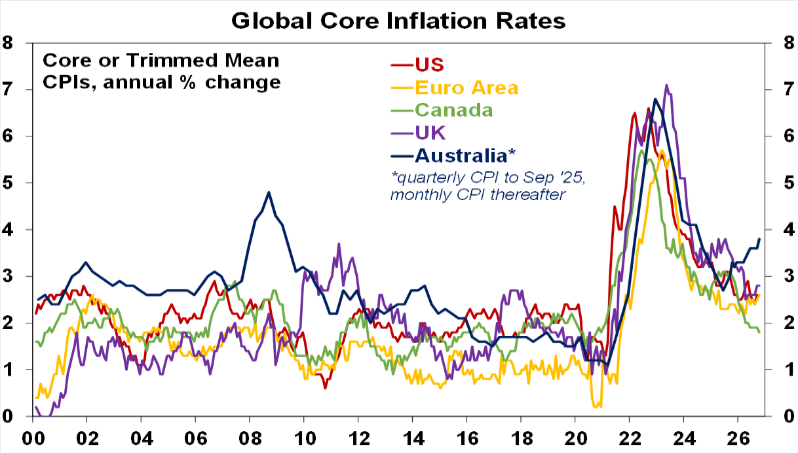
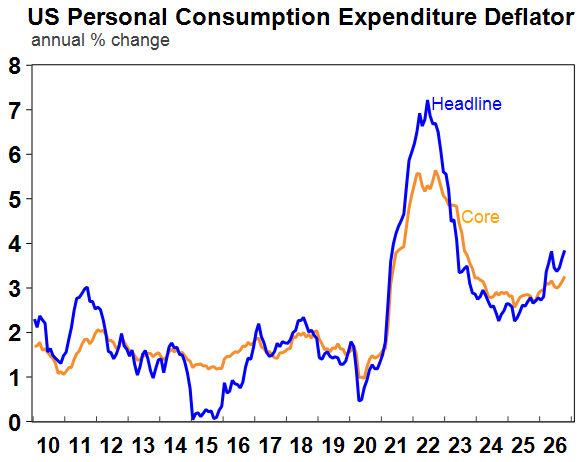
Also indicating that the surge in inflation is far more than just due to higher fuel prices is that core or underlying inflation at 3.8%yoy is well above that in comparable countries. In the US its 2.6% for the CPI or 3.3% for the core consumption deflator and its 1.8-1.9% in Canada, 2.6% in the Eurozone, 2.8% in the UK and 2.7% in NZ.
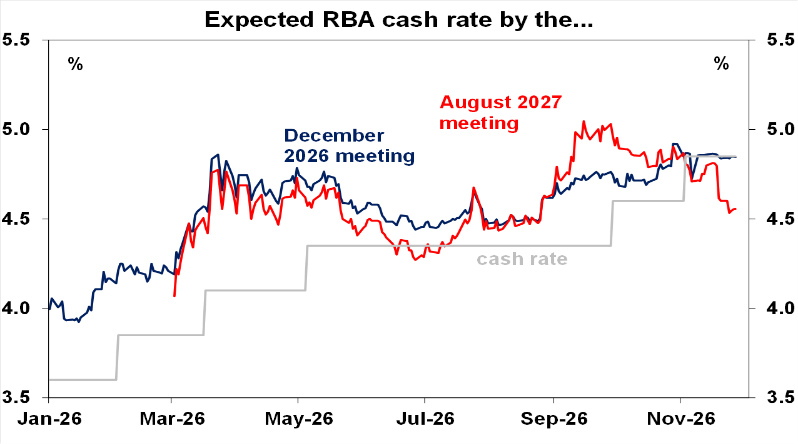
The hot inflation report would normally have meant another rate hike, but its offset by overwhelming evidence that the economy and jobs market are cooling. So, while another rate hike can’t be ruled out, we continue to think that the RBA has done enough and that rates have peaked ahead of rate cut later next year. History tells us that the slowing in demand in the economy will cool inflation with a lag. So, after five hikes this year the RBA is likely to leave rates on hold next month and this is likely to remain the case into next year as economic data likely continues to weaken. However, the hot October report, RBA worries about the credibility of its commitment to the inflation target along with wariness about a re-run of its 2025 experience where it arguably cut prematurely will likely mean that it will remain hawkish warning of possibly having to hike again for a while yet and that it will be cautious in moving towards rate cuts. So, in the absence of a financial crisis or recession our view is that rate cuts are unlikely to start until second half next year – probably in August.
A worse economy, but bigger budget deficits as “Things might get a bit harder before they get easier”. This was the basic message from Treasurer Chalmers ahead of the mid year budget update (MYEFO) due next month. Reflecting the tough conditions the Treasurer foreshadowed downwards revisions to forecasts for growth to well below 2%, unemployment to rise above 5% and inflation to stay above 3% out to mid next year before coming back to target. Of course, none of this is particularly surprising. The focus though will be on fiscal policy with the Treasurer indicating a slightly lower budget deficit near term thanks to higher revenue but bigger deficits ahead partly due to higher bond yields and unemployment with higher spending to GDP and tax to GDP ratios. The latter could mean a record tax to GDP ratio as at 24.1% in 2026-27 we were already close to the first mining boom record of 24.2%. This highlights a basic problem in the Government’s budget strategy – revenue has boomed to around record levels as a share of GDP largely thanks to higher than expected commodity prices boosting corporate taxes and bracket creep. Ideally this windfall should have been saved with big budget surpluses paying down public debt. This would have put money aside for a rainy day and helped put downwards pressure on inflation. But instead, the bulk of the windfall was spent – with real Federal spending rising 2.9%, 5.5% and 4.3% in each of the last three financial years - pushing spending up to a 40 year high (outside the emergency pandemic era spending) of 26.9% of GDP and locking it in well above pre-pandemic norms. The result has been a return to deficits and all the extra spending contributing to inflation as it added to demand in the economy and sucked resources away from the more productive private sector. This has left the Government under increasing pressure to cut spending. The Government claims that the last budget update and budget announced net savings which is true – but that saving doesn’t kick in for another two years (and may never occur). The Treasurer has indicated MYEFO will deliver “modest net saving”…but to get inflation down it needs to impact from now – not two years away!
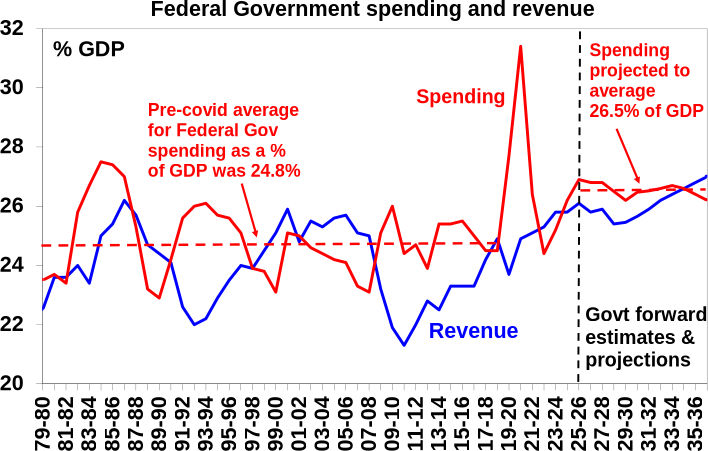
Of course, given the rising risk of recession, now is not the best time for the Government to cut spending. However, our view remains that the Government should still announce immediate and permanent net cuts to spending (and not just delay it to future years). This is necessary to to: start returning Federal spending to more normal levels as a share of the economy to help boost productivity; to allow more room for private sector spending without generating inflation; and to allow the RBA to cut rates earlier than might otherwise be the case.
Shares could bounce further. After the route last week shares were oversold and fear as measured by the VIX index had surged to levels often associated with a bounce which we have seen in the last week following Trump’s intervention in Nvidia which led to the reinstatement of Jensen Huang as CEO. It’s quite possible that the rebound could go further as the return of Huang to Nvidia as removed one area of uncertainty in a key AI player, there is still no sign of any downturn in the key US economy, US profit growth is still very strong and we are now coming into a seasonally stronger period of the year for shares.
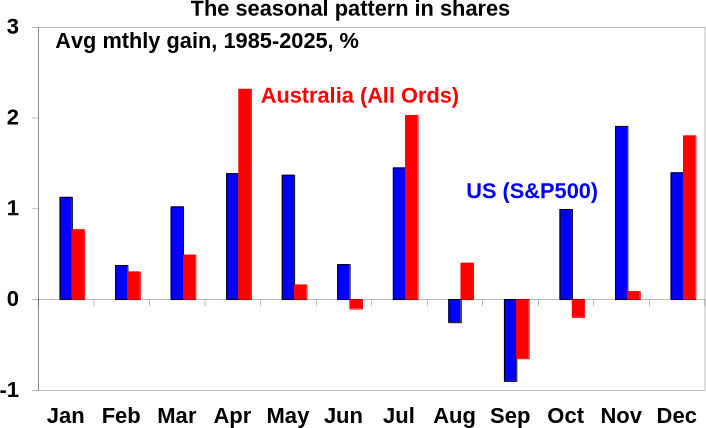
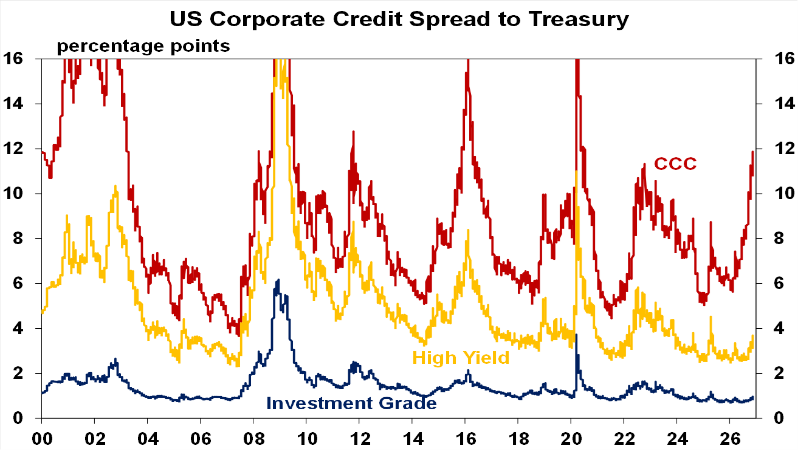
However, the risk of a deeper correction at some point in the next six months remains high as: so far the rebound lacks the strength that we normally see coming out of major market bottoms; other growth assets like copper, Bitcoin and gold remain weak and credit spreads have not narrowed (see the next chart); the worries around AI enthusiasm having gone too far remain; Huang and Nvidia will now face numerous investigations and tougher US chip export controls; the Fed looks on track for several rate hikes given ongoing hot US inflation; geopolitical threats remain high including around a resumption of the Iran War pushing oil prices higher again; the rise in bond yields could resume particularly given concerns about high public debt in the US and France; and in Australia even hotter than expected inflation for October will constrain the RBA’s ability to respond as growth slows possibly tipping the economy into recession.
In this regard, it’s worth noting that Nvidia’s share prices is still below where it was before Jensen Huang left and is still down 38% from its high last month. And Anthropic has given up all its gains since listing.
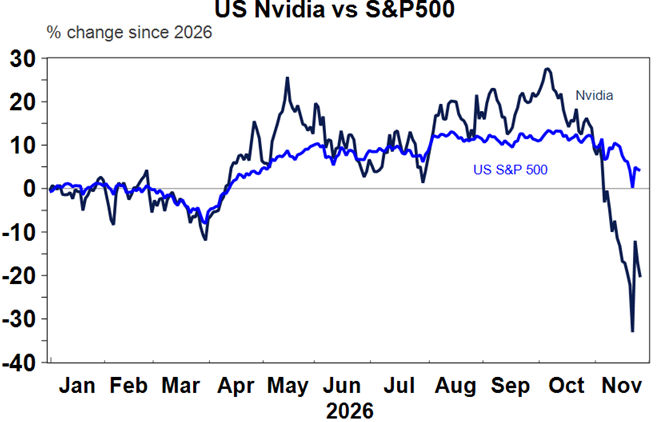
Correction, not bear market – at least for now. Because recession risks in the US and globally are low, profit growth remains strong and US monetary policy is not particularly tight we continue to see the main risks being skewed towards a deeper correction rather than a deep bear market. For Australian shares the risks of a bear market are bit higher given the higher risk of recession here but that risk is partly offset by the low direct exposure of the Australian share market to AI related companies.
On a broader level Trump’s intervention in Nvidia – “the board decided to do what we wanted” - may be good for business short term (Nvidia bounced and he had shares in it) but his ongoing trampling over ethical standards and the role company boards have in overseeing them may not be good for business on a long-term view. In particular, it risks adding to the perception that the system is stacked against ordinary people leading to unfair advantage for some which threatens faith in the free market system.
And just when we sort of forgot about it, US tariffs are on the way back up again! The latest US tariff announcement was largely as expected but again comes with its own uncertainties. After the Supreme Court struck down Trump’s emergency powers tariffs in February the Trump Administration aimed to permanently replace them under different legislation (section 301) first announcing “forced labour” tariffs for most countries in July (12.5% for Australia) and now announcing “excess capacity” tariffs on 14 countries (excluding Australia) that will replace the forced labour tariffs on those countries. This will effectively take their tariff rate back to around where it was prior to the emergency powers tariffs being struck down and for which “trade agreements” were reached. So, for Europe, Japan, Korea and Taiwan its 15%, for China its 20% (plus pre Trump 2.0 tariffs) and for India its 17%. It will take the average US effective tariff rate back to near where it was earlier this year at around 10-12%. So, no big deal as markets had got used to that. But the sting in the deal is that US has left room for tariffs to go even higher for some countries like Vietnam, India and China if Trump is not happy. So, tariff uncertainty could flare up again. Second, the return to higher tariffs after refunds were paid out could add to inflationary pressure in the US next year.
Major global economic events and implications
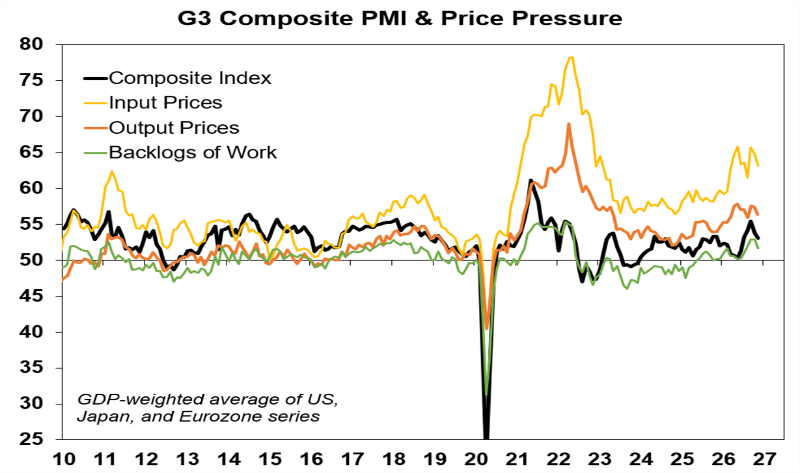
Developed country business conditions PMIs for November fell again but remain around levels consistent with okay economic growth. Input and output price pressures fell but remain elevated.
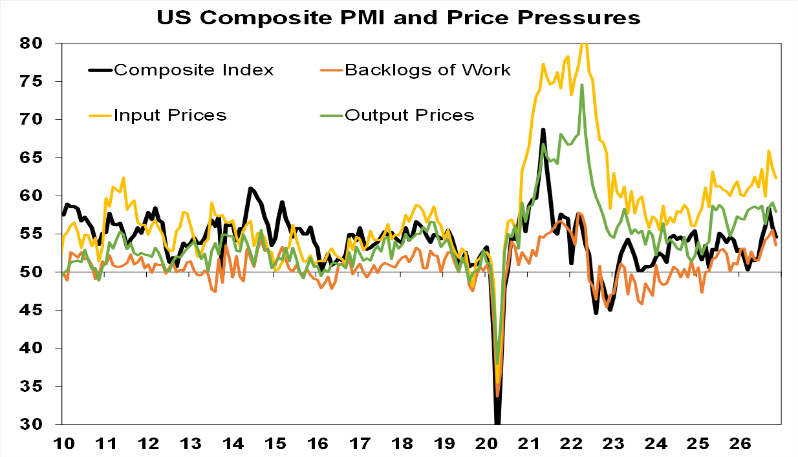
It’s a similar story in the US but with conditions being much stronger compared to other countries. Price pressures eased but remain elevated. There is nothing to stop further Fed tightening here.
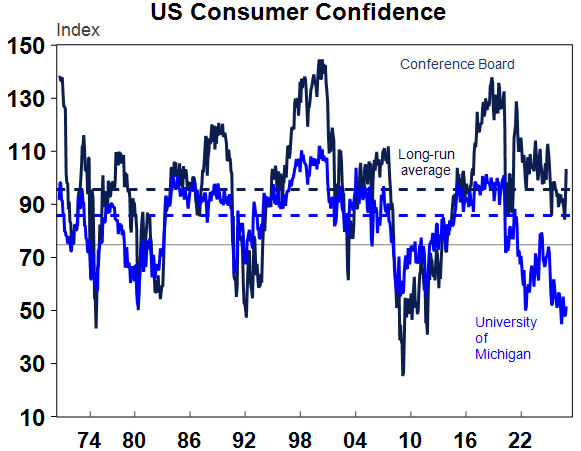
US economic data was mostly strong. September quarter GDP growth was revised up to an annualised pace of 4.3%. Underlying capital goods orders and shipments continued to rise strongly in October on the back of the data centre boom. Jobless claims remain low. And while real personal spending was flat in October the Conference Board’s measure of consumer confidence rose, albeit this was due to Democrats and independents feeling happier after the midterms. The Atlanta Fed’s GDPNow tracker of December quarter GDP growth remains strong at 2.9%.
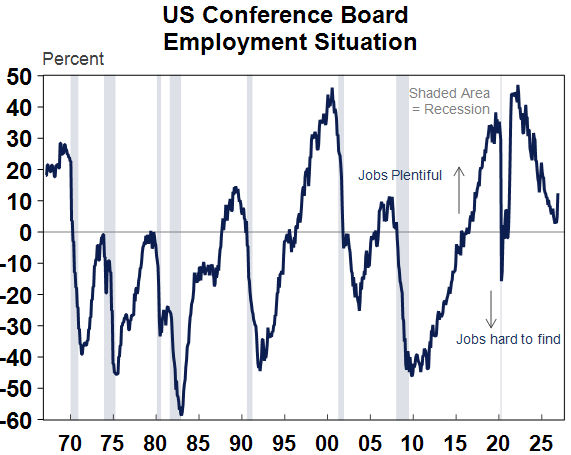
There were also more consumers indicating that jobs were plentiful versus hard to get.
The downside of course is that strong demand in the US economy is maintaining upwards pressure on inflation with the core private final consumption deflator rising 0.3%mom in October taking the annual rate up to 3.3%yoy. Note that this excludes the impact of higher energy prices flowing from the Iran War. Strong growth and hot inflation – albeit not as hot as in Australia – will keep the Fed on track to hike next month and again early next year.
Australian economic events and implications
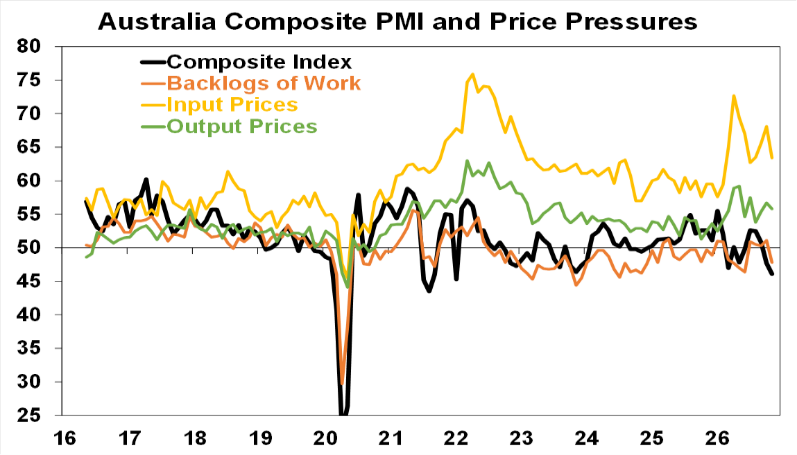
Australian business conditions PMIs showed a further weakening in economic conditions with the composite PMI falling to a weak 46.1 consistent with rising recession risks. This is far below levels seen in other developed countries and reflects the more aggressive rise in interest rates seen in Australia. Both input and output price pressures remain elevated, but they slowed suggesting some possible easing in inflation pressures.
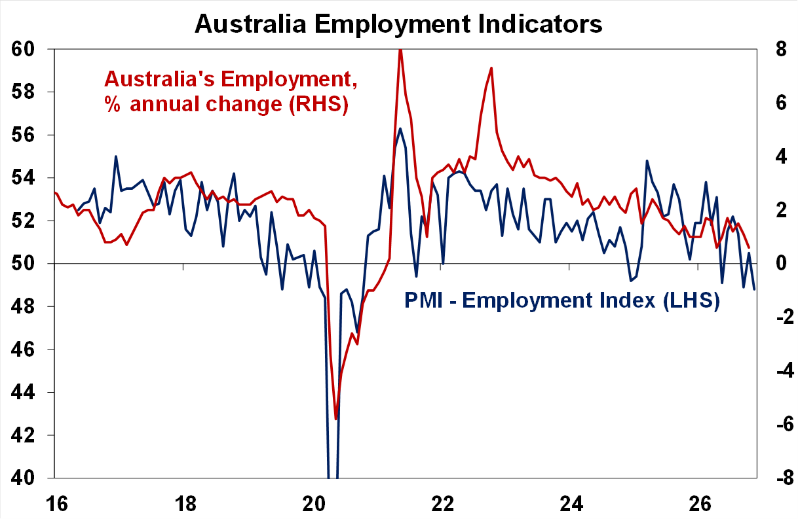
The downtrend in the employment component of the PMI survey points to further weakness in the labour market.
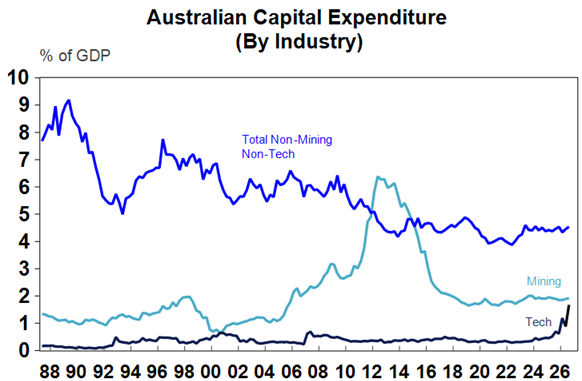
Meanwhile, business investment boomed in the September quarter with a 12.2%qoq rise, mainly due to a 183%qoq rise in data centre related investment. This is lumpy and mostly imported so won’t boost GDP much but should still help keep it positive. Non-tech capital spending rose by a far more pedestrian 1.2%qoq or 5%yoy but at least it’s still solid.
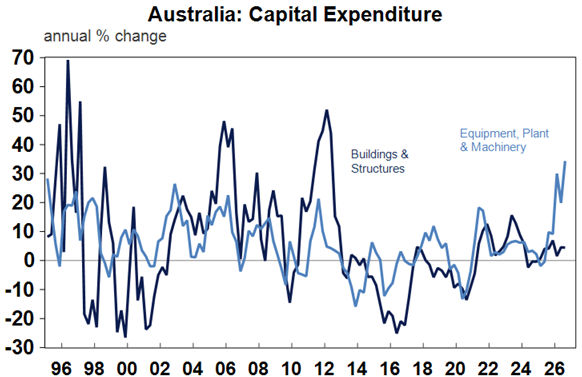
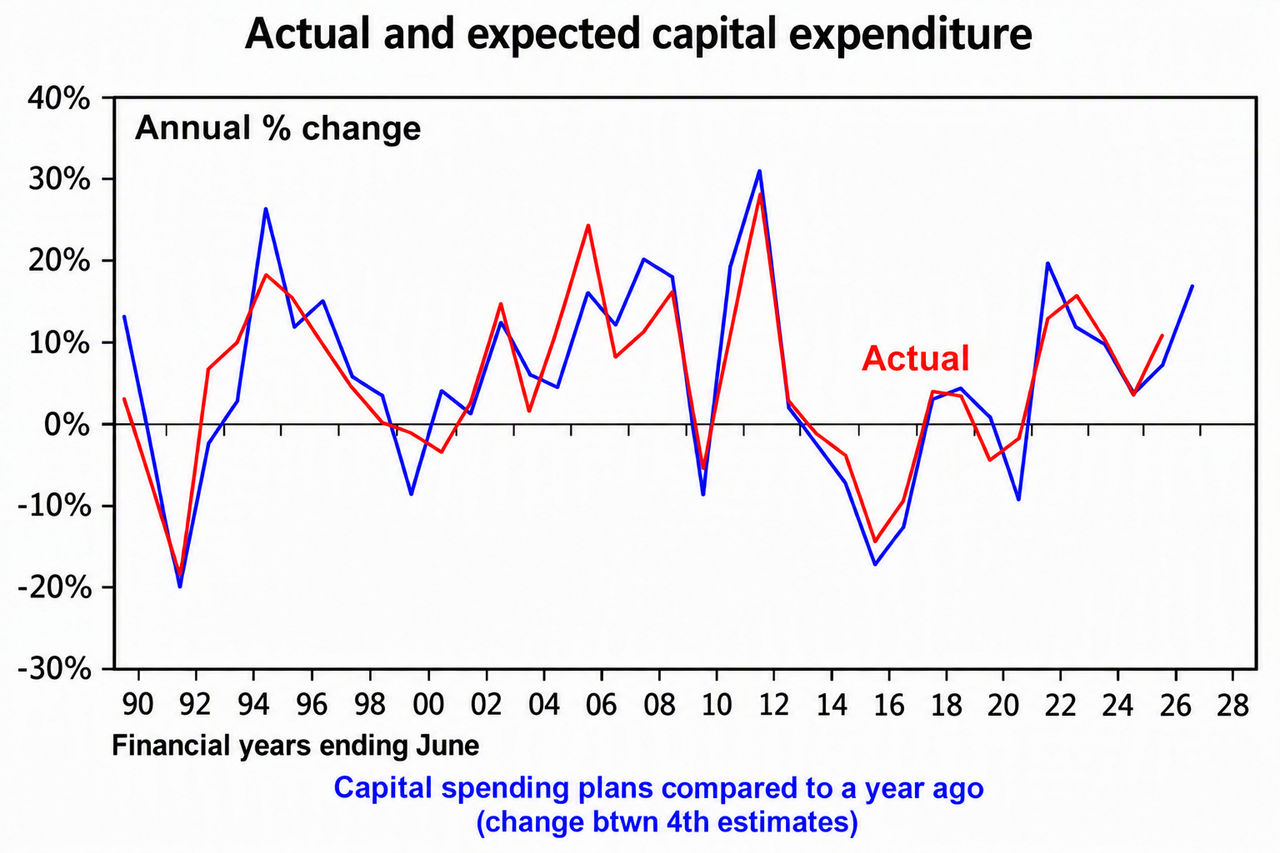
Business investment plans for 2026-27 rose 16% versus those of a year ago for 2025-26 suggesting that business investment growth will remain strong – which is one reason why a recession is not our base case.
However, the rising trend in unemployment is likely to continue likely pushing above 5.5% next year. It confirms our view that the RBA has already done enough to slow demand and hence inflation and that rates are likely now on hold for a while ahead of rate cuts later next year.
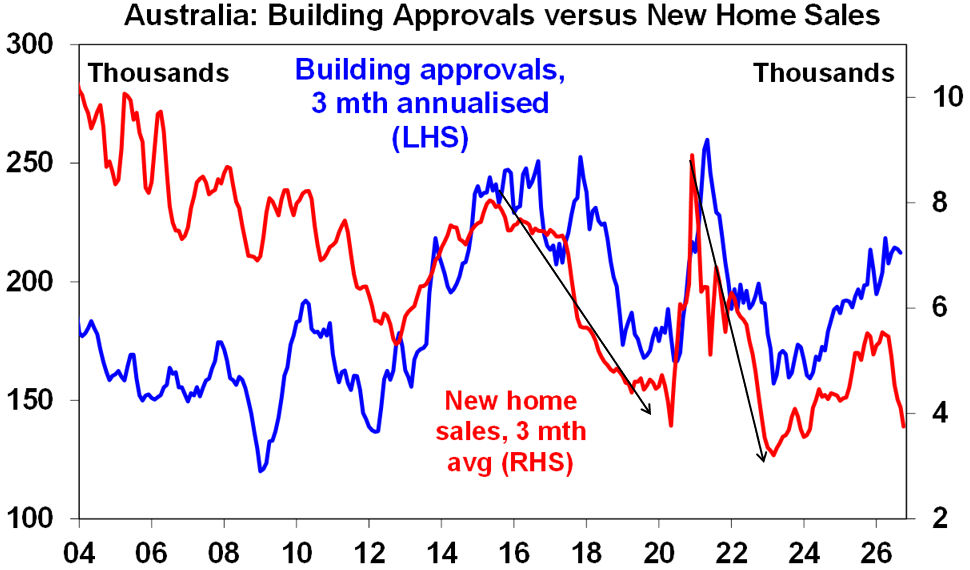
On the housing front new home sales as reported to the HIA fell 19% October, their fifth monthly fall pointing to a slump in building approvals ahead. As can be seen in the next chart, slumps in new home sales in the last two cycles preceded slumps in building approvals. So much for the Housing Accord target of building 240,000 homes a year.
Interestingly, tech related investment in Australia will soon replace mining investment, although it’s doubtful it will reach the mining boom highs of above 6% of GDP.
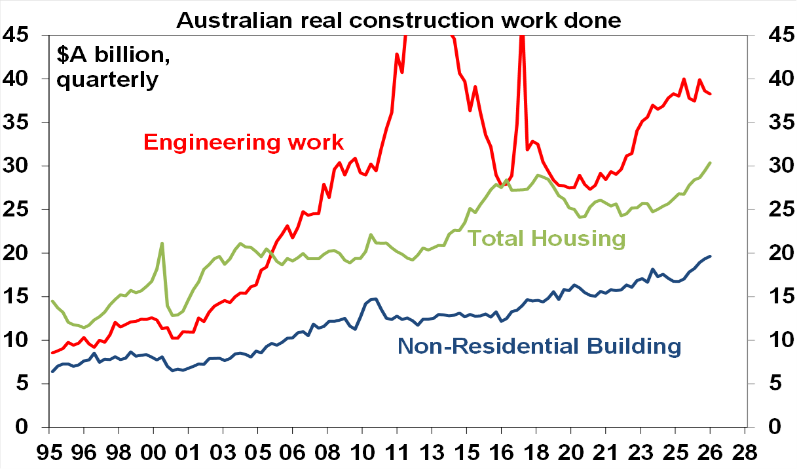
Construction activity also rose a bit more than expected in the September quarter with a 0.9%qoq rise with home building and non-residential building up but engineering activity down. Unfortunately, the slump in new home sales suggests a slump ahead in home building.
What to watch over the next week?
In the US, the focus is likely to be on jobs data for November (Friday) which is expected to show payrolls up a slower but still strong 70,000, unemployment to rise slightly to 4.2% and average wages growth around 2.9%yoy. In other data expect the manufacturing and services conditions ISMs (Tuesday and Thursday) to remain strong and job openings and quits data for October (Tuesday) to remain consistent with a still solid labour market.
Eurozone inflation data (Tuesday) is expected to show a fall to 3.9%yoy due to lower fuel prices but with core inflation rising slightly to 2.7%yoy. Unemployment (Wednesday) is expected to remain at 6.5%.
Chinese business conditions PMIs for November (Monday) are likely to have remained subdued.
Australian GDP growth for the September quarter (Wednesday) is likely to show growth of 0.5%qoq or 2.1%yoy with strength in business investment and home building, moderate growth in consumption and a detraction from trade and real estate transfer. In other data expect a 0.2%mom rise in household spending for October (Monday) distorted by another rise in fuel prices but falling discretionary spending, building approvals (Tuesday) to fall 8% and the trade surplus (Thursday) to fall back to be around $2.7bn). Cotality home price data for November (Tuesday) is expected to show a 1.6% fall led by Brisbane, Perth and Sydney but with falls in Melbourne continuing to show signs of moderation. This and downwards revisions will likely leave national average prices down around 8.5% from their high in March and will mark the fastest and deepest slump in prices since at least 1980. Sydney prices will be down around 11.8% from their high.
Outlook for investment markets
Global and Australian share markets are at risk of a further correction amidst worries about an AI bubble, sticky inflation and central bank rate hikes, the oil shock, the risk of further increases in bond yields and stretched valuations and uncertainty around what the blue wave from the midterm elections will bring. However, at this stage its likely just a correction rather than a new bear market thanks to continuing economic growth with recession likely to be avoided, albeit it’s a high risk in Australia, and strong global profit growth and likely rate cuts later next year.
Bonds are likely to see subdued returns.
Unlisted commercial property returns are likely to be solid helped by strong demand for industrial property associated with data centres. Higher bond yields are a constraint.
Australian home prices are expected to fall around 15% top to bottom, of which they have already done 6.7%, out to the September quarter next year as a result of RBA rate hikes, reduced investor demand flowing from the Budget tax hikes and poor confidence. Rising distressed sales risk also becoming a drag.
Cash and bank deposits are expected to provide returns around 5%.
The $A could see more weakness in the near as the Fed hikes versus the RBA. However, it should be supported on a 12-month view as metal prices rebound and fair value is around $US0.72.


You may also like
-

5 ways women can build towards a better retirement AMP experts explain the financial inequalities women can face throughout their working lives, and share five ways to build more wealth, independence and choice. -

Weekly Market Update - 20-11-2026 Weekly economic and market update - share correction likely has more to go; AI worries despite good Nvidia earnings & Anthropic IPO; high recession risk in Aust but Sahm is a furphy; RBA may be slow to cut; why the Fed Gov should still cut spending -

Oliver's Insights - Why free markets deliver higher living standards - AMP Free market economies generate higher living standards as prices allocate resources to their best uses; competition and incentive drive innovation; they result in creative destruction; and markets respond to consumer preferences.
Important information
Any advice and information is provided by AWM Services Pty Ltd ABN 15 139 353 496, AFSL No. 366121 (AWM Services) and is general in nature. It hasn’t taken your financial or personal circumstances into account. Taxation issues are complex. You should seek professional advice before deciding to act on any information in this article.
It’s important to consider your particular circumstances and read the relevant Product Disclosure Statement, Target Market Determination or Terms and Conditions, available from AMP at amp.com.au, or by calling 131 267, before deciding what’s right for you. The super coaching session is a super health check and is provided by AWM Services and is general advice only. It does not consider your personal circumstances.
You can read our Financial Services Guide online for information about our services, including the fees and other benefits that AMP companies and their representatives may receive in relation to products and services provided to you. You can also ask us for a hardcopy. All information on this website is subject to change without notice. AWM Services is part of the AMP group.