





Econosights
Are higher interest rates working in Australia?
There are a lot of questions right now about the uneven impact of interest rate increases in Australia. Are higher rates working as intended to bring inflation down? Or are they just crushing mortgage holders, while having much less impact on other households?
9 min read

Key points
The transmission mechanism of higher interest rates is broader than just the household channel, although this is the most obvious.
Higher interest rates in Australia work to ease inflation, but the impact is not immediate, it’s uneven and has been complicated this year by the near doubling in oil prices.
However, there is no painless way to deal with elevated inflation. Popular discourse to simply “cut government spending”, “tax the billionaires”, or “increase taxes on big companies” also can have negative consequences.
Introduction
There are a lot of questions right now about the uneven impact of interest rate increases in Australia. Are higher rates working as intended to bring inflation down? Or are they just crushing mortgage holders, while having much less impact on other households?
In this Econosights we look at how changes in interest rates flow through the economy, whether the hikes so far this year are having the intended effect, and what this all means for economic growth, households, inflation and where interest rates go from here.
How do interest rate changes impact the economy?
The RBA's job is to keep inflation under control while supporting full employment. Its main lever for doing this is the cash rate, which influences other interest rates throughout the economy.
But, changing the cash rate doesn't immediately change inflation. Think of
monetary policy more like turning around a very large ship, rather than
slamming the brakes in a car. Higher rates first affect borrowing costs and
financial decisions, then spending and investment, then employment and
wages and, eventually, inflation.
This is why looking at inflation immediately after a rate hike and concluding that the hike “didn't work” misses much of the transmission process.
If you studied economics at high school or university you will remember
that we are taught that interest rate changes work with a 12-18 month
delay. But some effects happen much sooner. Mortgage holders on
variable rates can see their repayments rise within months, while changes
to household spending, employment and inflation can take much longer to
become apparent.
Interest rates work through four main channels in the economy:
- Cash Flow Channel – This is the one most associated changes to interest rates and the one households pay most attention to. Interest rate increases lift the cost of debt and repayments, leaving those with debt less money to spend elsewhere. Interest rate decreases reduce the cost of debt, leaving households that are indebted with more income to spend on goods and services or to increase their debt holdings. Around 80% of borrowing in Australia is on variable interest rates, so the impact of rate changes tends to be quick in Australia, compared to countries where most lending is done on fixed mortgage rates (like the US).
- Asset Price Channel – Higher interest rates reduce how much people can borrow which decreases demand to buy assets, like housing and shares. Lower interest rates tend to support asset prices.
- Savings and Investment – Higher interest rates increase the return from saving and lift the hurdle for new investment. This increases household incentive to save, rather than spend. For businesses, projects that made financial sense at a lower interest rate may no longer stack. Lower interest rates reduce the return from savings, de-incentivise households to save and may support business investment as the hurdle rates for projects declines.
- Exchange Rate – Higher interest rates in Australia (relative to the rest of the world) support the Australian dollar. A higher Australian dollar reduces the Australian cost of imported goods (good for consumers purchasing from overseas and going on overseas holidays) but makes Australian exports more expensive on the global market. Lower interest rates in Australia (relative to the rest of the world) put downward pressure on the Australian dollar. A lower currency means imports become more expensive, adding to inflation but Australian exports get boosted on the international market, helping to boost exports.
How are higher interest rates impacting the cash flow channel?
The impact of higher interest rates on Australian households has been
uneven. The average household in Australia has debt worth 1.8 times their
income (see the chart below).
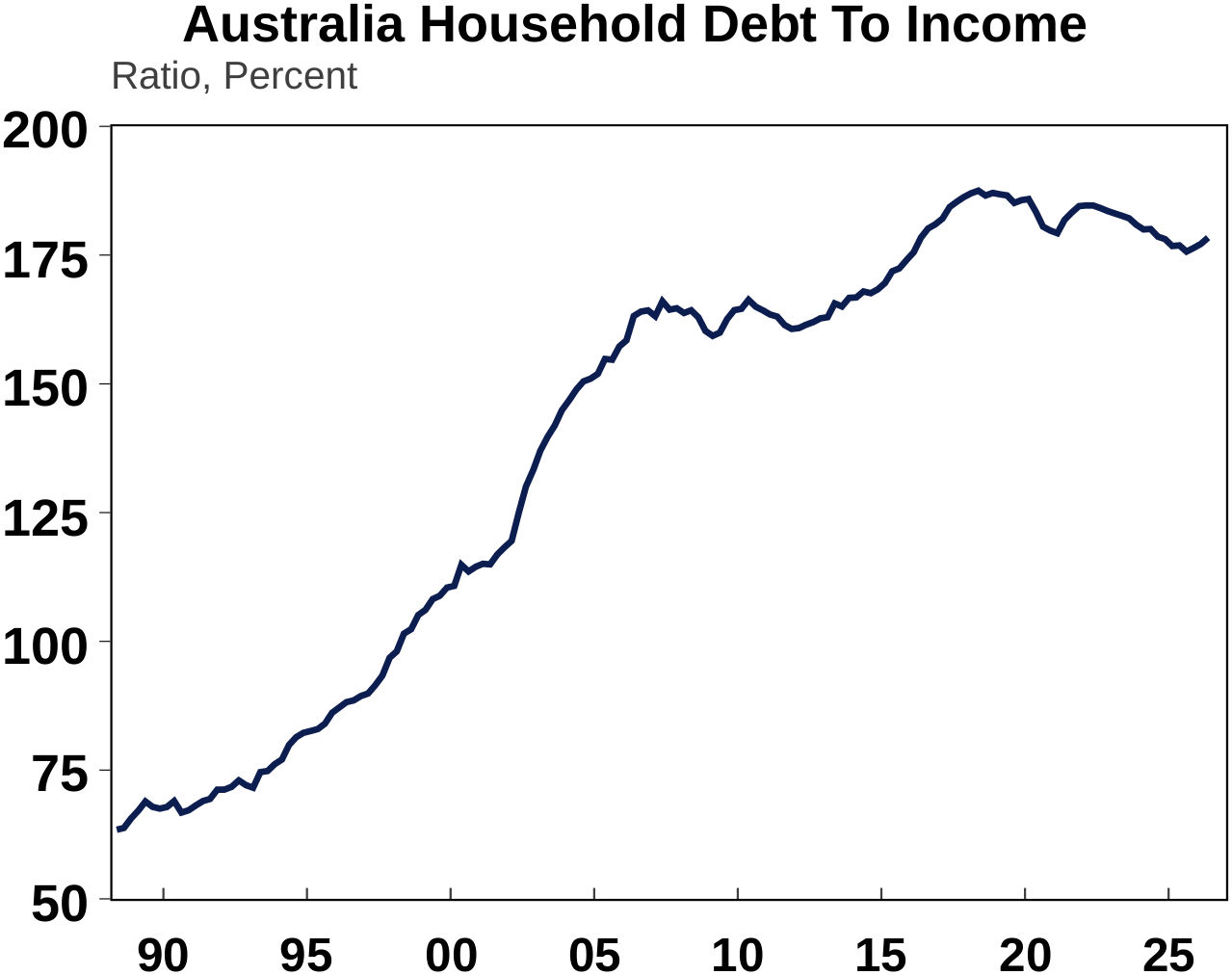
However, this is an aggregate average figure – some households have no debt and some households have large debt levels. Australia’s household debt levels have been high for decades, as a result of expensive housing (relative to incomes).
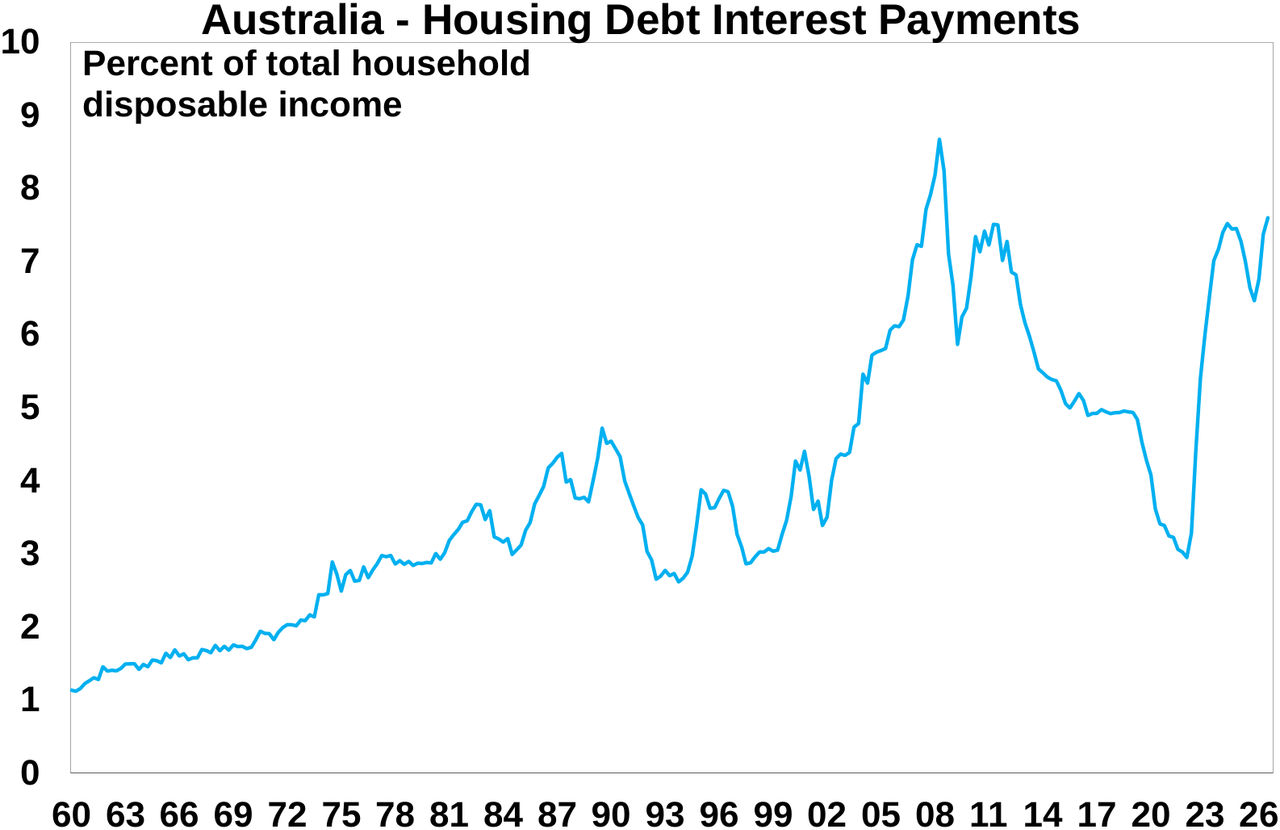
Rate increases this year have meant that households with mortgages have seen an increase in their repayments. On average, household interest repayment rates have increased from ~7.7% of income (see the chart below). This is back to the 2024 high of the last rate hike cycle and is around the highs since the series began in 1960. This excludes the last two rate hikes so interest payments will climb even higher from here – probably close to the all-time 2008 high.
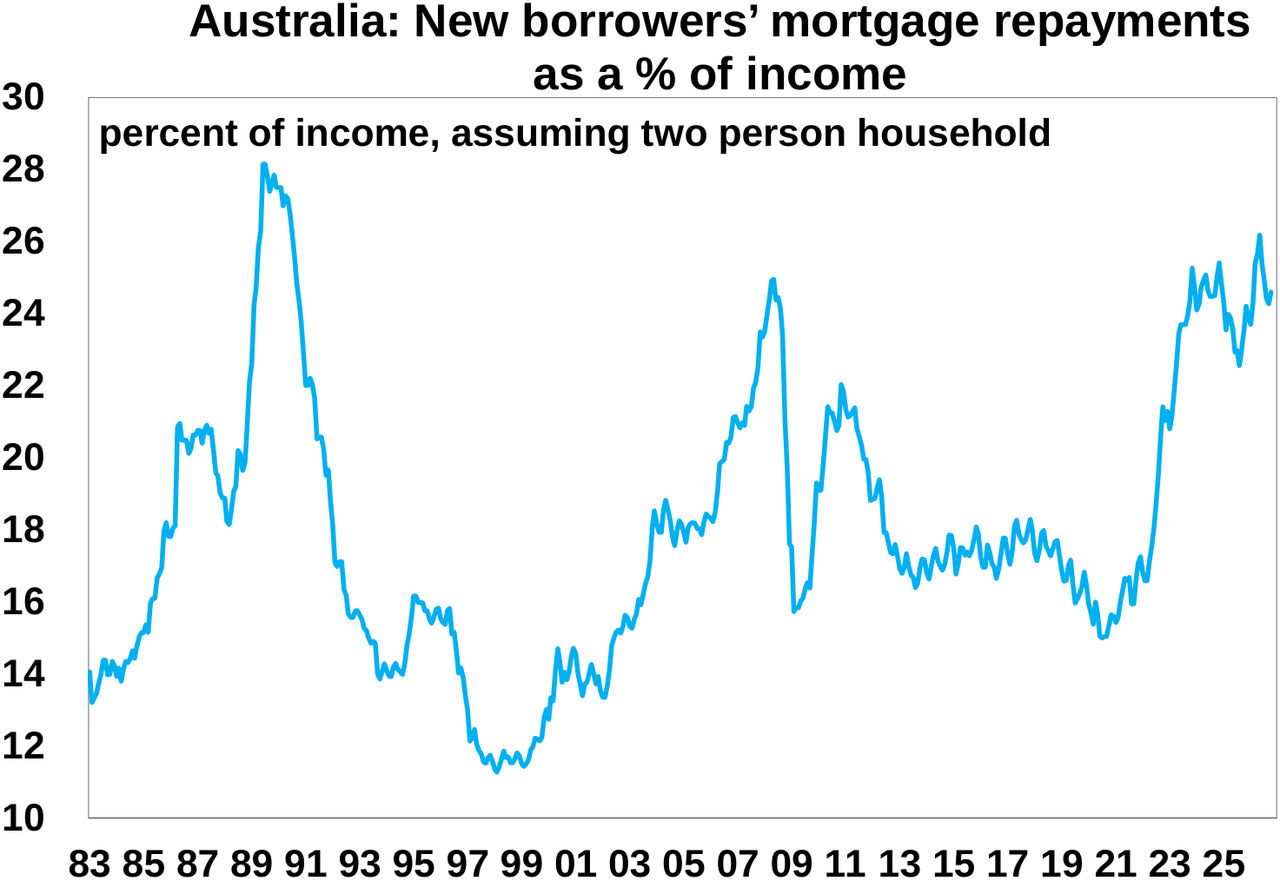
This measure includes all households, so it underestimates how much new
households would be allocating on mortgage repayments. We estimate
that for new borrowers, around 25% of income is dedicated to housing
repayments – see the chart below – which is around its historical highs and
a significant share of income.
Higher spending on mortgage repayments leaves less income for discretionary and/or essential spending. So as interest rates increase, those with debt often cut back. The 5 interest rate increases this year mean an extra $550 per month in mortgage repayments since January on a mortgage worth ~$700,000, which is $6,600 a year – a serious dent in consumer budgets.
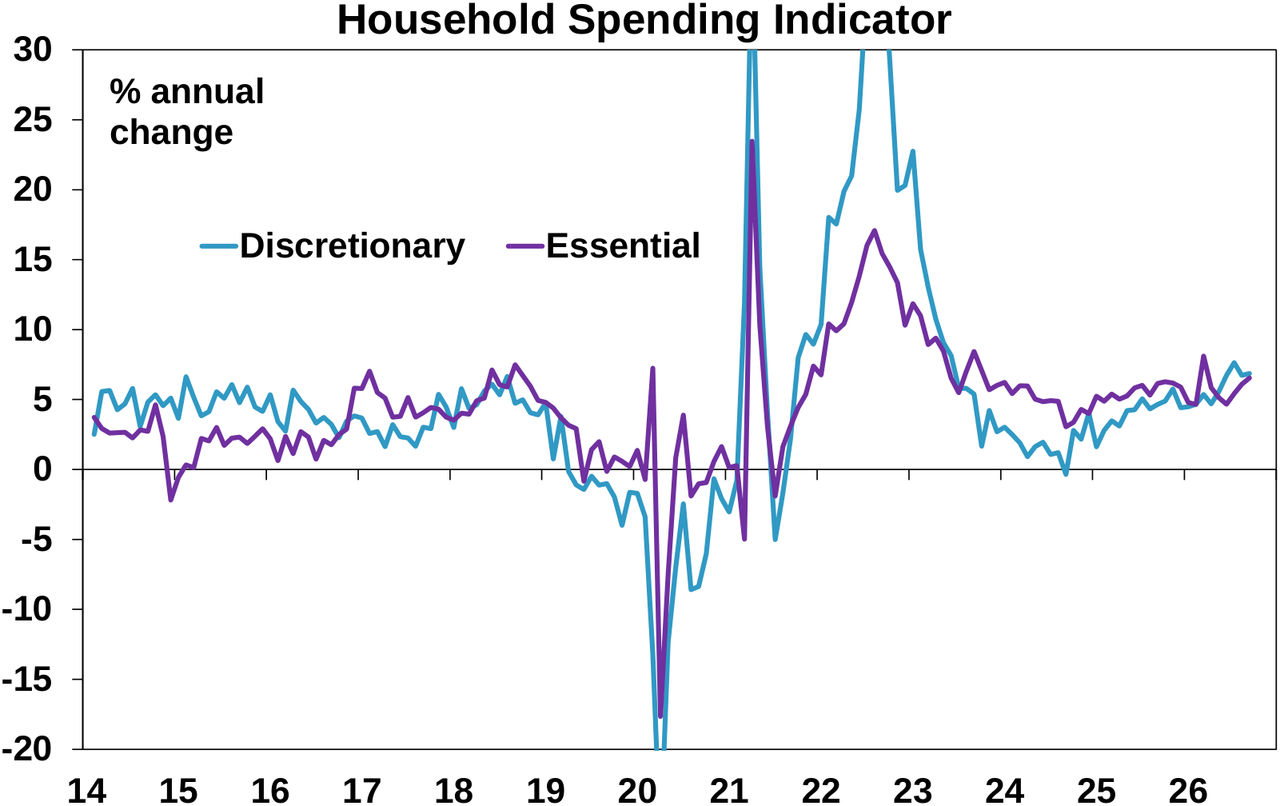
But what has been surprising is that consumer spending has held up in 2026, despite the challenging backdrop. Real spending volumes (which strip out the impact of inflation) have been steady (see the chart below).
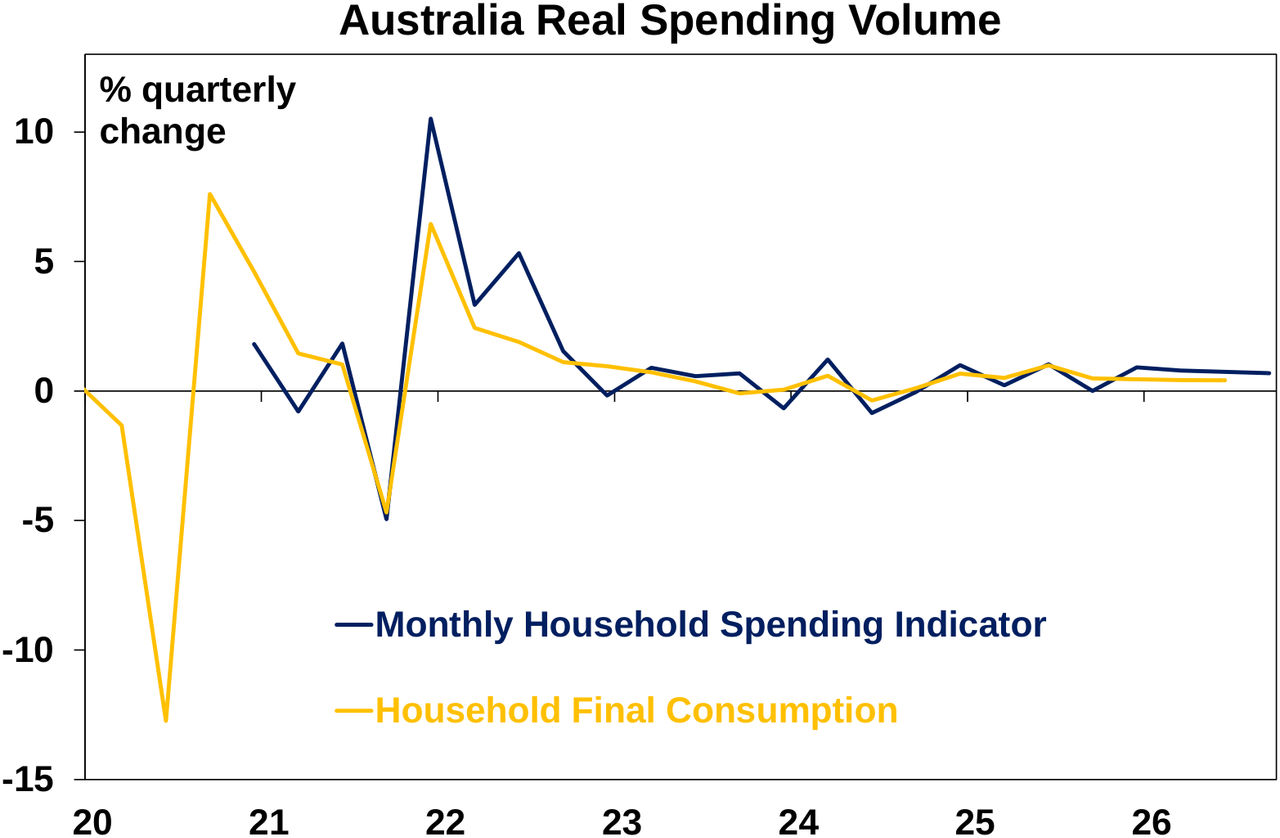
And within consumer spending, both discretionary and essential spending have tracked at similar levels.
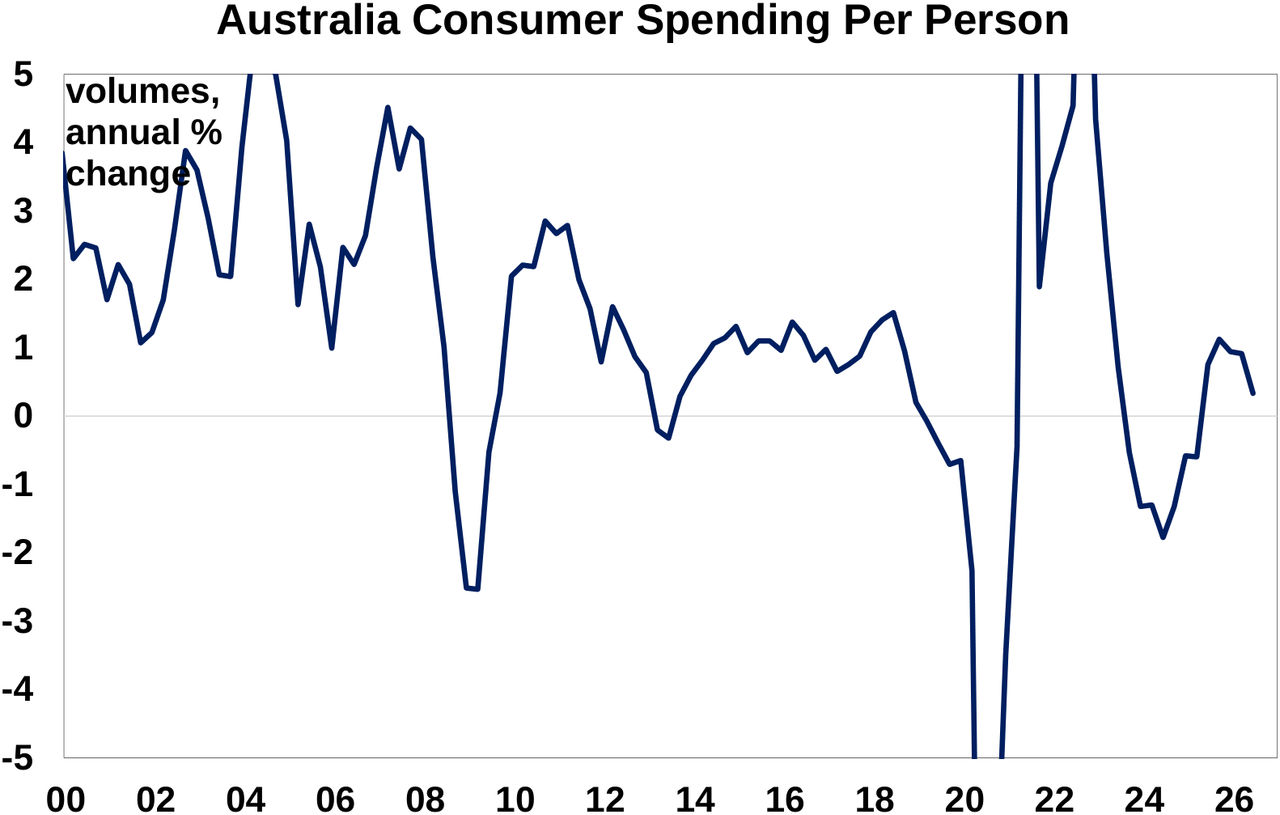
But, the aggregate numbers do show a much stronger picture for total consumer compared to per person spending. Per person, household spending has turned down this year – see the chart below.
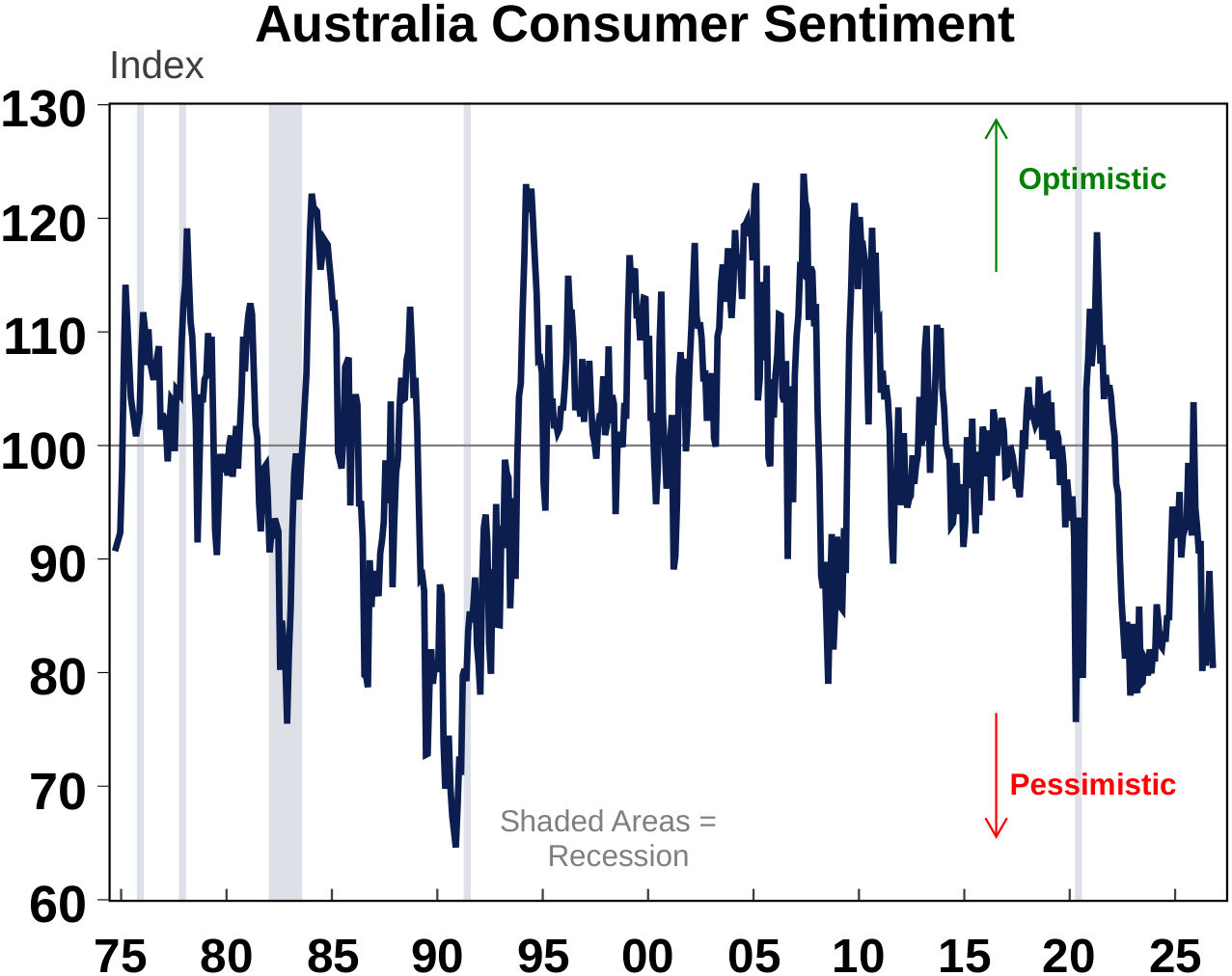
This weakness in per person spending is consistent with poor readings of consumer confidence, which remain around recession-like levels (see the chart below). Ongoing elevated inflation has also been another major drag on confidence.
There is also the question of who is spending. Younger generations have expressed frustration that many Baby Boomers have relatively little debt and may actually benefit from higher interest rates through increased returns on their savings. There is limited data on how important this dynamic is for overall consumer spending, but it highlights the uneven impact of higher interest rates across generations, something monetary policy has limited ability to address.
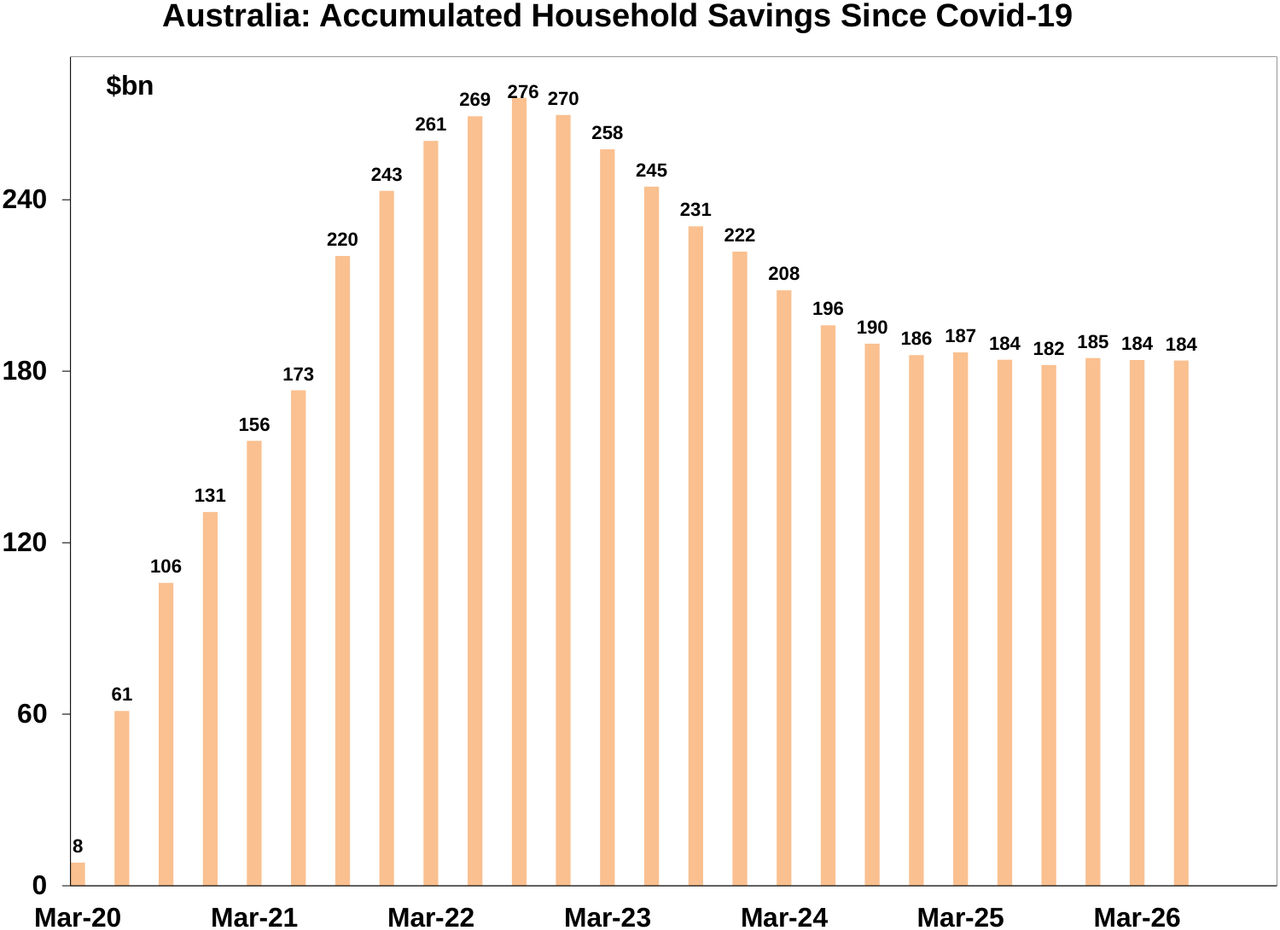
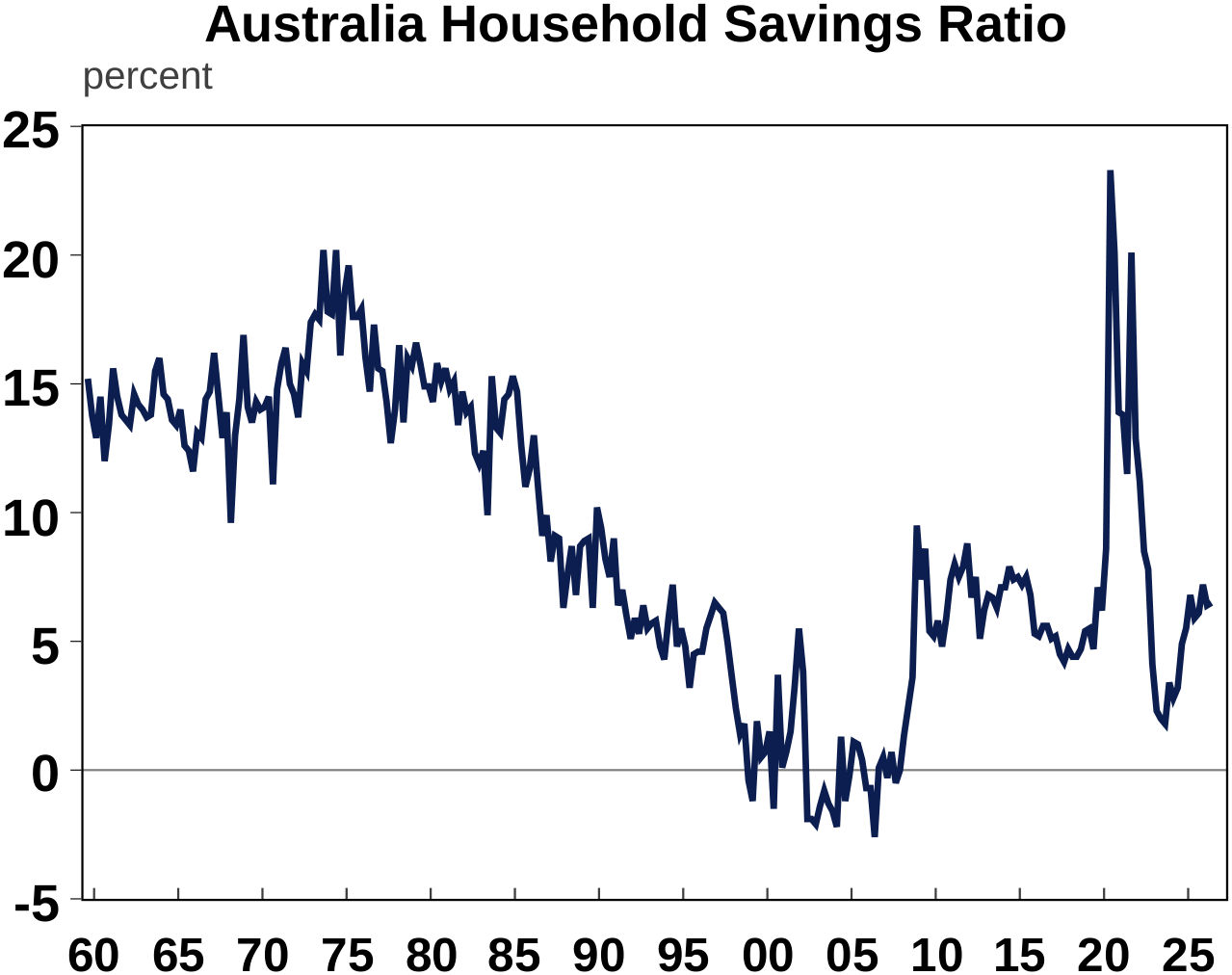
In the short-term, households often have a few avenues to cushion higher mortgage repayments including drawing down on accumulated savings, mortgage buffers or accumulated wealth. Households accumulated large savings buffers since Covid-19 which are still elevated – see the chart below – as the savings rate has not fallen too much, as wages growth has been solid which has lifted consumer incomes.
According to RBA analysis, the average borrower also holds buffers in offset and redraw accounts, with the median borrower able to cover over a year of scheduled mortgage payments at interest rates around 4.6% (slightly below the current cash rate of 4.85%). So far, there doesn’t appear to have been a significant rise in borrowers who are drawing down on these buffers to manage their cash flows even at elevated interest rate levels.
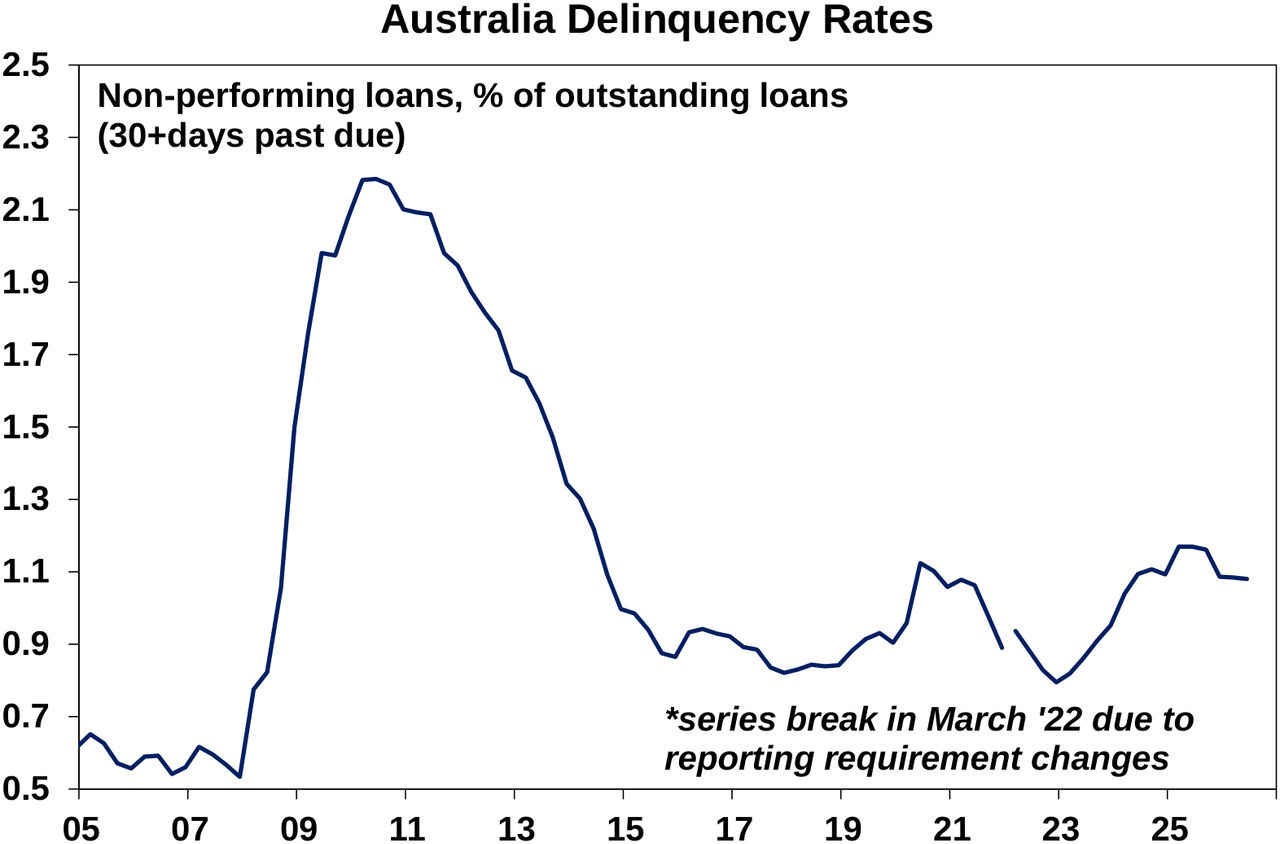
The low level of severely stressed borrowers is also evident in a small increase in borrowers behind on their payments (or “delinquent” loans), with just over 1% of all loans 30 days past their due date – see the chart below.
All of this indicates that yes, there are pockets of stress among consumers, with food banks reporting increased demand and banks indicating more hardship program calls. But on average, households still have financial buffers to use before reaching the point of having to sell their home. These buffers suggest that households should be able to withstand even with another one or two more interest rate increases without triggering a significant downturn in the economy.
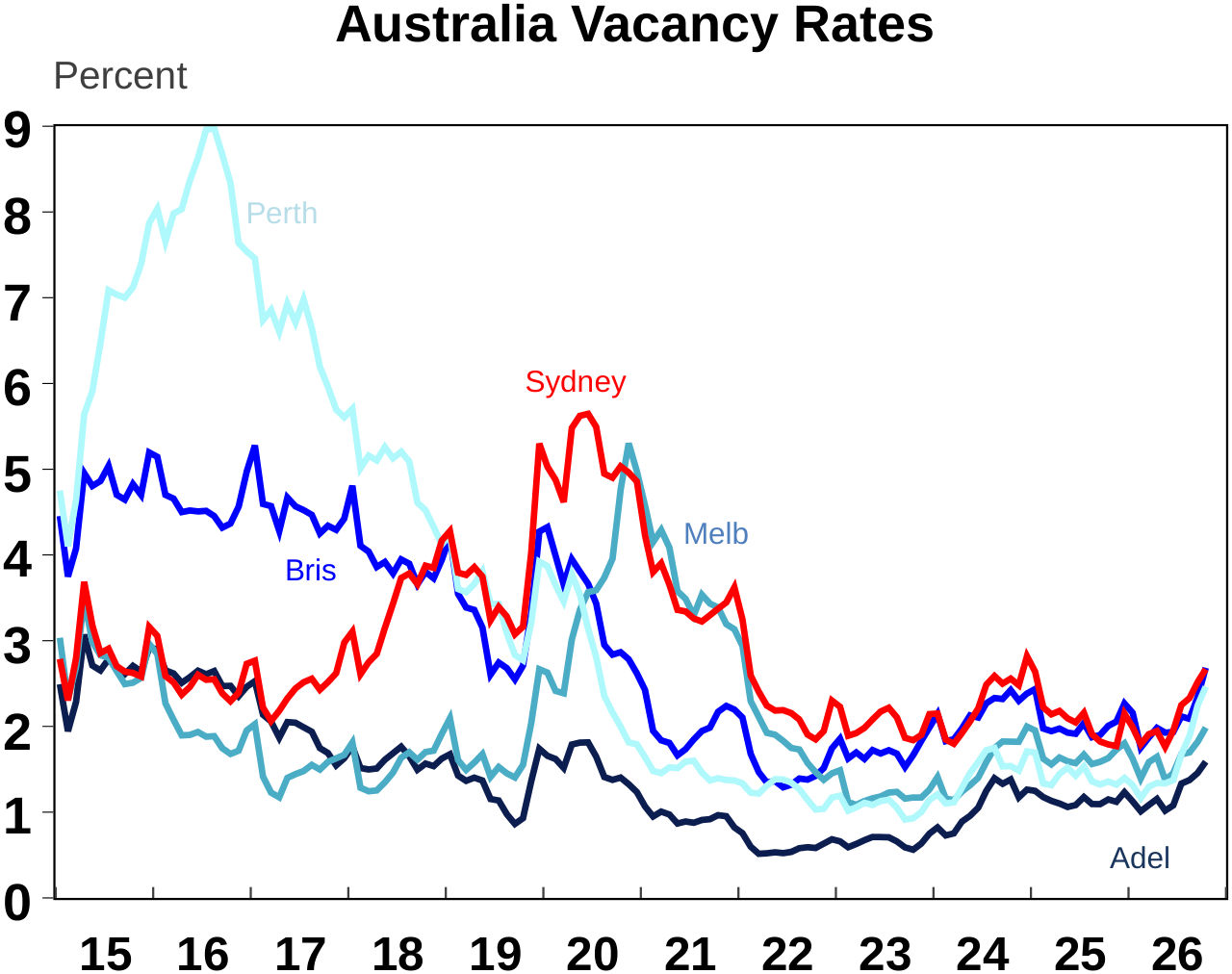
What about the impact of higher interest rates on non-mortgage holders? The impact on renters from higher interest rates is mixed. The common assumption is that higher interest rates increase rent prices because landlords pass on the higher cost of debt. But, the actual evidence is not as straight forward. Landlords can only pass on rent increases if the market conditions favour higher rents. The biggest determining factor for rents is the supply of stock and this is evident in vacancy rates – as in what proportion of rental properties are vacant and available to rent. Vacancy rates fell from 2020 to very low single digits around the country and only recently started rising again. Very low vacancy rates have been the key driver behind higher rental growth. But, rate hikes at a time of tight supply would have driven up rents as well. Rental growth has eased over 2026 (from 4% in late 2025 to 3.6% at the moment) as vacancy rates have gone up – despite the increase to rates this year.
For those that own their own home outright, the impact of higher interest rates on those without a mortgage is more indirect because it comes via the slowing in overall economic growth, the subsequent reduction in employment growth, or the higher cost of debt for other debt.
Are higher interest rates impacting asset prices?
Higher interest rates have put some downward pressure on asset prices in 2026. The housing market and interest rates have a close relationship. Higher interest rates mean that households and investors can borrow less which slows demand and puts downward pressure on prices. In the context of rising rates, it is not surprising to housing market deteriorating, auction clearance rates falling, low transaction volumes, poor investor confidence and home prices declining. Other factors weighing on prices are the impact of the Federal government’s tax changes in the May Federal budget and poor affordability with home prices up over 50% since 2020 at the start of the year, which means it becomes simply more expensive to buy homes.
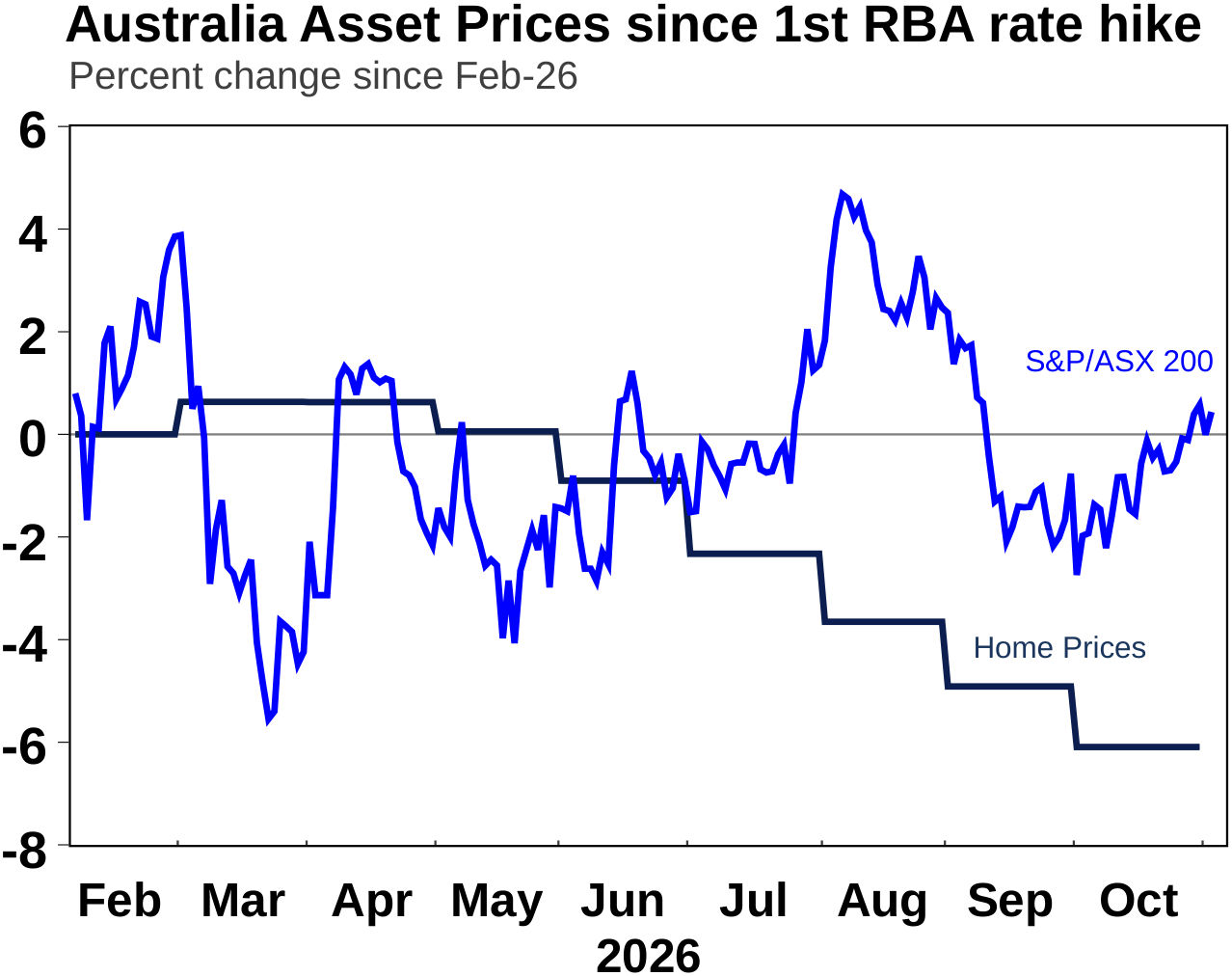
Since the first rate hike in February, home prices are down by ~6% (see the chart below) and we think there is more downside (we see a peak to trough fall in prices of 15% of which we are just under half of the way through).
The impact of higher rates on the Australian sharemarket has also been negative. Australian shares are basically unchanged on levels at the start of the year – see the chart below. This is because higher interest rates reduce equity valuations (a higher discount rate reduces present value) and higher rates may weaken company earnings if the economy slows. Of course there are variations across sectors, with some sectors more interest-rate sensitive than others. Australian households do not just have exposure to Australian shares but also other global markets, especially through their superannuation. So better growth in offshore shares (mostly thanks to good performance in the tech sector) has helped to offset the weakness in the Australian market.
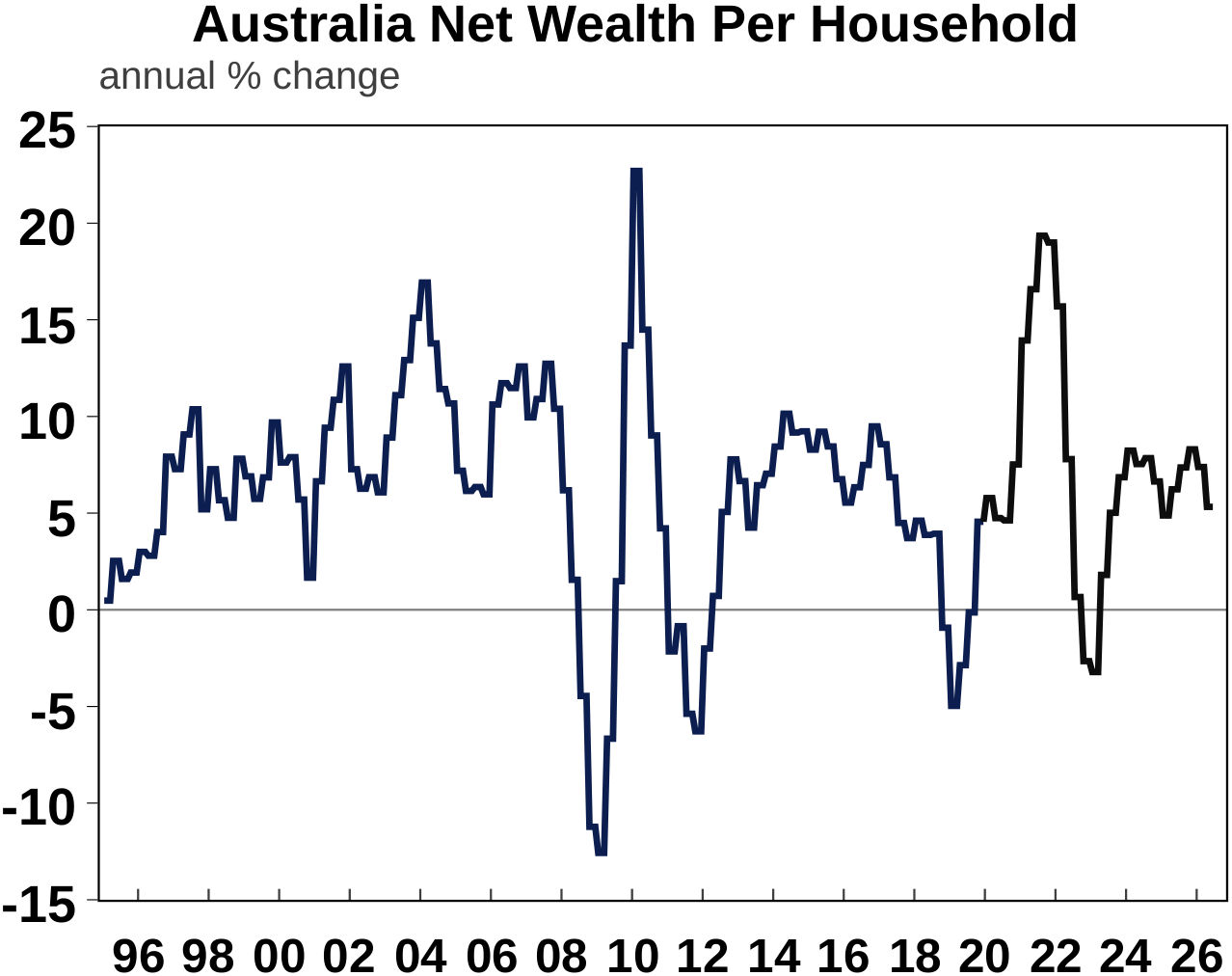
Lower asset prices could have a negative “wealth effect” on households. This is the idea that households cut back on spending if they see a decline in their wealth or increase their spending as wealth increases. Growth in household wealth has still been positive in 2026 as the declines in asset prices has so far been moderate, especially given large gains in recent years – see the chart below. But a further slowing in household wealth as home prices decline from here will be another drag on consumption. We think sharemarkets will have positive returns in the next 12 months, especially from overseas markets which should help offset negative wealth impacts from housing.
What about the impact on savings and investment?
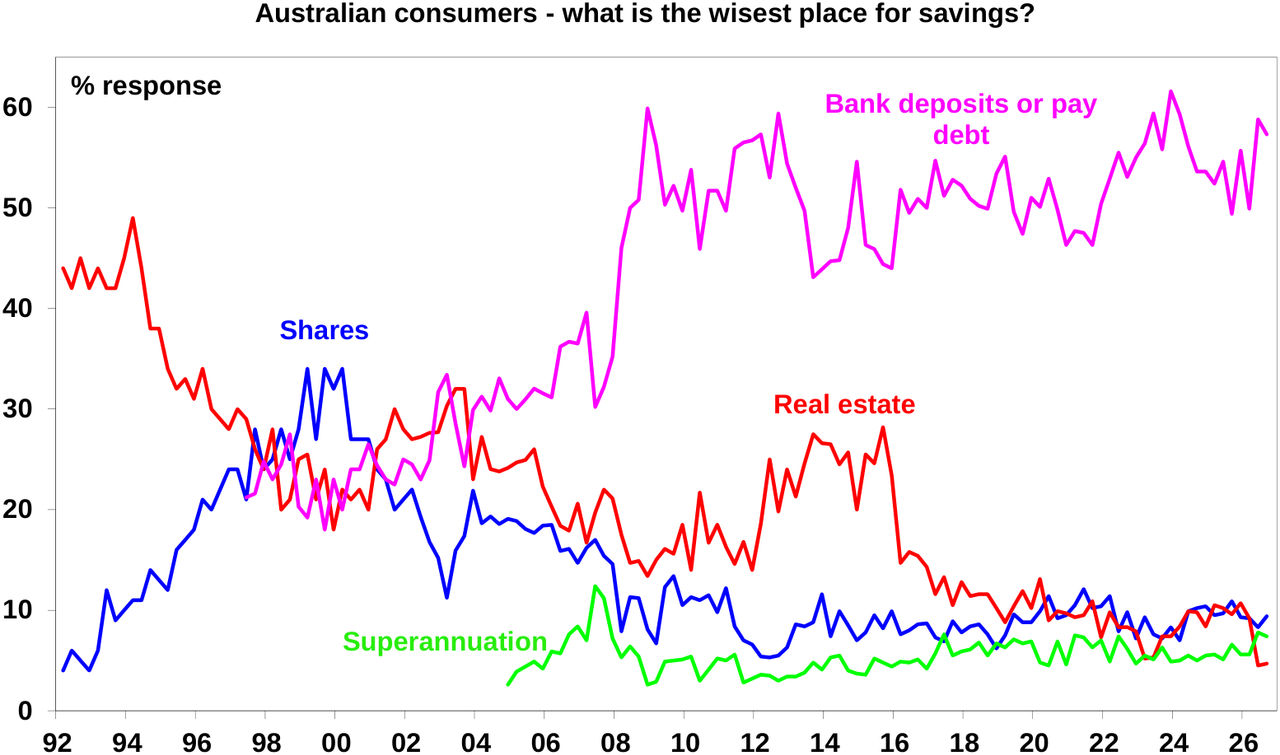
Higher interest rates should technically encourage more saving as term deposit rates (which are low risk) offer better returns. Consumer surveys around the “wisest place” to invest show that nearly 60% of surveyed consumers still think that putting savings into bank deposits or paying down debt is the “wisest place” for savings, but it’s basically been stable at this level for years – see the chart below. So there is little evidence that consumers are shifting into savings accounts en masse.
The household saving ratio, at 6.4%, is roughly back around “normal” levels after significant swings in the post-Covid period. So again it’s not clear that households are saving more with higher interest rates. If anything, there should be downward pressure on savings somewhat as households draw down on savings to fund consumption.
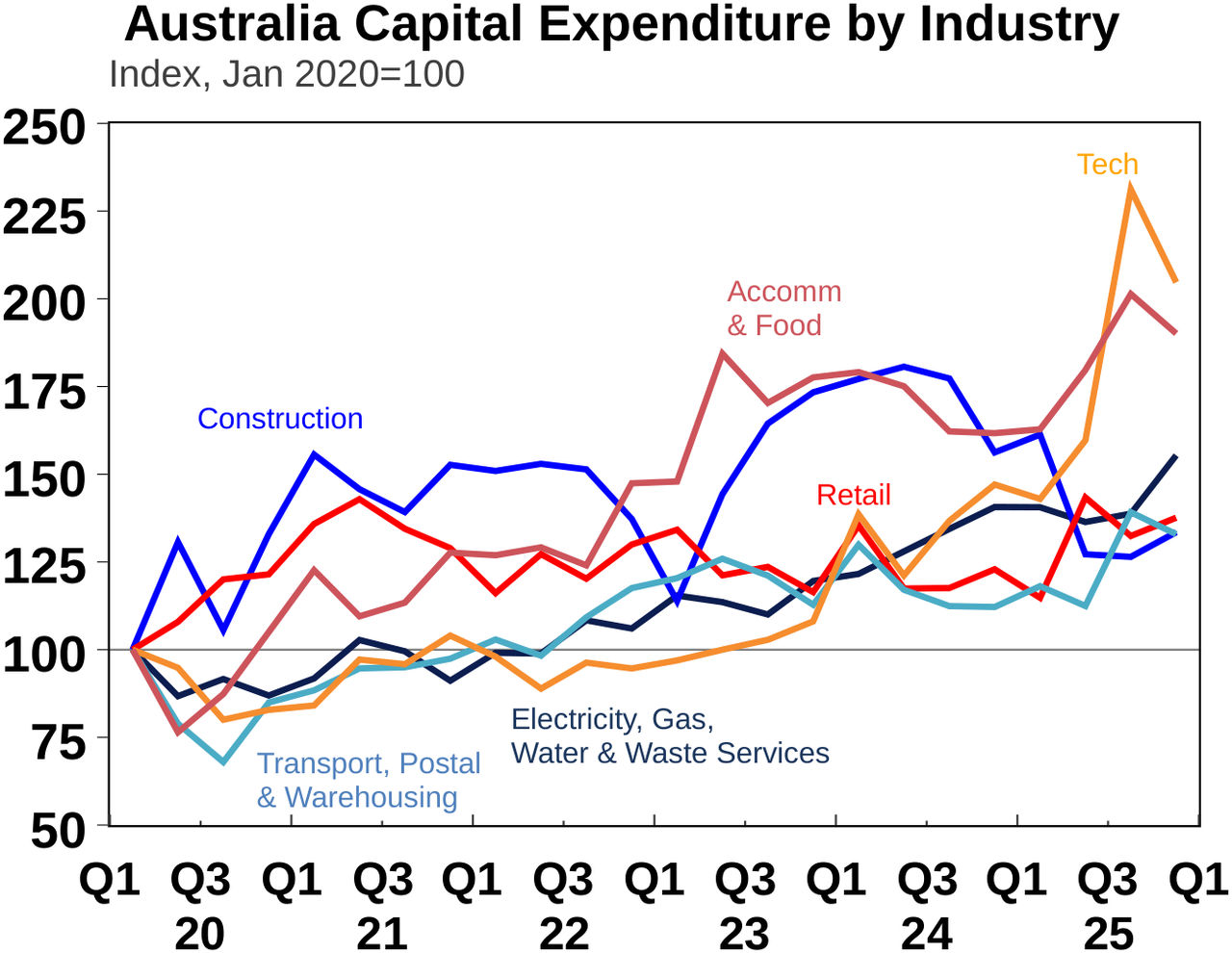
Higher interest rates usually put downward pressure on business investment through increasing the “hurdle rates” required for projects and through the downward impact on economic growth. But in this cycle, aggregate business investment has been strong in 2026 and outperforming other sectors (see the chart below) thanks to data centre spending, which is likely to continue.
The exchange rate
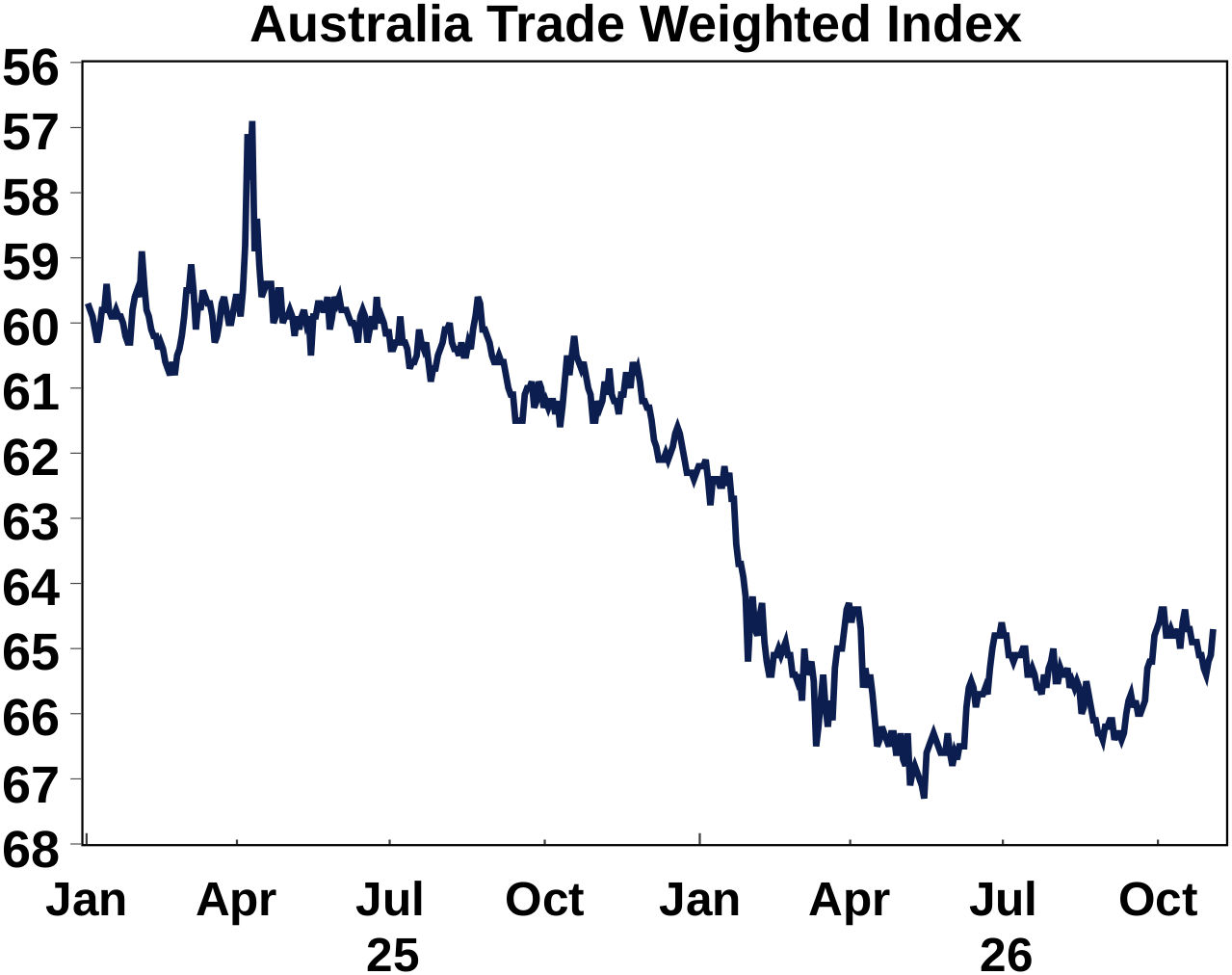
The exchange rate transmission mechanism has been relatively weak this cycle. The $A has not appreciated since the RBA began raising rates, despite the usual expectation that higher interest rates should support the currency. The Australian Trade Weighted Index, which measures the $A against a basket of currencies of our major trading partners, has actually depreciated relative to 2025 levels. This partly reflects the strength of the US dollar this year amid heightened geopolitical uncertainty, which has offset the support from higher Australian interest rates. We expect the $A to remain range-bound between US$0.69 and US$0.72 over the coming months.
The overall impact of interest rate increases
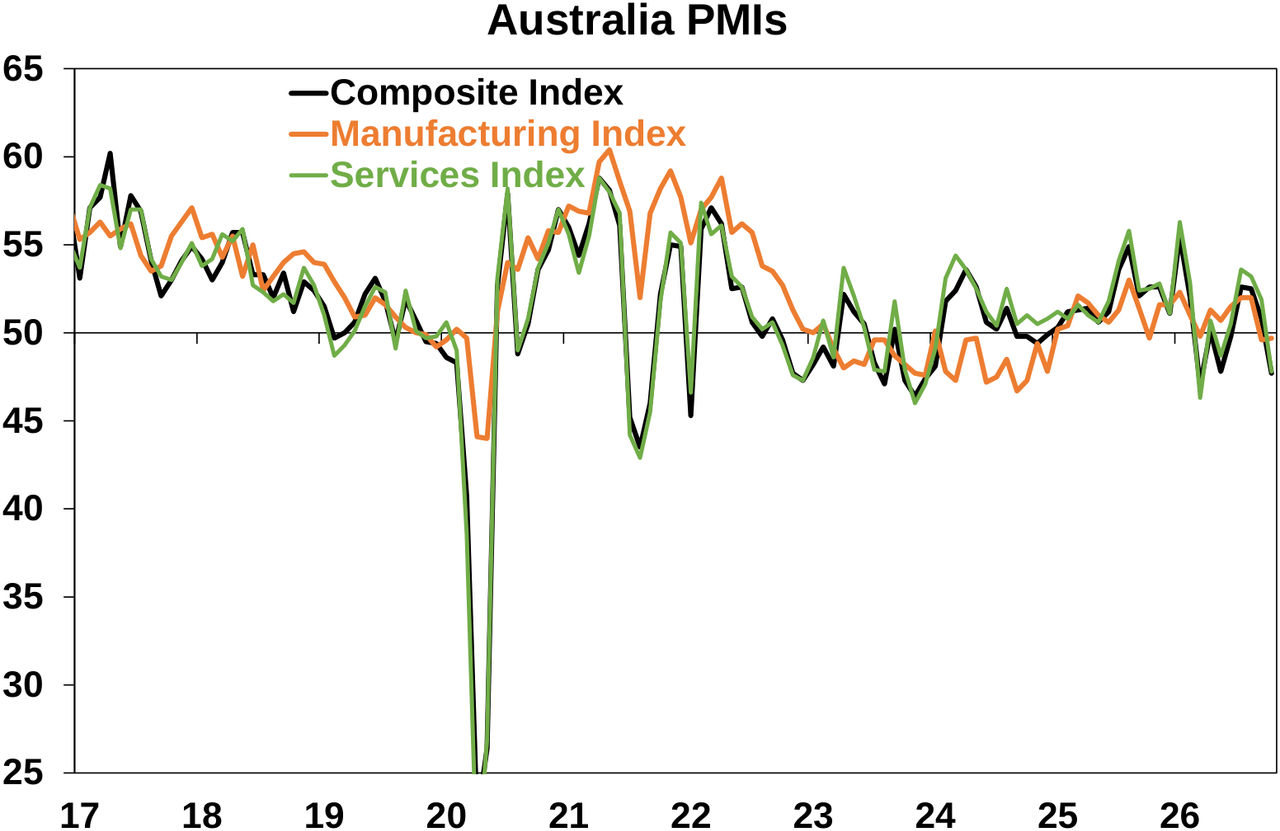
The combined impact of these transmission mechanisms ultimately flows through to economic activity and employment, and there are signs that activity in Australia is now slowing. Recent PMI surveys show that both manufacturing and services activity have weakened, with the indices moving into contractionary territory. This is consistent with the subdued activity readings in the NAB business survey.
We expect that GDP growth in Australia will be slower in 2027, running at ~1.3% by the end of 2027 (from 2% in mid-2026). Slower economic growth means a softer labour market and we expect the unemployment rate to rise towards 5% in mid-2027. But, this is at the lower end of Australia’s usual experience – see the chart below.
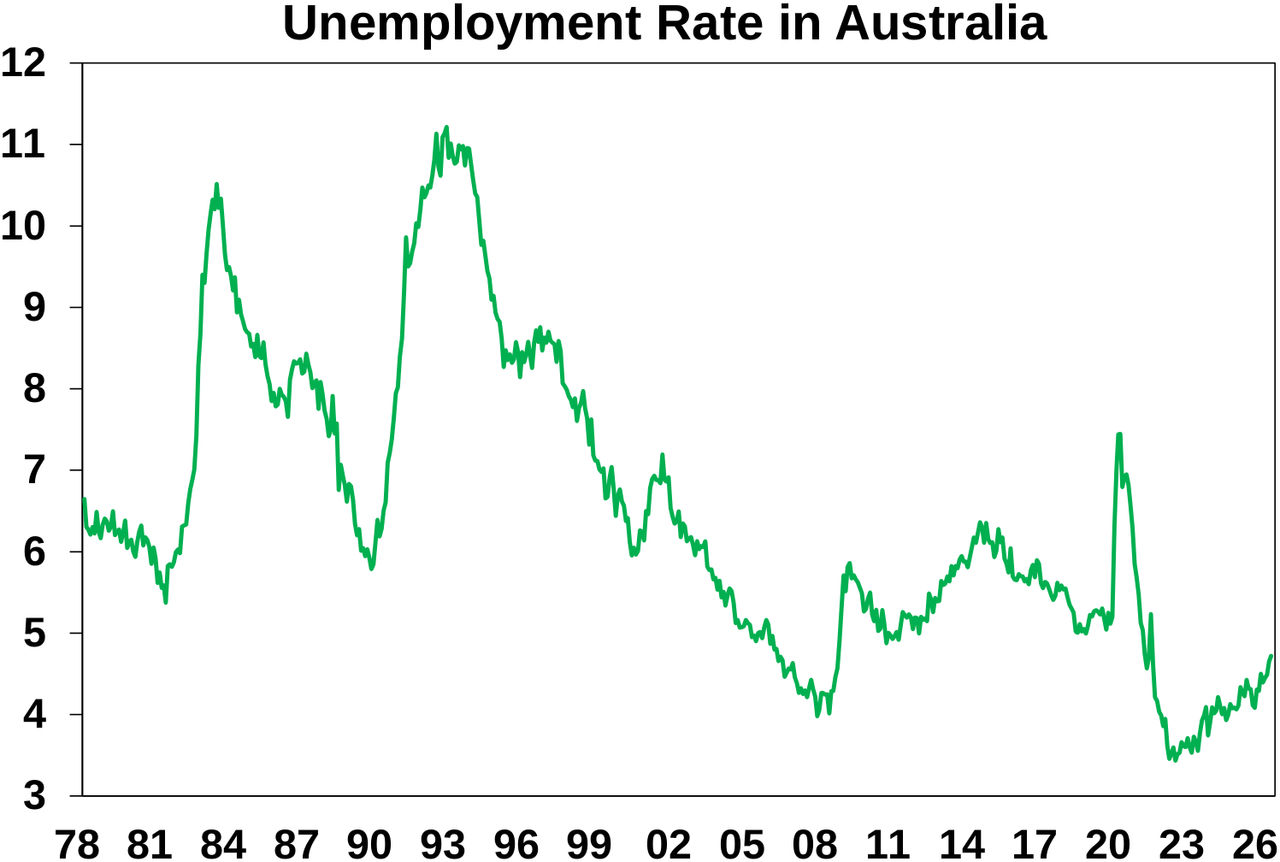
A common misconception is that the RBA is deliberately trying to push up unemployment to bring inflation down. But this is not the RBA’s objective. The RBA has a dual mandate of price stability and full employment, which means it must balance bringing inflation under control with preserving gains in the labour market. During the 2022-23 rate-hiking cycle, the RBA raised rates by less than many of its global peers, reflecting this desire to preserve employment gains. Higher interest rates do, however, slow economic activity and reduce demand for labour, which can ultimately lead to higher unemployment. This is a consequence of the monetary policy transmission mechanism, rather than the goal itself.
What about parts of the inflation basket that the RBA has no control over?
A common question that I get is “well the RBA can’t control the price of oil” or the “the RBA has no control over food prices” so why bother raising interest rate? It is true that the RBA can’t control these global commodity prices. But the point is that if the conditions in the economy are such that it is easier for firms to pass on price increases then there are things like supply shocks, then it does become the RBA’s job. For example, take this years increase to fuel prices. This is not something that the RBA has control over. But, if cafes and restaurants start adding a “fuel levy” to their prices and consumers absorb this increase, then that does become a problem for the RBA to deal with. Firms can only keep raising their prices up to a point which people will pay for the goods and services.
Take this year’s rise in fuel prices. The RBA cannot do anything about the initial increase in global oil prices. But if cafes and restaurants respond to higher transport and delivery costs by adding a “fuel levy” to their prices, and consumers are willing and able to absorb those increases, then the original fuel shock starts spreading into the prices of other goods and services. That is where monetary policy comes in. Higher interest rates weaken demand and make it harder for businesses to continually pass higher costs on to consumers.
Ultimately, businesses can only raise prices as far as their customers are willing and able to pay. The RBA cannot prevent the original supply shock, but it can try to prevent that shock from becoming embedded in broader inflation.
Are there other options to battle inflation without higher interest rates?
Another common question is: if higher interest rates are working, why is inflation still high? The answer is that rate rises do work, but monetary policy operates with a lag and takes time to flow through the economy. More importantly, there is no painless way to bring inflation back down.
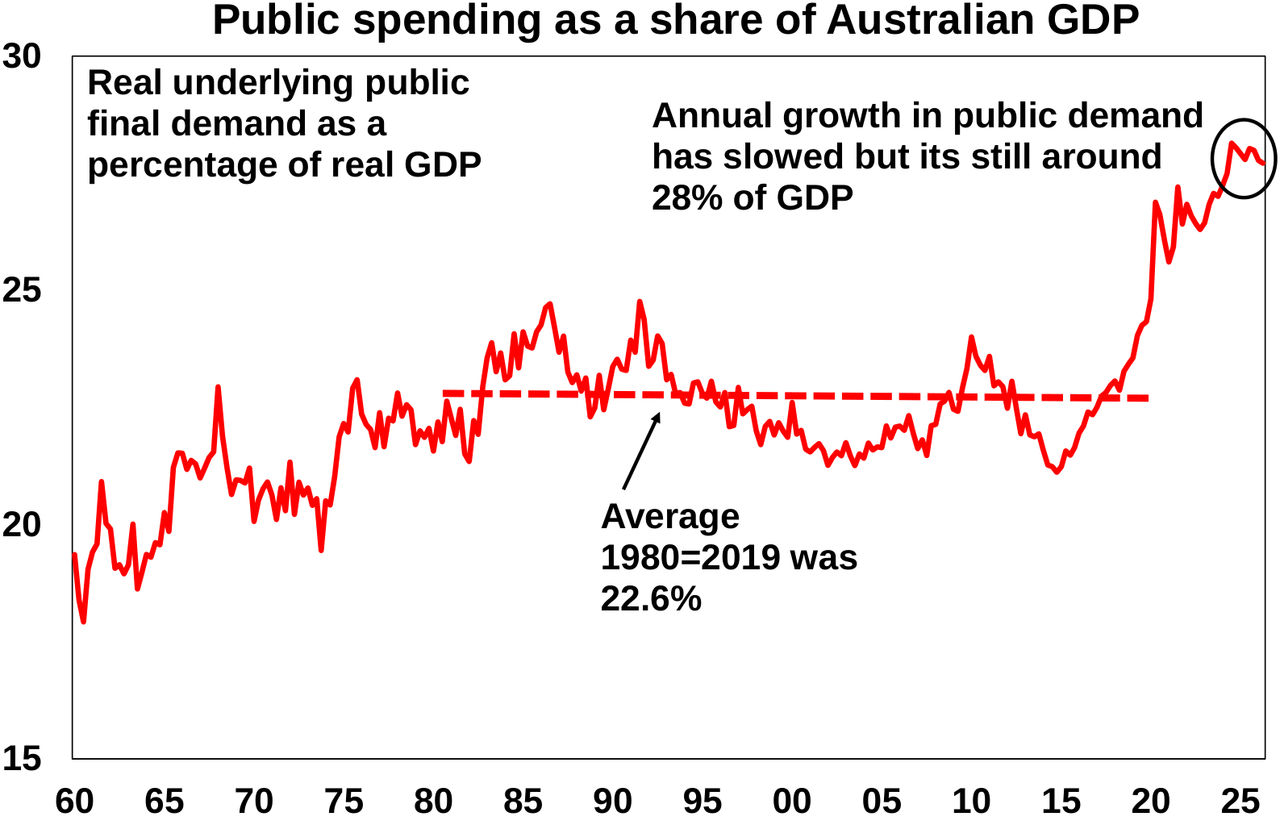
The other major policy lever available to reduce inflation is fiscal policy. Governments could cut spending or raise taxes to reduce demand in the economy. But this would also come at a cost. Cutting spending can mean fewer government services, lower payments or reduced programs, while higher taxes leave households with less disposable income. The pressure may fall on different parts of the economy than it does with higher interest rates, but somebody still has to spend less.
Total government spending across the federal and state governments is
currently close to 28% of GDP, compared with a historical average of
around 23%. Returning government spending to that historical share of the
economy would require around $135 billion in spending cuts, equivalent to
roughly 16% of annual government expenditure. That would be an
enormous fiscal adjustment and, importantly, spending would then need
to remain around that lower share of the economy. Spending doesn’t have
to come back all the way to this level instantly though – it could be spread
over time. So there is no easy alternative to monetary tightening. The
debate is ultimately about where the adjustment should fall: on borrowers
through higher interest rates, or broadly through lower government
spending or higher taxes.
Another argument is that rather than relying on higher interest rates, we need more direct government intervention to bring prices down. One option is price controls, where governments cap the prices of particular goods and services. But price controls do not remove the underlying imbalance between demand and supply and can create other distortions, particularly reduced supply. They can also be poorly targeted: if the government caps the price of an essential good for everyone, higher income households receive the same benefit despite being better able to absorb higher prices.
Another argument is that governments should tax billionaires and large corporations more heavily, or crack down on “price gouging”. There may be good reasons to pursue tax reform or stronger competition policy, particularly where markets are highly concentrated. But they should not be confused with policies that necessarily solve economy-wide inflation.
The evidence that excessive corporate profits were the main driver of Australia's inflation outbreak is also not particularly strong. Corporate profits as a share of the economy have not increased much in the last 10 years, especially in the non-mining sector. Similarly, the inquiry into Australia's major supermarkets identified problems with competition and pricing practices, but it did not conclude that supermarket price gouging but this is not the only reason for Australia’s inflation problem.
Ultimately, governments can change who bears the cost of high inflation, and there is an important debate to be had about whether that burden is distributed fairly. But there is no simple policy that allows us to bring inflation down without some economic cost. If inflation reflects demand running ahead of the economy's capacity to supply goods and services, ultimately demand needs to slow or supply needs to increase.
Implications for investors
Interest rate changes are having an impact on the economy, but the
effects are not immediate and they are not felt evenly across households.
It is understandable that people are frustrated. High inflation and cost-of
living pressures have persisted for several years. Social media amplifies the
echo chambers and the experiences of households under financial stress,
which makes people feel more frustrated. Interest rates have certainly
been higher in the past (see chart below) but that does not necessarily
mean they feel less painful today. Households are carrying much larger
mortgages and facing much higher living costs. And for many people, it can
be difficult to understand why higher interest rates are necessary when
they already feel financially stretched.
That is perhaps the biggest challenge for monetary policy: the RBA is trying
to reduce excess demand at an economy-wide level, but many individual
households do not feel like they have been spending excessively.
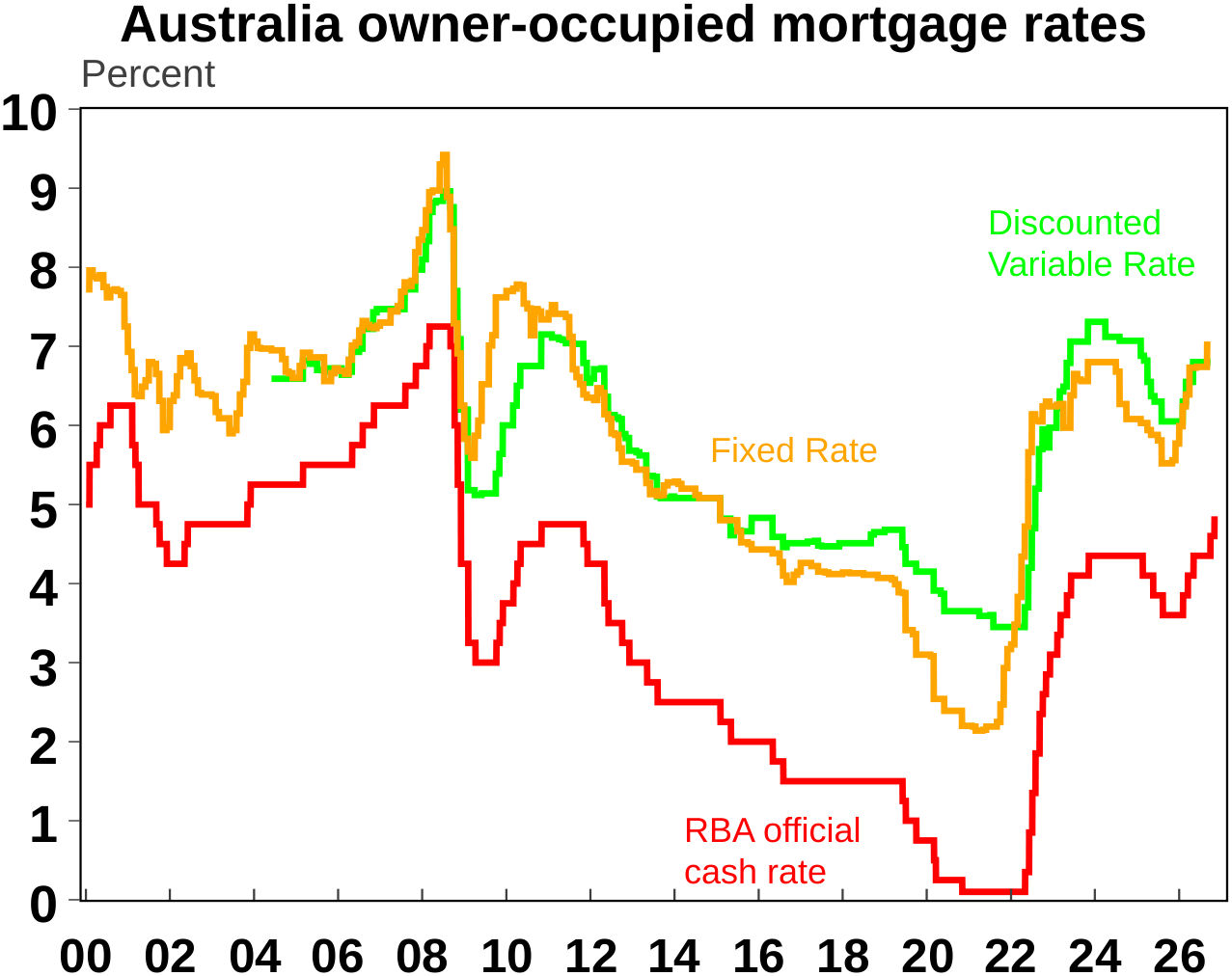
Borrowers are more directly affected by higher interest rates, but monetary policy does not work solely through the mortgage channel, even if this is its most visible effect.
So, the better question is not whether monetary policy is working, but whether it is working quickly enough to bring inflation back under control without causing unnecessary damage to the rest of the economy. So far, progress has been slower than we would have liked, and external shocks, including the Iran conflict and its impact on energy prices, have complicated the task. But there is still evidence that higher interest rates are working as intended.
Diana Mousina Deputy Chief Economist, AMP


You may also like
-

Oliver's insights - House Price Slump Australian home prices continue to slide and look likely to see a 15% fall. The home price slump will weigh on economic growth via negative wealth effects, but it’s not significant enough yet for the RBA to shift gears toward cutting rates given high inflation is the more pressing problem. But it likely will be by the second half next year. -

Weekly market update - 23-10-2026 It was another rocky week across markets. For most of 2026, the narrative has been that investors have benefitted from strong earnings and AI investment. But now, rising oil prices, rising bond yields and central bank rate hikes are making the outlook more fragile. -

Baby budgeting: How to financially prepare for a baby Learn how to budget for a baby, prepare for parental leave, estimate childcare costs and build a financial buffer before becoming a parent.
Important information
Any advice and information is provided by AWM Services Pty Ltd ABN 15 139 353 496, AFSL No. 366121 (AWM Services) and is general in nature. It hasn’t taken your financial or personal circumstances into account. Taxation issues are complex. You should seek professional advice before deciding to act on any information in this article.
It’s important to consider your particular circumstances and read the relevant Product Disclosure Statement, Target Market Determination or Terms and Conditions, available from AMP at amp.com.au, or by calling 131 267, before deciding what’s right for you. The super coaching session is a super health check and is provided by AWM Services and is general advice only. It does not consider your personal circumstances.
You can read our Financial Services Guide online for information about our services, including the fees and other benefits that AMP companies and their representatives may receive in relation to products and services provided to you. You can also ask us for a hardcopy. All information on this website is subject to change without notice. AWM Services is part of the AMP group.