





Can Bessent-nomics stop the rise in US yields?
The last few years have been filled with bouts of concern about rising bond yields. Investors worry about rising yields because they increase borrowing costs, lift mortgage rates for households, put downward pressure on equity valuations and threaten the relative attractiveness of risk assets (like shares) relative to bonds. In this Econosights, we go through why yields have been rising, what the US government is doing to prevent a further rise in yields and what it all means for investors.
10 min read

Key Points
- Since the start of 2026, rising US bond yields reflect higher inflation expectations, greater uncertainty about the US Fed’s policy path with the new Fed Chair being vague in avoiding forward guidance, continued high US debt and increasing interest costs and financing for the AI boom.
- US Treasury Secretary, Scott Bessent’s latest US bond buyback program may help to cap long-end bonds in the short-term but the risk is that it causes investors to question the independence of US institutions, especially the US Fed which may backfire and cause higher (rather than lower bond yields).
- This could support the “debasement” trade again, with investors favouring assets like gold while the US dollar depreciates – much like it did in 2025.
- For now, higher bond yields are not high enough to threaten US equities in the face of supercharged AI-related profit growth.
Introduction
The last few years have been filled with bouts of concern about rising bond yields. Investors worry about rising yields because they increase borrowing costs, lift mortgage rates for households, put downward pressure on equity valuations and threaten the relative attractiveness of risk assets (like shares) relative to bonds. In this Econosights, we go through why yields have been rising, what the US government is doing to prevent a further rise in yields and what it all means for investors.
The increase in bond yields
The bond yield is the return that investors get from investing in a government issued security. The government issues these securities (via the Treasury) to fund spending. The bond yield reflects reflect the level of interest rates set by the central bank in that country and investor expectations for future inflation, economic growth and therisks associated with holding government debt.
In the US, mortgage rates are also highly correlated to long-end bond yields. US mortgage rates are over 6.5% - the highest level since 2006, adding to the cost-of-living pressures for consumers who are already dealing with elevated inflation.
The major global central banks were in an interest rate hiking cycle over 2022 – 2024 then started cutting interest rates from late 2024 into 2025 (with timings varied across countries). Most are now holding rates steady with a few
increasing rates again (like Australia and New Zealand). Global policy rates
are mostly below their post-Covid highs (apart from Australia) – see the chart
below. The one exception is Japan, which is only at the beginning of its
interest rate hiking cycle.
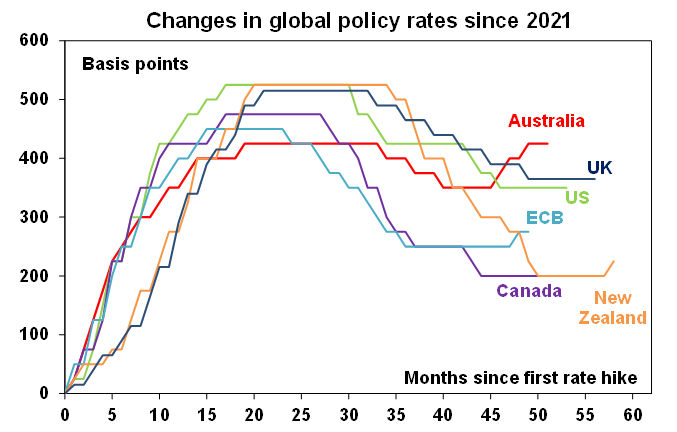
Policy rates are mostly below their 2022/24 peaks and financial markets are expecting only a slow and gradual interest rate tightening cycle from here. Despite this backdrop, global bond yields have continued increasing over the past year – see the chart below.
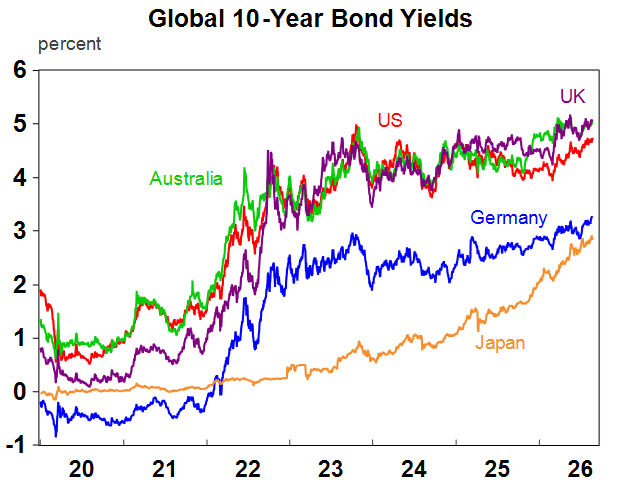
US 10-year yields are around 4.7% higher than a year ago, from ~4.4% a year ago. Australian 10-year yields arecloser to 5% from 4.3% a year ago.
To understand why bond yields are rising, first it’s helpful to look at the components of bond yields.
What does the bond yield reflect?
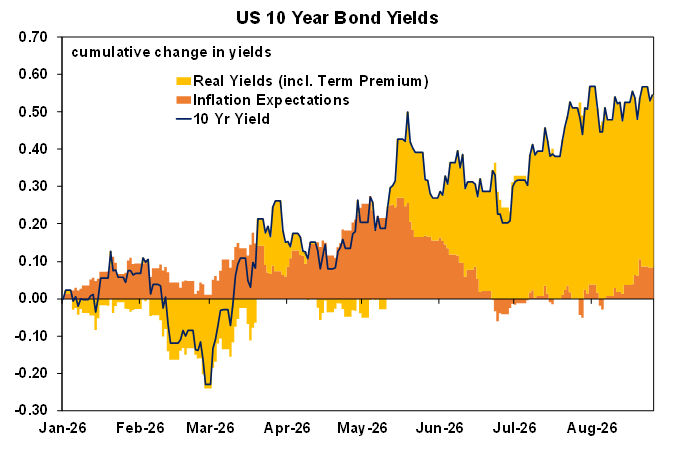
The nominal bond yield is comprised of: what inflation is expected to be over the bond’s life (otherwise known as inflation expectations) plus the short-term real yield (the inflation-adjusted compensation for investors that is closely related to the federal funds rate) plus a long term premium (the additional compensation for the risk of holding a long-dated bond rather than rolling over short-term bonds, which is also the risk that interest rates may change over the life of the bond). Since the start of 2026, the initial rise in US 10-year bond yields was due to a rise in inflation expectations (as inflation was surprising higher) but more recently it has been the rise in the real yield, and most attribute this to the increase in the term premium.
Why have bond yields been rising?
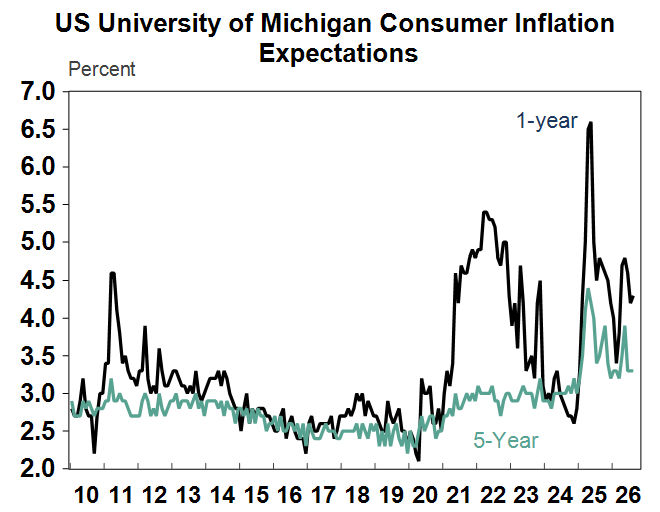
It is understandable that elevated inflation expectations are keeping US nominal yields lifted. 1-year and 5-year inflation expectations remain well above their pre-Covid averages (see the chart below). More recently, actual and expected inflation has been supported by US tariffs pushing up the cost of imported goods, ongoing broad-based US economic growth and the AI-related capital expenditure boom putting upward pressure on prices. But, longer-term inflation expectations (10 years +) haven’t changed materially (see chart above).
But what is less clear cut is therise in “real yields”. We think the recent rise in real yields reflects:
- Greater uncertainty about the US Federal Reserve’s monetary policy plan and the path back to the 2% inflation target. The new Federal Reserve Chair, Kevin Warsh has been surprisingly cagey about how the Fed would respond to changes in inflation, growth and the labour market – otherwise known as the “reaction function” of the central bank. Warsh does not want to provide much forward guidance, giving the Fed flexibility to react to economic developments. This leaves investors with more uncertainty about the path of interest rates at a time of elevated inflation which may be adding to a higher term premium.
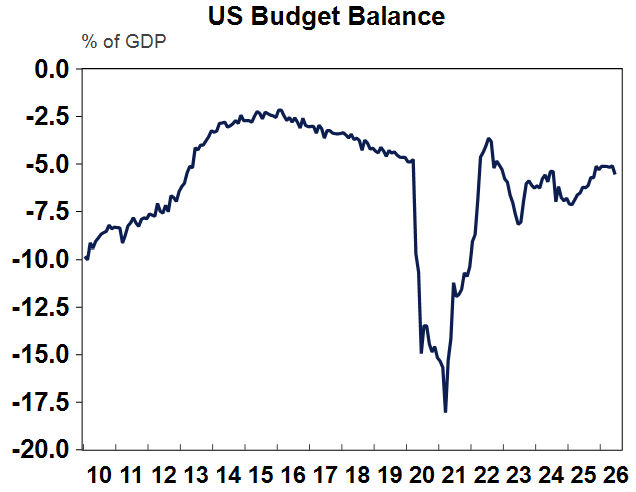
- The US fiscal situation. Concern about high US debt is nothing new. The US budget deficit has improved slightly from close to -7% of GDP in 2025 to -5.6% on the latest numbers (see chart below) but this is still very high! To finance these large deficits, Treasury has to keep issuing bonds. More bond issuance (higher supply) and unchanged demand lowers bond prices and puts upward pressure on yields because it is more bonds that investors need to absorb.
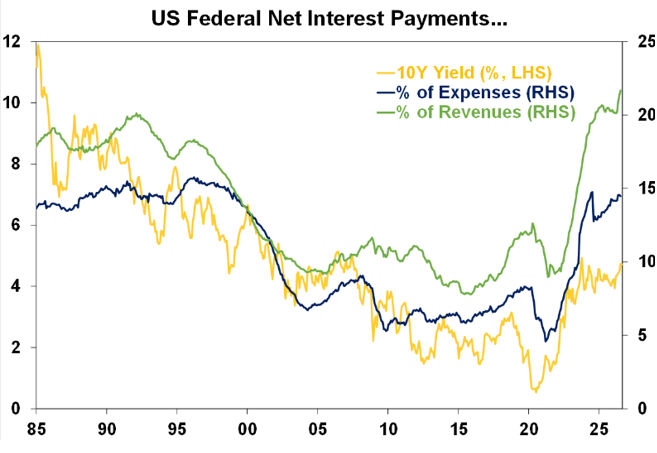
And, the bigger problem is that the cost of servicing that debt continues to grow because of the lift in bond yields. US Federal interest payments are worth nearly 21% of revenue – a record high and as a share of expenses, interest payments are worth nearly 15%. When the government is allocating more to paying down its debt, it leaves less room to spend on essentials as well as productive areas. This could lead to slower economic growth which in turn reduces government tax revenue and decrease the government’s capacity to services its debt without additional bond issuance. This further increases costs and the cycle can then repeat itself.
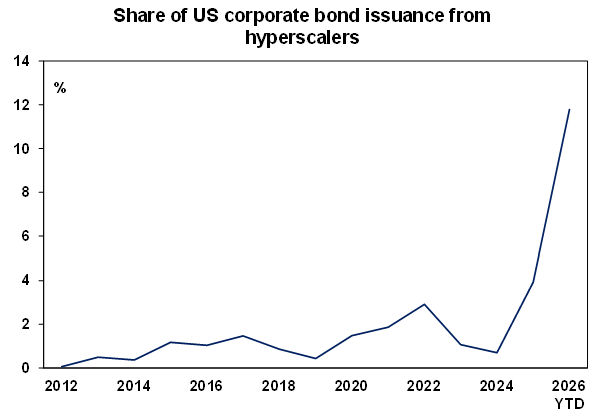
- Financing for the AI boom. This is a relatively new factor driving bond markets. We know that the technology boom is driving massive capital expenditure spending in the US. This spending is now increasingly being funded by debt markets to keep up with the investment plans of the hyperscalers. The latest data shows that hyperscaler issuance went up by 127% in 2026 so far and hyperscalers have made up nearly 12% of corporate bond issuance this year – up from 4% last year. The rise in corporate bond issuance adds to the supply of fixed income securities available to investors – so the government and big tech have to compete for the pool of global investors which can also push up real yields.
The announcement from the US to combat high yields
Last week, US Treasury Secretary Scott Bessent announced an increase in the Treasury’s long-dated buyback program, to $4bn from $2bn. Treasury buybacks are not actually abnormal. They are usually done to replace older bonds and to help with market liquidity. But this operation is much more overt and larger. However, this latest initiative was much more explicit. It is being done to reduce the pressure on long-term bond yields at a time when government borrowing costs are rising.
Because the Treasury is not the US Federal Reserve and cannot “print” money, Treasury will need to issue short-dated bills to fund this purchase. When Treasury issues short-dated bills it will push up the yield on those and will buy long-dated bonds which will reduce yields on those bonds. Another announcement this week indicated that they could use the Treasury General Account (TGA) to help fund its bond purchase.
This overt process by Treasury is out of the ordinary of the normal interaction between the government and bond markets. Usually, intervention in bond markets is left to the central bank, through processes like quantitative easing. Some analysts are comparing the current program to “Operation Twist” which was most recently done in 2011/12 when the Fed sold short-dated securities and bought long-dated securities to help reduce long-term borrowing costs. But again, this was the US Fed not the government doing this process.
Implications for investors
I think there are two important implications for investors from the decision of US Treasury to purchase bonds.
First, there is a question about the perceived independence of US institutions, particularly the US Fed. This has been an ongoing issue in the past year, when President Trump was publicly putting pressure on former Fed Chair Powell to cut interest rates. While the latest Treasury buyback program does not threaten Fed independence in itself, some investors may question whether the lines between fiscal and monetary policy are becoming blurred.
If investors lose confidence in the Fed’s independence, the result could actually be higher, not lower, bond yields. Investors may begin to assume that the policymakers can tolerate higher inflation, keep interest lower rates lower than warranted or keep financing government deficits indirectly. This may work to backfire on Treasury plans to keep a lid on bond yields. Fed Chair Warsh has spoken about the importance of the independence of the US Fed. But this issue is worth watching, especially as we get more speeches from Warsh from here. I think he will try to provide more confidence that the Fed will control inflation, to maintain credibility.
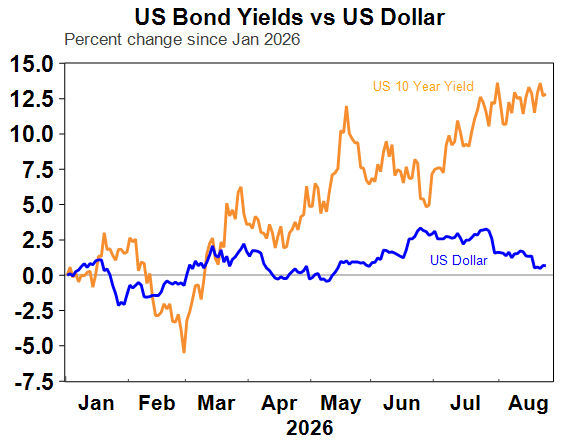
The second implication from Treasury’s announcement is the impact on the so called “debasement trade”. This got a lot of airtime last year when the US dollar depreciated by around 10% (see the chart below). “Debasement” means a lowering in the intrinsic value of the currency, causing it to lose purchase power in the domestic market. This could occur if monetary policy is overly accommodative, if monetary policy is influenced by government budget needs or if there is a loss in confidence of the central banks ability to control inflation. The “trade” that is then done is the sell the currency and purchase assets that cannot be easily created by government (mostly gold and bitcoin this days) but also could be other assets like commodities or real assets. In 2025, the debasement trade saw a fall in the USD and a big rise in gold prices (as well as other commodities like silver).
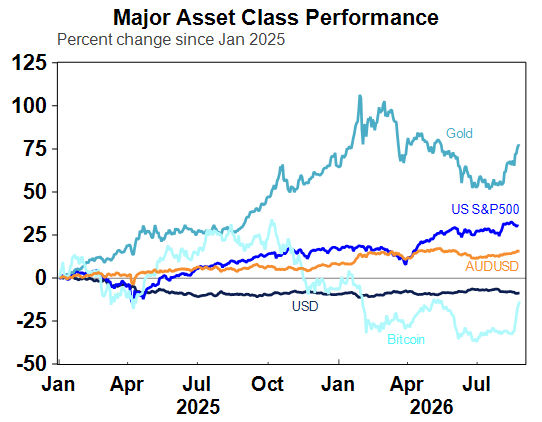
Treasury’s buyback announcement is likely to fuel more demand for the “debasement trade” and put some renewed downward pressure on the US dollar, which has held up this year, especially after the conflict in the Middle East started in March. Gold and bitcoin may benefit, especially after being relative underperformers to the US S&P500 this year.
US bond yields did initially fall after Treasury’s announcement. Treasury can probably limit how far yields can go up for a short period of time. But to completely offset the other things that are causing upward pressure on yields – higher inflation expectations, US debt concerns and more AI-related bond issuance will mean more constant intervention which may work against what Treasury is trying to achieve. Investors could become concerned that the government does not have control of long-end yields and demand even larger compensation for risk (higher yields), or they could choose to buy other defensive assets.
A moderation in inflation and clear guidance from the new Fed Chair Warsh about its commitment to get inflation back down to the 2% inflation target would help to bring yields down.
The current level of US bond yields are not high enough to threaten US equities performance, which is being driven by super-charged AI profit growth. However, if yields keep rising this could limit upside performance for US shares.
Diana Mousina
Deputy Chief Economist, AMP
Subscribe here
Subscribe me to economic market updates


You may also like
-

Weekly market update - 23-10-2026 It was another rocky week across markets. For most of 2026, the narrative has been that investors have benefitted from strong earnings and AI investment. But now, rising oil prices, rising bond yields and central bank rate hikes are making the outlook more fragile. -

Baby budgeting: How to financially prepare for a baby Learn how to budget for a baby, prepare for parental leave, estimate childcare costs and build a financial buffer before becoming a parent. -

Weekly Market Update - 16-10-2026 - AMP Weekly Market Update: AI credit fears hit shares, Investors flocking to safe haven (because of CoreWeave?), Oil still high but global growth still resilient, and Weak jobs data gives RBA room to pause.
Important information
Any advice and information is provided by AWM Services Pty Ltd ABN 15 139 353 496, AFSL No. 366121 (AWM Services) and is general in nature. It hasn’t taken your financial or personal circumstances into account. Taxation issues are complex. You should seek professional advice before deciding to act on any information in this article.
It’s important to consider your particular circumstances and read the relevant Product Disclosure Statement, Target Market Determination or Terms and Conditions, available from AMP at amp.com.au, or by calling 131 267, before deciding what’s right for you. The super coaching session is a super health check and is provided by AWM Services and is general advice only. It does not consider your personal circumstances.
You can read our Financial Services Guide online for information about our services, including the fees and other benefits that AMP companies and their representatives may receive in relation to products and services provided to you. You can also ask us for a hardcopy. All information on this website is subject to change without notice. AWM Services is part of the AMP group.